
A Message From Haney
Welcome to the 128th edition
of ResusNation!

You're Better Off Red
The Science and Lore of Red Hair
From fiery hues to a rich history, red hair has long captivated people across cultures. It's a genetic trait found in less than 2% of the global population, making natural redheads a fascinating minority. The unique color is a result of a mutation in the MC1R gene, and a person must inherit a copy from each parent to be born a redhead. This genetic predisposition for red hair is most common in northern European countries, with Scotland and Ireland having the highest concentrations of redheads in the world. But beyond its striking appearance, the MC1R gene is also linked to several surprising biological characteristics, influencing everything from how redheads perceive pain to how their skin handles the sun.
The allure of red hair extends far beyond its biology, permeating art, history, and pop culture. It has been a symbol of everything from royalty to rebellion, and today, it is celebrated with festivals and conventions around the world. From Queen Elizabeth I to modern-day celebrities like Ed Sheeran and Julianne Moore, redheads have made their mark in countless fields. This rare and beautiful genetic trait continues to be a source of wonder and distinction.
Here are some of the most intriguing facts about red hair and the people who have it:
-
Rarest combination: Red hair and blue eyes is the rarest hair and eye color combination in the world.
-
Pain sensitivity: Redheads may have a higher tolerance for some types of pain but are also more sensitive to thermal pain.
-
Anesthesia needs: On average, redheads may require about 20% more general anesthesia to be fully sedated.
-
Vitamin D production: Their fair skin allows redheads to produce Vitamin D more efficiently in low-light environments.
-
No gray hair: Red hair doesn't turn gray; it gradually fades to a silvery-white over time.
-
Fewer, thicker strands: Redheads typically have fewer individual strands of hair compared to people with other hair colors, but their hair is often thicker.
-
Sun sensitivity: Due to lower melanin levels, redheads are at a higher risk of sunburn and skin cancer.
So now you know...

They Kept Operating During an 8.8 Quake
I recently saw a clip that perfectly captures why I’m so proud to be part of the medical community. During a powerful 8.8 magnitude earthquake in Kamchatka, a surgical team was in the middle of a procedure. As the ground violently shook and the very building threatened to collapse, these doctors and nurses didn’t stop. They didn't flee for safety. Instead, they held the patient down to keep them stable and continued working. It’s an unbelievable act of dedication and a stark reminder of the immense responsibility we carry.
This wasn't just a job; it was true heroism. It’s a testament to the unwritten code that governs our profession: you never abandon your patient. The instinct to save yourself must have been overwhelming, yet their training, their empathy, and their unwavering commitment to the person on that table won out. It’s a powerful story that reminds me, and hopefully all of us, of the true meaning of putting a patient first, no matter the cost. Hats off to that incredible team.
Watch the full video here and leave a comment.
Don't forget to like and follow my IG, TikTok, YT, Facebook or Linkedin accounts.

Our Merch Store is Now Live!
Say it with your chest — literally. The “Roccuronium” tee is soft, ridiculously comfortable, and tells the world you’ve got nothing but love for the king of neuromuscular blockers. Whether you're performing RSI or just repping your resus roots at Starbucks, this shirt delivers peak paralysis energy with premium cotton vibes. Show the world you are a true Roc-Star.

The “Roccuronium” tee isn’t just merch—it’s a mindset. It’s for the who’ve mastered the art of rapid sequence intubation, and who understand that Roc isn’t just a drug—it’s a symbol of control, calm, and commitment in the most critical moments. This shirt is your inside joke, your subtle flex, your daily reminder that you belong to a community that gets it.
This shirt is a conversation starter, a teaching moment, and a connection to others who walk the same path. Whether you’re gearing up for a shift or just headed out with friends, this shirt carries your clinical confidence and lets you rep your resus roots with pride.
Show everyone that you are a true Roc-Star. Get this limited-run T-shirt now...it will not last!


Ultrasound Could Get Patients Off The Ventilator Faster
A difficult part of critical care is knowing the right time to wean and extubate patients. If it's done too early, the patient might struggle to breathe on their own and need to be reintubated, which can lead to complications and longer hospital stays. A new study reviewed five clinical trials to see if using an ultrasound to check the diaphragm—the main muscle for breathing—could help doctors make better decisions. The results are promising: adding a diaphragmatic ultrasound to the standard process significantly reduced the chance that a patient would need to be reintubated within 48 hours.
This research suggests that using a simple, non-invasive ultrasound may make the transition off a ventilator safer and more successful for patients. In addition to lowering the risk of reintubation, one study included in the review found that using ultrasound to guide this decision was linked to a shorter stay in the intensive care unit by about one day. While these findings are encouraging, the authors note that more research is needed, as the current evidence comes from a small number of studies. Future studies should aim to confirm these findings and explore how this technique might be used for patients with different health conditions.
Here's my Takeaways:
- Finding: Using a diaphragmatic ultrasound to guide extubation decisions reduced the risk of reintubation within 48 hours by 38% compared to standard care.
- Practice Impact: The study suggests that incorporating diaphragmatic ultrasound into the ventilator liberation process can help reduce the reintubation rate. It was also associated with a one-day reduction in ICU length of stay in one of the studies.
- Population: The study focused on adult patients on mechanical ventilation in the ICU after respiratory failure or surgery.
- Limitation: The review was limited to five randomized controlled trials, with only three studies providing data for the primary outcome. This means the findings are based on a small overall sample size with low statistical power.
Want to learn more? Read the full study "Clinical utility of diaphragmatic ultrasound for mechanical ventilator liberation in adults: a systematic review and meta-analysis" by Naonori Tashiro et al. in Journal of Intensive Care.
Watch the August's Videos Now!
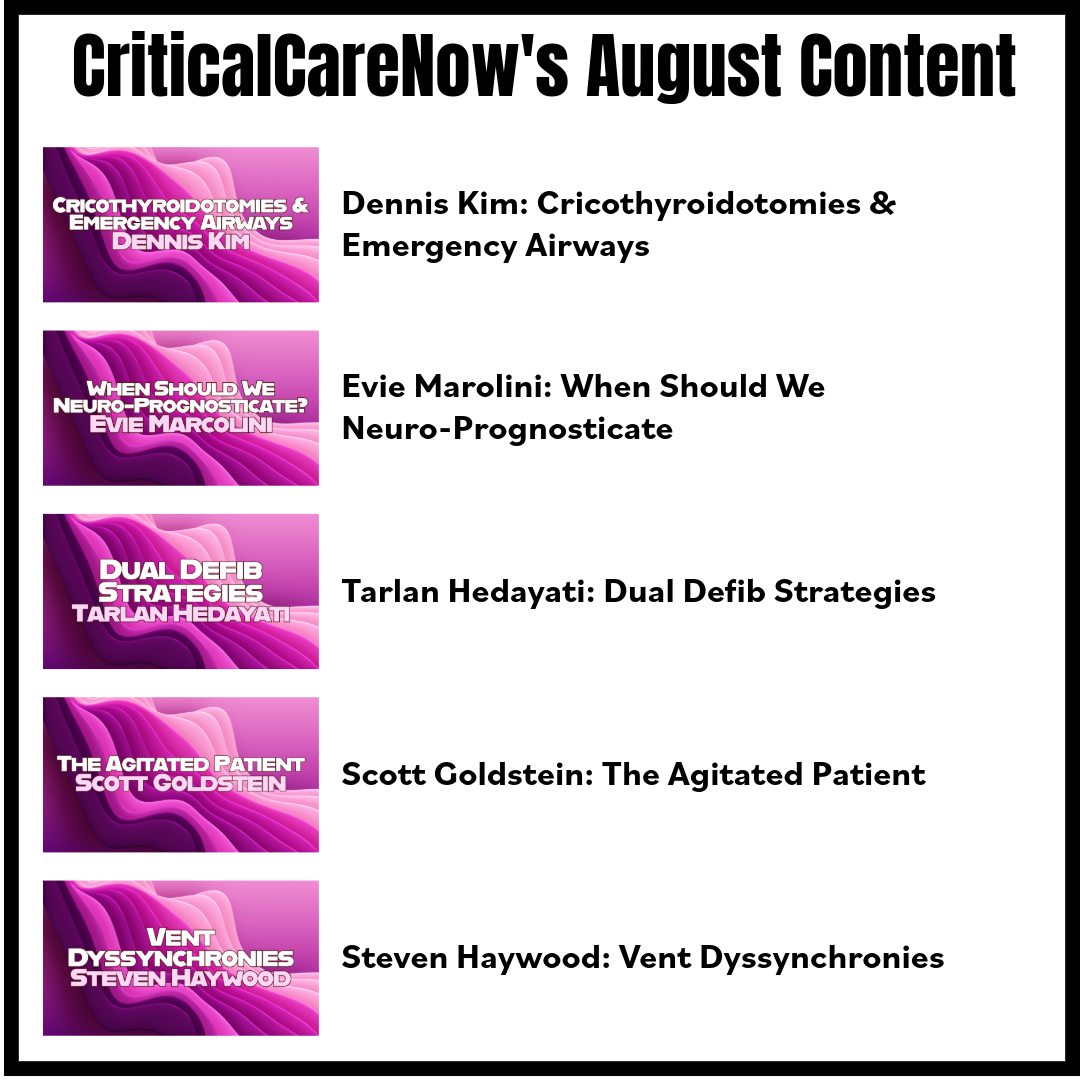
If you're an All-Access Member, you're in for some great content this month. We have FIVE videos hand-picked by our staff that are high-yield and our most highly watched. We're featuring
- Kim on "Cricothyroidotomies & Emergency Airways"
- Marolini on "When Should We Neuro-Prognosticate"
- Hedayati on "Dual Defib Strategies"
- Goldstein on "The Agitated Patient"
- Haywood on "Vent Dyssynchronies"
Each month we bring you fresh new content from the best of the best in resuscitation. If you're an All-Access member, go watch these videos NOW! If you're not, then sign up here.


Are you a member of ResusNation? For less than a cup of coffee, you can get even more content from CriticalCareNow. Digital teaching sessions, podcasts, free video lectures, grand rounds, and so much more can be your today. Come watch on replay all the content that CriticalCareNow does live. Check out the membership options below and decide the right one for you.
Do you want even more resus content anytime you want? For less than a cup of coffee, you can get even more content from @CriticalCareNow. Digital teaching sessions, free video lectures, grand rounds, and so much more can be your today. Come watch on replay all the content that @CriticalCareNow does live.
Check out the membership options below and decide the right one for you.


Get Access To The ResusNation Today!


Responses