
A huge milestone for us here at CriticalCareNow and we're so glad you're here. Welcome to the new subs, and thank you to the old ones for recommending us to your friends.
Thank you for subscribing and enjoy Newsletter #146!

Everything is TB (And We’re All Just Living In Its Gothic Fanfic)
For a solid chunk of human history, tuberculosis wasn’t just a disease; it was a vibe, a fashion statement, and a literal personality trait. John Green dives into how Mycobacterium tuberculosis has basically ghostwritten modern culture, convincing the Victorian elite that looking "consumptive"—pale skin, dilated pupils, and that "about to faint in a meadow" energy—was the peak of aesthetic perfection. We’re talking about a pathogen that killed one in four people in the 1800s but was so deeply romanticized that people actually tried to catch it to seem more "soulful" and artistic. It shaped our architecture with those sun-drenched sanatoriums (the original minimalist aesthetic) and even dictated how we dress, as long skirts were ditched because they were literally dragging through TB-laden sputum on city streets.
The real plot twist is that while we act like TB is some ancient relic relegated to Les Misérables or a dusty history book, it’s still out here being the most successful serial killer in human history. It’s been chilling in our lungs for 9,000 years, evolving alongside us like a toxic ex who knows exactly which buttons to push to evade our immune systems. We built the modern world around trying to escape it—think city planning, public health codes, and the very concept of "fresh air"—yet it remains a glaring reminder of global inequity. It’s a disease that’s technically curable but continues to thrive on our collective burnout and systemic failures, proving that while science moved on to CRISPR and mRNA, TB is still playing the long game with terrifyingly effective simplicity.
Welcome to the 146th edition of ResusNation!

Pain is Not a Vasopressor!!!
"Pain is not a vasopressor." It sounds like a joke, but in the chaos of a crash intubation, it’s a reality many of us have ignored. I’ve seen it time and again: a patient’s blood pressure tanks after we start analgesia and sedation, and the immediate reflex is to back off the drips to "save" the hemodynamics. We convince ourselves we’re being cautious, but what we’re actually doing is leaving a patient to suffer behind a mask of paralytics or sheer exhaustion.
The truth is that those "stable" pre-intubation numbers are often a lie fueled by an unsustainable sympathetic surge. Sedation doesn’t cause the collapse; it simply unmasks the patient’s true physiologic state. If their pressure drops when they finally get comfortable, it’s a sign they need better resuscitation—volume, inotropes, or pressors—not less pain control. We have the technology to support a blood pressure; we have no excuse for failing to support a human being’s comfort.
Watch the full video here and leave a comment.
Don't forget to like and follow my IG, TikTok, YT, Facebook or Linkedin accounts.

|

Tachycardia plus low voltage is a pericardial effusion until proven otherwise.
In this video from ResusX 2026, Dr. Amal Mattu breaks down a case where a misidentified ECG led to a fatal outcome. When a patient presents with chest pain and shortness of breath, the instinct is to treat for acute coronary syndrome or pulmonary embolism. However, if you miss the subtle signs of low voltage, standard anticoagulation treatments like Heparin or Clopidogrel can lead to hemorrhagic tamponade.
What you will learn:
• The "Classic" Fallacy: Why electrical alternans only appears in about 15% of real-world cases.
• Low Voltage Definitions: The difference between specific (textbook) and sensitive (clinical) definitions.
• The 1-2-3 Rule: A simple calculation to identify low voltage in the limb and precordial leads.
• Differential Diagnosis: Differentiating between obesity, COPD, and life-threatening fluid.
• Point-of-Care Ultrasound: Why the probe is your best tool when the ECG is ambiguous.
Check out this video of Dr. Amal Mattu from ResusX 2026 now!

Watch 75 of Our Best Resus Videos!
Have you managed a crash airway, had to resuscitate with refractroy ventricular tachaycardia, or lead your team during a resuscitation? If you answered yes, then ask yourself, "are you treating your patients with the most cutting-edge and evidence based medicine?" Today you can sign up for ResusX:Select Volume 1,2, and 3. In all, you will get lifetime access to 75 of our very best resuscitation videos so you can take your skills to the next level!

Each of these videos is hand picked by our editorial team because they demonstrate mastery in resuscitation. Each of these videos is engaging, entertaining, and jam packed with information. At the completion of the program, you will be able to claim 12.0 AMA PRA Category 1 Credits or CEU contact hours.
Check out all 75 videos that you'll get lifetime access to:

And because you're a newsletter subscriber, I have a super special deal for you. Register for ResusX:Select right now and get 20% off your registration. That's a HUGE savings for 75 videos! Plus, if you are a resident, NP, PA, or nurse, you'll receive an additional 20% off. The only catch is we only have 50 of these discounts codes to giveaway, so it's first come first serve. Use the code "SELECT3" at checkout or just click the link below!


A Smarter Way to Manage Congestion in Cardiorenal Patients
Congestion is the main reason people with heart failure end up in the hospital, making it feel like they are "drowning" in excess fluid. For decades, doctors have relied on a group of medications called loop diuretics to help the body flush out this extra water. However, nearly one in three patients hits a wall where these drugs simply stop working—a frustrating and dangerous condition called diuretic resistance. This research is a game-changer for patients because it explains that the body isn't just ignoring the medicine; it's actively fighting back by changing how the kidneys handle salt and minerals like chloride. By understanding these secret "braking" mechanisms, doctors can now identify early warning signs through simple urine tests and step in before the problem becomes severe.
The study shows that there is no "one-size-fits-all" fix, but rather a need for personalized strategies based on a patient’s unique health profile. For example, patients with obesity or advanced kidney disease may need much higher doses or a "cocktail" of different diuretics to jump-start their system. While adding extra medications can sometimes cause temporary shifts in kidney lab results, the ultimate goal remains clear: clearing the fluid is the best way to improve symptoms and keep people out of the hospital. This move toward "phenotype-tailored" care marks a new era in heart and kidney treatment, promising more effective, comfortable, and individualized recovery plans for those who need them most
Here's my Takeaways:
- Up to one-third of heart failure patients develop resistance to loop diuretics, which is strongly linked to increased mortality and repeat hospitalizations.
- Practice Impact: Clinicians should move toward "natriuresis-guided" therapy, using spot urine sodium (UNa) measurements 1–2 hours after a dose to catch inadequate responses early.
- High-risk phenotypes—including those with Right Heart Failure, advanced CKD, and obesity—require higher "ceiling" doses or early combination therapy to achieve effective decongestion.
 |
Want to learn more? Read the full study "Diuretic resistance in cardiorenal syndrome: mechanisms, monitoring and phenotype-tailored management" by Aletras G. et al. in Frontiers in Cardiovascular Medicine.

ROUNDS WITH ICUBOY
What’s up ICU nerds?I’ve been reading a lot about bicarb lately… and honestly, obsessing over bicarb feels like the medical version of a mid-life crisis. (Porsche? Bangs? Same energy.)
Quick rant:
In BICAR-ICU (2018), severe metabolic acidemia (pH ≤ 7.20) patients got 4.2% sodium bicarb. The headline is “no mortality benefit,” but the story is more nuanced; there was a signal toward better survival and a real reduction in RRT, and the severe AKI subgroup looked like they benefited most (hello, BICAR-ICU2).
My current take:
Pure respiratory acidemia? No bicarb. If pH is crashing because CO₂ is 120, your problem is ventilation. Bicarb just makes more CO₂ and increases ventilatory demand when you’re already in trouble.
Severe metabolic acidemia (pH ≤ 7.2 / HCO₃ ≤ 15)? I pause. Treat the cause first. In uremia/AKI, bicarb may buy time and reduce RRT. In DKA, it’s rarely the answer (except profound acidemia).
How I give it:
I try to avoid rapid 8.4% amp boluses (hypertonic + big sodium load) unless I need a quick push. If there’s time, I lean isotonic: 150 mEq in 1 L (3 amps in D5W). Data here is still messy.
Cardiac arrest: generally not routine—they can’t blow off the CO₂ you’re generating. Exceptions: toxin-induced wide QRS or life-threatening hyperK.
What’s your threshold—pH, HCO₃, or clinical context (pressor dose, AKI, lactate)? And what new ICU meds do you wish we had instead of debating the same ones forever?
Until we meet again - stay safe & be kind to one another,
ICUBOY
@icuboy_meded (IG/TikTok/X/Threads)
@icuboymeded (FB)
Watch the February Videos Now!
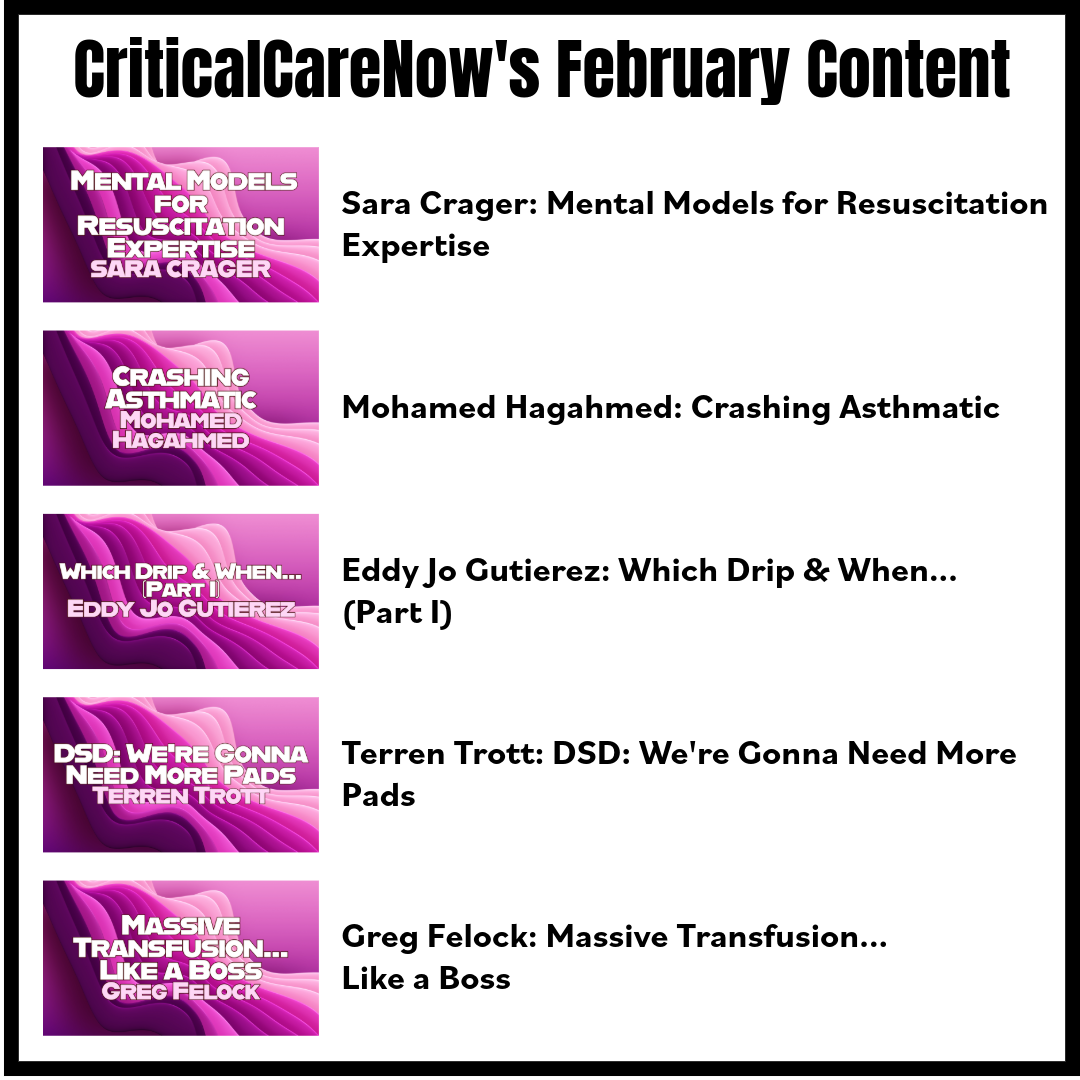
If you're an All-Access Member, you're in for some great content this month. We have FIVE videos hand-picked by our staff that are high-yield and our most highly watched. We're featuring
- Crager on "Mental Models for Resuscitation Expertise"
- Hagahmed on "Crashing Asthmatic"
- Gutierez on "Which Drip & When... (Part I)"
- Trott on "DSD: We're Gonna Need More Pads"
- Felock on "Massive Transfusion... Like a Boss"
Each month we bring you fresh new content from the best of the best in resuscitation. If you're an All-Access member, go watch these videos NOW! If you're not, then sign up here.


Responses