
Welcome to ResusNation #149

Phrenology: The Original "Trust Me, Bro" Science
Imagine it’s the early 1800s and you’re Franz Joseph Gall, a man with a dream and a very suspicious interest in the topography of your friends' heads. You decide that the brain isn't just a mushy organ for processing thoughts, but a collection of 27 distinct "organs" responsible for everything from "poetic talent" to "the instinct to murder." Instead of using, you know, actual neurology, you decide that if a specific part of your personality is thriving—like your "capacity for friendship"—that bit of the brain must be hitting the gym and getting swole. Naturally, this "muscle growth" would push against the skull, creating a physical bump. Essentially, Gall convinced the entire Western world that you could "read" a person’s moral compass and career potential just by feeling their scalp like they were a particularly lumpy avocado at the grocery store.
The whole trend spiraled into the ultimate Victorian personality test, where "phrenologists" would charge you a premium to tell you that the dent behind your left ear was the reason you were bad at math. It was the 19th-century equivalent of checking your birth chart, but with significantly more pseudoscience and a side helping of "scientific" racism that the era’s elite used to justify every systemic bias they had. Eventually, the medical community realized that the skull is actually a pretty rigid helmet that doesn't care about the size of your "amativeness" organ, and the whole field was relegated to the "What Were We Thinking?" wing of history. It remains a humbling reminder that before we had functional MRIs, we were basically just out here playing "connect the dots" on people's foreheads and calling it medicine.
Early-Bird Is Over Next Week!
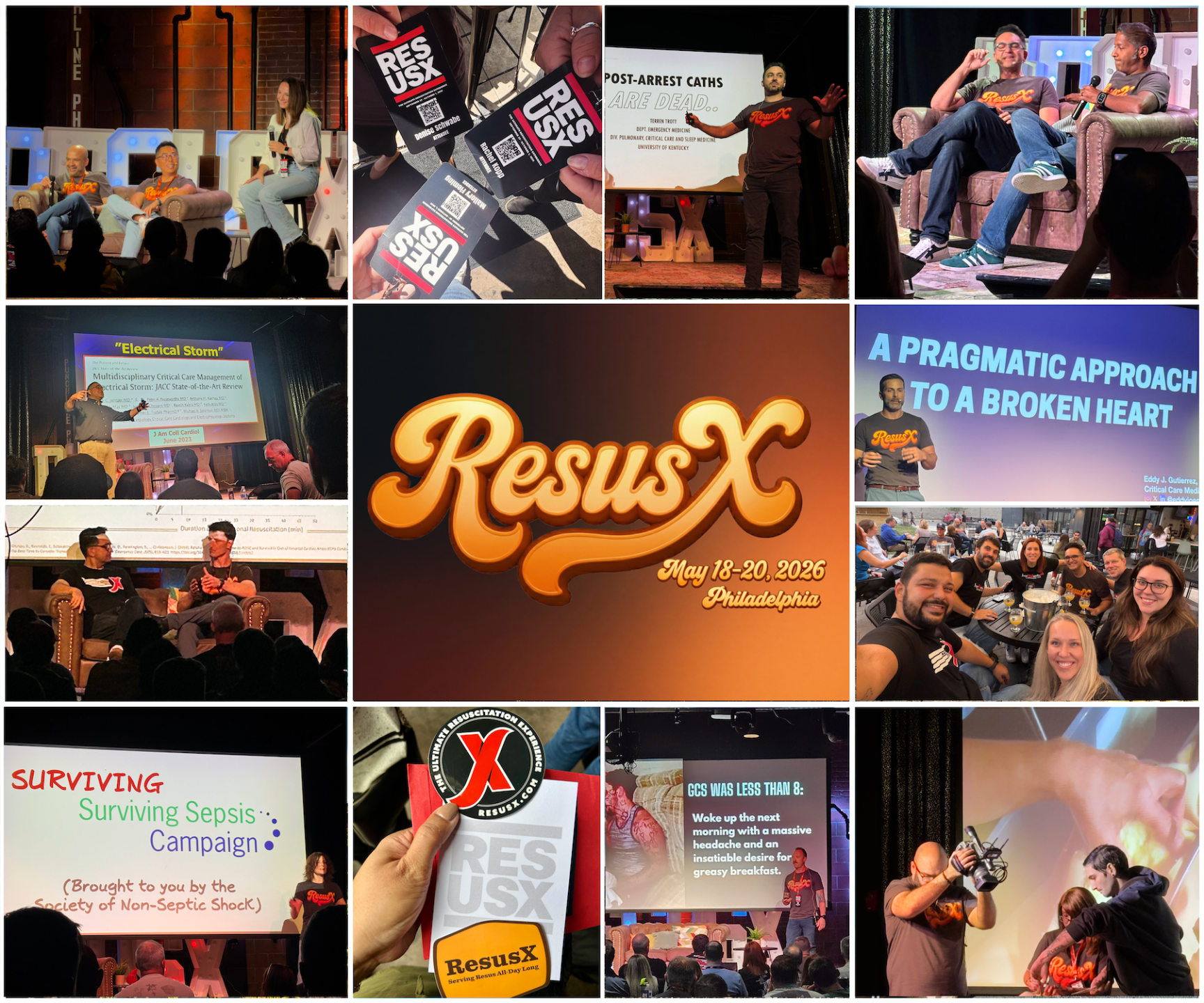
If you’ve been on the fence about ResusX:2026, here’s an important detail that makes this one different:
We’re not hosting it in a hotel ballroom.
ResusX runs May 18–20 at the Punch Line Comedy Club in Philadelphia—and that setting is very much on purpose.
A comedy club changes everything.
The room is intimate. The stage is close. The energy is higher. There’s no hiding in the back row, no dim lights lulling you into passive mode, and no endless slide decks draining the life out of the content.
It feels more like a live performance than a traditional conference—and that’s exactly how resuscitation education should feel.
What does ResusX actually look like inside a venue like this?
• Short, high-impact sessions designed to keep momentum
• Live on-stage procedural demos you can actually see
• Real debates where experts disagree—and explain their thinking
• Games, challenges, and audience-driven decision-making
It’s serious topics, delivered in a space built for attention, timing, and impact.
Special Offer for Non-Attending Physicians
We haven’t forgotten about you! If you’re a non-attending clinician, fill out this form to receive your unique discount code.

If You Stopped Using Benzos for Alcohol Withdrawal — You Might Be Wrong
Imagine giving a patient in status epilepticus rocuronium and thinking you fixed the problem because they stopped seizing! In reality, you're just masking the motor activity without addressing the underlying issue. The same principle applies here - giving dexmedetomidine (“dex”) while discontinuing benzos in a patient with alcohol withdrawal. Dex works on alpha-2 receptors centrally, reducing norepinephrine release and sympathetic outflow, so yes, it absolutely can make the patient look better — heart rate decreased, blood pressure controlled, less agitated — but that's purely sympatholytic symptom suppression. The underlying GABAergic deficit from chronic alcohol use and the resulting glutamate/NMDA receptor upregulation is still raging. You haven't touched the actual pathophysiology of withdrawal.
The danger being that someone who looks "calm" on dex may lead to the team backing off on benzos, and then you've got a patient who's at real risk for breakthrough seizures or full DTs because nobody was adequately treating the withdrawal itself. The CIWA score might even look artificially suppressed. Phenobarbital as a backbone makes a lot of sense given it hits GABA-A directly and has a long half-life, which provides a kind of built-in taper. Some institutions are moving toward phenobarbital-primary protocols for exactly that reason — more predictable, less breakthrough.
Dex as an adjunct for the sympathetic overshoot on top of adequate GABAergic coverage? Totally reasonable. As monotherapy or a benzo-sparing replacement? That's where it gets dangerous. The “salt bae” administration route is admittedly underrepresented in the literature though.
Watch the full video here and leave a comment.
Don't forget to like and follow my IG, TikTok, YT, Facebook or Linkedin accounts.


Why a Systolic of 90 is NOT Enough
In lecture from ResusX:2025, Dr. Evie Marcolini and Dr. Haney Mallemat dive into the nuanced management of intracranial hemorrhages, specifically focusing on subarachnoid hemorrhage, traumatic brain injury (TBI), and spontaneous intracerebral hemorrhage (ICH). The discussion highlights critical updates in hemodynamic stabilization, noting that traditional blood pressure targets for TBI are shifting higher—often requiring a systolic pressure above 100 or 110 depending on age—to prevent secondary brain injury. They also introduce the BIG (Brain Injury Guideline) criteria, a strategic framework designed to help clinicians determine which patients require neurosurgical intervention or transfer and which can be safely observed, reducing unnecessary strain on tertiary care centers.
The conversation further explores advanced neuro-critical care topics, including the science and art of managing vasospasms and the specific role of nimodipine in improving patient outcomes. Dr. Marcolini explains the emerging use of middle meningeal artery embolization for chronic subdurals and the vital importance of the neuro-cardiac axis, where brain trauma can cause sudden cardiac stunning similar to Takotsubo cardiomyopathy. The session concludes with a strong emphasis on "gentle" management, advocating for the use of analgesics like fentanyl and sedatives like Precedex to manage both pain and blood pressure without "manhandling" the delicate environment of the brain.
Check out this video of Dr. Evie Marcolini from ResusX:2025 now!


Is Standard ICU Sedation Actually Creating a Post-Discharge Opioid Crisis?
Pain management in the ICU has long relied heavily on opioids, but a 2026 narrative review published in the Journal of Clinical Medicine makes clear that the way we use them matters enormously — not just during the ICU stay, but for months afterward. Critically ill patients face moderate-to-severe pain from underlying illness, invasive procedures, and indwelling devices, and unrelieved pain genuinely worsens outcomes. However, the old assumption that deep sedation benefits patients has been overturned. Excessive or poorly controlled analgosedation prolongs ICU length of stay, increases ventilator days, and drives delirium — particularly when opioids are combined with benzodiazepines in elderly patients. The review synthesizes evidence from randomized controlled trials, systematic reviews, and major guidelines to advocate for a rational, stewardship-driven approach built around the e-CASH framework (early Comfort using Analgesia, minimal Sedatives and maximal Humane care).
The pharmacokinetics of opioids in critically ill patients are substantially altered compared to non-ICU populations, and this has major clinical implications for drug selection. Fentanyl and sufentanil accumulate with prolonged infusion due to high lipid solubility and expanding volume of distribution — fentanyl's context-sensitive half-time climbs to nearly 5 hours after 23 hours of infusion, while remifentanil's remains a stable 3–5 minutes regardless of infusion duration. This makes remifentanil particularly attractive for analgosedation when rapid titration, daily sedation interruptions, or neurological assessment is needed. The review also highlights that under- or oversedation occurs in up to 75% of ICU patients, underscoring the need for validated pain assessment tools like the CCPOT and RASS scales, and pointing toward emerging nociception monitoring technology as a future direction.
Perhaps the most practice-changing section concerns post-ICU opioid outcomes. A retrospective cohort of 6,764 mechanically ventilated adults found that higher daily opioid doses during mechanical ventilation were directly associated with opioid prescriptions in the year following discharge. Approximately 4% of previously opioid-naïve ICU patients develop persistent opioid use at six months post-discharge, with early high-dose prescribing as the strongest predictor. Multimodal analgesia protocols incorporating acetaminophen, NSAIDs, gabapentinoids, ketamine, and regional techniques have demonstrated consistent reductions in both inpatient and post-discharge opioid requirements. The bottom line for clinicians: implement analgesia-first protocols, choose opioids thoughtfully based on pharmacokinetics and organ function, build multimodal strategies into every ICU patient's care plan, and reassess opioid prescriptions before discharge.
KEY TAKEAWAYS
- Finding: Approximately 4% of opioid-naïve ICU survivors develop persistent opioid use at six months post-discharge, with higher inpatient opioid doses being the strongest independent predictor — and 75.8% of mechanically ventilated patients experienced at least one failed opioid weaning attempt in a recent retrospective analysis.
- Practice Impact: Shift from opioid-heavy sedation protocols to analgesia-first (analgosedation) strategies using the e-CASH framework; prioritize short-acting agents like remifentanil for patients requiring rapid titration; integrate multimodal non-opioid adjuncts (acetaminophen, NSAIDs, ketamine, regional techniques) and formally reassess all opioid prescriptions before ICU discharge.
- Population: Adult critically ill patients in the ICU receiving mechanical ventilation for more than 24 hours, particularly opioid-naïve patients, elderly patients (where opioid-benzodiazepine combinations carry heightened delirium risk), and those with renal or hepatic impairment requiring individualized pharmacokinetic dosing.
- Limitation: This is a narrative review without formal risk-of-bias assessment or quantitative meta-analysis; direct comparative trials on long-term outcomes and optimal multimodal drug combinations specifically in ICU survivors remain limited, and nociception monitoring tools have not yet been validated for routine ICU use.
Want to learn more? Read the full article Strategies for a Rational Use of Opioids in Critical Care Settings by Misseri et al. in Journal of Clinical Medicine.
Rounds with ICUBOY
Dearest gentle reader… wait—sorry.
I mean… what’s up, ICU nerds?
I’m clearly in a Bridgerton phase. Don’t knock it until you’ve watched it.
Lately, I’ve been thinking about dialysis in the ICU—specifically patients who develop acute kidney failure and start hemodialysis (AKI-D). It’s a tough situation for patients and families, and the question I hear every single time is: “How long will I be on dialysis? Will my kidneys recover?”
The honest answer is often watchful waiting and supportive care.
But what if how we dialyze could influence kidney recovery?
And yes—you might say, “I’m not a nephrologist.” Fair.
But if data supports a better strategy, we should be advocating for it.
Enter: the LIBERATE-D trial(JAMA, published 11/2025)
Here’s the backdrop:
-
AKI requiring dialysis (AKI-D) is becoming more common
-
Inpatient mortality for AKI-D remains high
-
Failure of renal recovery is associated with long-term morbidity, mortality, healthcare utilization, and poor quality of life
-
Clinical signs of recovery include improving urine output and stabilizing or improving creatinine off dialysis
This was a multicenter, unblinded, randomized superiority trial across 4 U.S. centers (220 patients total).
HD-stable patients with AKI-D were randomized to:
-
Conventional strategy: scheduled HD 3×/week
-
Conservative strategy: HD only if predefined clinical or biochemical criteria were met
What did they find?
-
Renal recovery at hospital discharge was higher in the conservative group
64% vs 50%, p = 0.04 (OR 1.76) -
The conservative group received fewer dialysis sessions
-
Patients recovered earlier, with more dialysis-free days
(21 vs 5 dialysis-free days by day 28)
Important limitations
This trial excluded sicker ICU patients, including those on:
-
Mechanical ventilation
-
Inotropic support
-
5 L/min supplemental oxygen
-
Decompensated heart failure
I know what you’re thinking. That’s a large portion (if not all) of our ICU population.
Still, it raises an important question: If this strategy benefits stable patients, could it matter even more in others?
The bigger takeaway
Hemodialysis can feel benign once the temporary catheter is in—but it isn’t.
Through mechanisms that aren’t fully understood (likely recurrent hypotension and dialysis membrane-induced inflammation), more frequent dialysis—after the acute indication has resolved—may impair renal recovery.
Sometimes, less really is more.
That’s all for now.
Stay hydrated—and protect those kidneys.
----------
Dr. Mahmoud Ibrahim (ICUBOY) is a triple board-certified pulmonary critical care intensivist based in Texas. He is passionate about breaking down complex critical care topics, as well as mental health for health care professionals.
Connect with Dr. Ibrahim:
@icuboy_meded (IG / Tiktok / X / Threads)
@icuboymeded (FB)
Watch the February Videos Now!

If you're an All-Access Member, you're in for some great content this month. We have FIVE videos hand-picked by our staff that are high-yield and our most highly watched. We're featuring
- Crager on "Mental Models for Resuscitation Expertise"
- Hagahmed on "Crashing Asthmatic"
- Gutierez on "Which Drip & When... (Part I)"
- Trott on "DSD: We're Gonna Need More Pads"
- Felock on "Massive Transfusion... Like a Boss"
Each month we bring you fresh new content from the best of the best in resuscitation. If you're an All-Access member, go watch these videos NOW! If you're not, then sign up here.


Responses