
Welcome to ResusNation #153

Click Here to Complete the Survey!
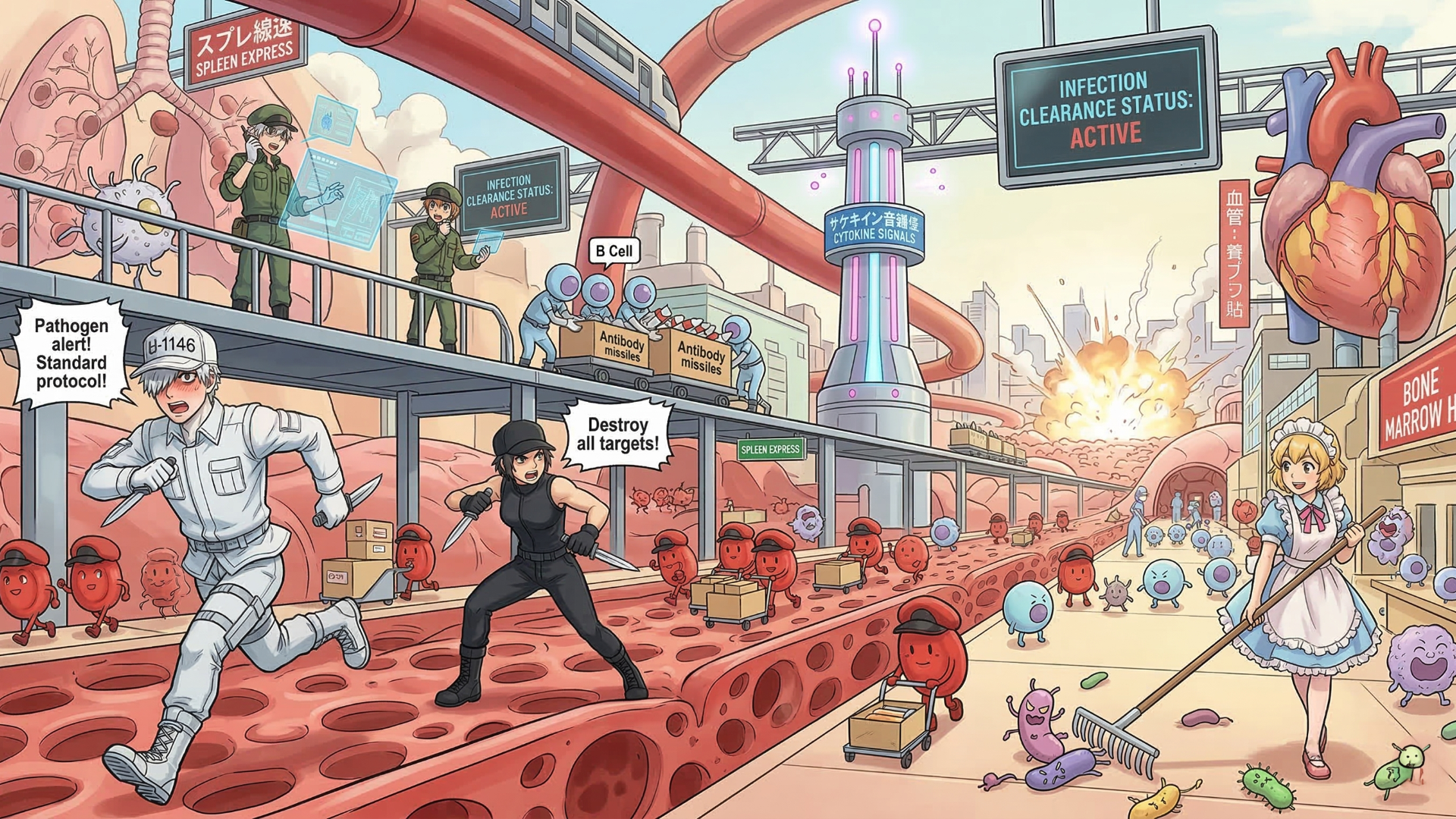
Your Immune System is Basically a Shonen Anime
(And You’re the Protagonist)
Imagine your body isn't just a meat suit holding a coffee addiction together, but a sprawling, hyper-industrialized megacity where the infrastructure is managed by people who are perpetually one minor inconvenience away from committing absolute violence. This is the world of the anime Cells at Work, where your immune system isn't some abstract concept of wellness, but a literal army of white-clad assassins and tactical specialists. You’ve got Neutrophils sprinting through the blood vessels like stressed-out first responders, looking for any excuse to go full slasher-movie on a stray bacterium, while the Macrophages are basically the terrifyingly polite moms of the group—cleaning up the mess with a smile and a giant cleaver. It’s a chaotic, high-stakes ecosystem where the line between "optimal health" and "cytokine apocalypse" is thinner than the sleep schedule of a surgical intern.
The real drama kicks off when the Helper T Cells—who are essentially the middle management of your lymph nodes—start screaming into their headsets to coordinate the carnage. They’re the ones making the big tactical calls, deciding exactly when to deploy the Killer T Cells, who move with the aggressive energy of a gym rat who just discovered pre-workout. Watching a B Cell frantically crank out antibodies like a high-end 3D printer in the middle of a war zone makes the whole "innate vs. adaptive" lecture you slept through in MS1 finally click. It’s a brutal, beautiful, and weirdly wholesome depiction of the fact that even when you’re doomscrolling at 3am, there are trillions of tiny enthusiasts inside you working overtime to make sure a single sneeze doesn't end your entire career.

We're hosting a medical conference at a comedy club.
No, really.
ResusX 2026 lands May 18–20 in Philadelphia — not at a hotel ballroom with fluorescent lights and lukewarm coffee. At the Punch Line Comedy Club.
Here's why that matters:
Comedy clubs are engineered to hold attention. The stage is close. The seats are intimate. The room doesn't let you zone out — which means the 2pm session hits exactly like the 9am one.
And what's filling those sessions?
→ Live procedural demos. Not clips. Not diagrams. Live.
→ Expert debates that actually change how you think.
→ Interactive formats where you're the one making the calls.
→ High-momentum learning built for retention, not résumés.
→ Heavy content. Unforgettable room.
If you've been telling yourself you'll level up your resuscitation skills "soon" — this is what soon looks like.
→ Not an attending physician? You're still invited. Fill out this form to unlock a discount code built for non-attending clinicians.

Beyond the Code: Three Things Every Resuscitation Leader Should Practice
Running a code is one of the most physically and emotionally demanding experiences in medicine, and what happens in the minutes after it ends matters just as much as the resuscitation itself. Three simple but powerful practices can make a lasting difference for the team. The first is genuine, specific gratitude — not a quick "thanks" on the way out the door, but a deliberate acknowledgment of each person's contribution, calling them out by name or role. This small act communicates that their effort was seen and valued, which goes a long way in high-stakes, high-burnout environments.
The second practice is a structured debrief, treating the code as a learning opportunity by openly discussing what went well and what could be improved next time. Codes are a team sport, and honest reflection after each one sharpens performance for the future. Finally, when a patient doesn't survive, a moment of silence serves as a powerful reset — a brief pause that honors the human life lost and reminds the team why this work matters. Together, these three actions support team morale, foster a culture of continuous improvement, and help prevent the emotional numbness that can creep in when difficult cases become routine.
Watch the full video here and leave a comment.
Don't forget to like and follow my IG, TikTok, YT, Facebook or LinkedIn accounts.


The shift toward extubating patients directly in the ED marks a significant evolution in critical care, moving away from the traditional "intubate and wait for the ICU" mindset. By implementing a rigorous three-phase protocol—focusing on resolution of the initial critical illness, spontaneous breathing trials (SBTs), and cognitive readiness—emergency physicians can safely remove patients from mechanical ventilation before they ever leave the ER. This practice is not merely about clinical convenience; it is a strategic response to ICU boarding crises, as it frees up high-acuity beds for patients who truly need them while often allowing stable patients to bypass the intensive care unit entirely.
Despite historical skepticism, emerging data from specialized centers like the Emergency Critical Care Center (EC3) at the University of Michigan suggests that ED extubation is remarkably safe when protocolized. Unlike the ICU, where a 10-30% reintubation rate is often tolerated, the ED operates on a "zero-failure" mandate, aiming for 100% success to maintain safety and staff confidence. Achieving this requires a high-functioning, collaborative environment where respiratory therapists, nurses, and physicians are aligned on continuous monitoring and secretion management. Ultimately, this approach transforms the ED from a transition zone into a definitive treatment space, optimizing hospital workflow and improving patient trajectories.
Check out this video of Dr. Alex Bracey from ResusX:2025 now!


Stop Waiting for the ICU to Start VAP Prevention — Here's Why the ED is Already Too Late
Ventilator-associated pneumonia (VAP) remains one of the most preventable yet deadly complications of mechanical ventilation, with mortality rates up to 15.5% in developing countries. Despite effective ICU-based prevention bundles, emergency departments have been largely excluded from these protocols — even though VAP risk begins at the moment of ED intubation. Patients spend critical hours in the ED exposed to modifiable risks such as suboptimal positioning, inconsistent oral care, and inadequate hand hygiene before reaching the ICU. This narrative review, synthesizing 45 studies, argues that waiting for ICU transfer to initiate prevention represents a critical and correctable gap in care.
To address this, the authors propose the PHASE bundle — a nurse-led, five-component strategy designed for the resource-constrained ED environment, covering Positioning (head-of-bed elevation 30–45°), Hand hygiene, Airway care (oral care, cuff pressure monitoring, suctioning, and early enteral nutrition), Sedation minimization with daily interruption and extubation readiness assessment, and Equipment management. The bundle deliberately excludes chlorhexidine oral rinse, now linked to increased mortality, and other elements lacking direct VAP prevention evidence. Nurse-driven sedation protocols alone have been shown to reduce VAP incidence by over 56%. While ED-specific interventional trials are still needed, the evidence supporting each component is robust, and EDs that adopt PHASE stand to meaningfully reduce one of the most resource-intensive hospital-acquired infections in critically ill patients. The bottom line for ED clinicians and nurses is straightforward: VAP prevention cannot wait for the ICU.
My Takeaway Points:
-
Finding - Subglottic secretion drainage reduces VAP incidence by 44%, and nurse-driven sedation protocols cut VAP rates by more than half (RR 0.438) — yet these interventions are rarely initiated in the ED despite risk beginning at the moment of intubation.
-
Practice Impact - ED teams should implement the PHASE bundle (Positioning, Hand hygiene, Airway care, Sedation minimization, Equipment management) immediately following intubation — not at ICU transfer — using electronic checklists and multidisciplinary protocols to ensure adherence.
-
Population - Mechanically ventilated adults intubated in resource-constrained emergency departments, particularly those expected to require more than 48–72 hours of ventilation, who face elevated VAP risk during the preventive gap before ICU transfer.
-
Limitation - As a narrative review without a formal systematic protocol or risk-of-bias assessment, PHASE lacks direct ED-based interventional validation; most supporting evidence is extrapolated from ICU studies, and the optimal frequency of individual interventions (oral care, cuff checks) in the ED workflow remains undefined.
Want to learn more? Read the full article A Potential Bundle for Preventing Ventilator-Associated Pneumonia in the Emergency Department: A Narrative review by J. Di, et al. in Journal of International Medical Research.
Can’t believe it’s March already. Time flies!
Anywho – the Society of Critical Care Medicine (SCCM) JUST released new guidelines on the use of neuromuscular blocking agents (NMBAs aka paralytics) in patients with ARDS.
This is their fourth update; the last one was published in 2016.
For each recommendation, they issued a score on the strength of the recommendation: either strong or conditional. They also issued a comment on the certainty of evidence.
Spoiler alert: they made NO strong recommendations. All the recommendations were conditional. The certainty of evidence for all recommendations was either low or very low. So yeah – we’re not off to a very hot start, are we?
I want to say it gets better, but it doesn’t really. They made 5 recommendations; 4 of the 5 were a point of clinical equipoise, aka they said “you can do either this or that, we don’t really have good enough evidence to guide you either way.” I’m paraphrasing.
The 4 equivocal recommendations are:
-
Using either a fixed dose strategy of NMBAs without monitoring depth of neuromuscular blockade, OR a titration-based strategy with monitoring depth of neuromuscular blockade for adults with ARDS
-
Using either a scale-based evaluation OR non-scale-based evaluation for depth of analgesia & sedation before initiating NMBAs for adults with ARDS
-
Using either a monitoring-based strategy OR no monitoring of depth of analgesia & sedation in adults with ARDS who are receiving NMBAs
-
Administering neuromuscular blockade OR not administering neuromuscular blockade in adult patients who are PRONED for ARDS
Alright and now – drum roll – the only recommendation that picked a side was:
-
“We suggest using NMBAs over not using NMBAs in adults with ARDS with PaO2/FiO2 < 150 who are persistently hypoxemic and/or not achieving mechanical ventilation targets on sedation”
Well, there you have it folks. As is often the case, we are left with more questions than answers. I would love to see more large-scale prospective data on this topic.
I will say from my standpoint, I would lean towards a titration-based strategy with monitoring depth of neuromuscular blockade. The paper did mention increased ICU-acquired weakness with deeper neuromuscular blockade.
I also would lean towards a scale-based evaluation of depth of analgesia & sedation before and during paralysis. Because I like measuring things. And also - because paralyzing an awake patient is what wakes me from sleep in a panic aka my biggest nightmare.
What’s your take on all this?
Have a wonderful day, my friends!
Till next time,
ICUBOY
----------
Dr. Mahmoud Ibrahim (ICUBOY) is a triple board-certified pulmonary critical care intensivist based in Texas. He is passionate about breaking down complex critical care topics, as well as mental health for health care professionals.
Connect with Dr. Ibrahim:
@icuboy_meded (IG / Tiktok / X / Threads)
@icuboymeded (FB)
Watch the March Videos Now!
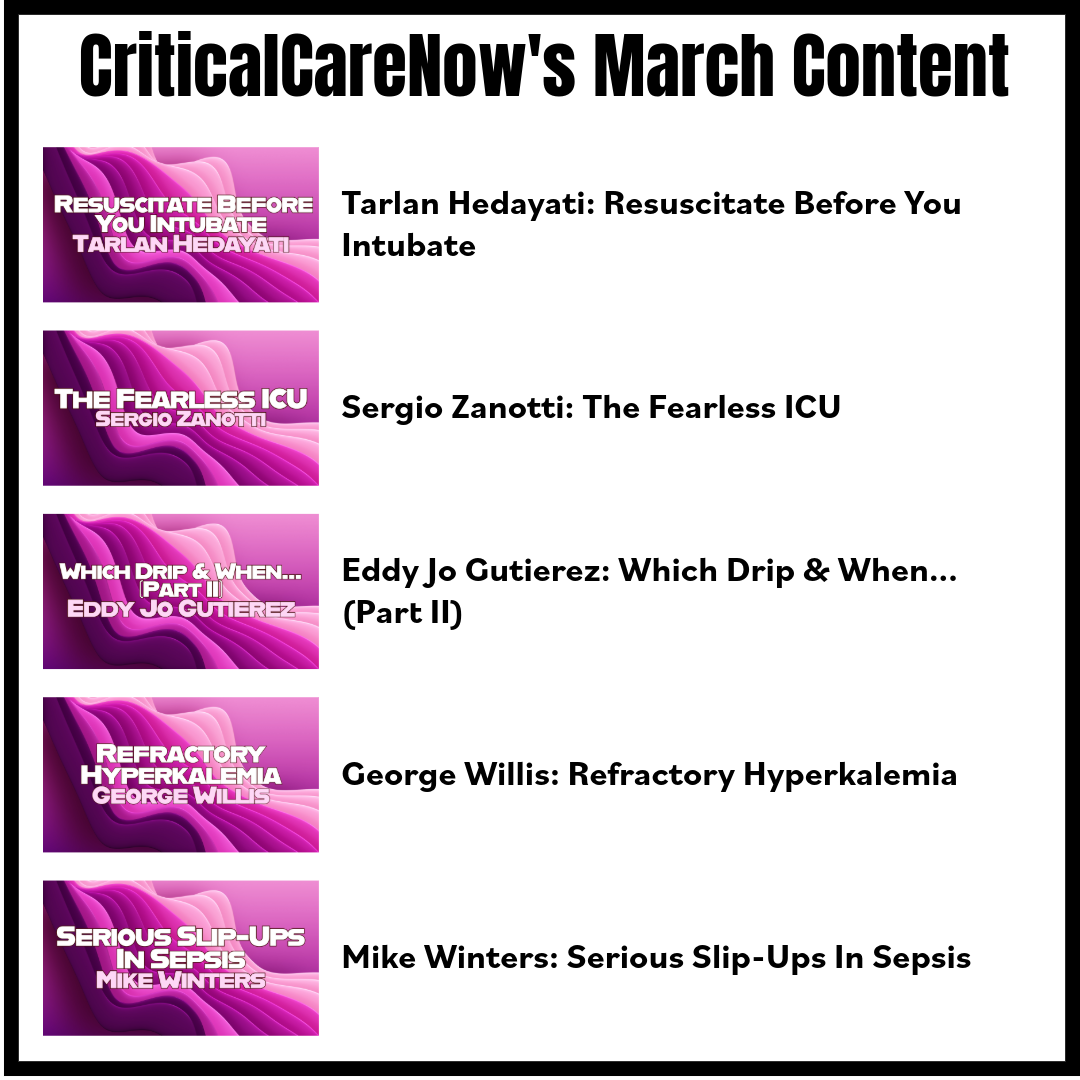
If you're an All-Access member, you're in for some great content this month. We have FIVE videos hand-picked by our staff that are high-yield and our most highly watched. We're featuring:
- Hedayati on "Resuscitate Before You Intubate"
- Zanotti on "The Fearless ICU"
- Gutierez on "Which Drip & When...(Part II)"
- Willis on "Refractory Hyperkalemia"
- Winters on "Serious Slip-Ups In Sepsis"
Each month we bring you fresh new content from the best of the best in resuscitation. If you're an All-Access member, go watch these videos NOW!


Responses