
A Welcome From Haney

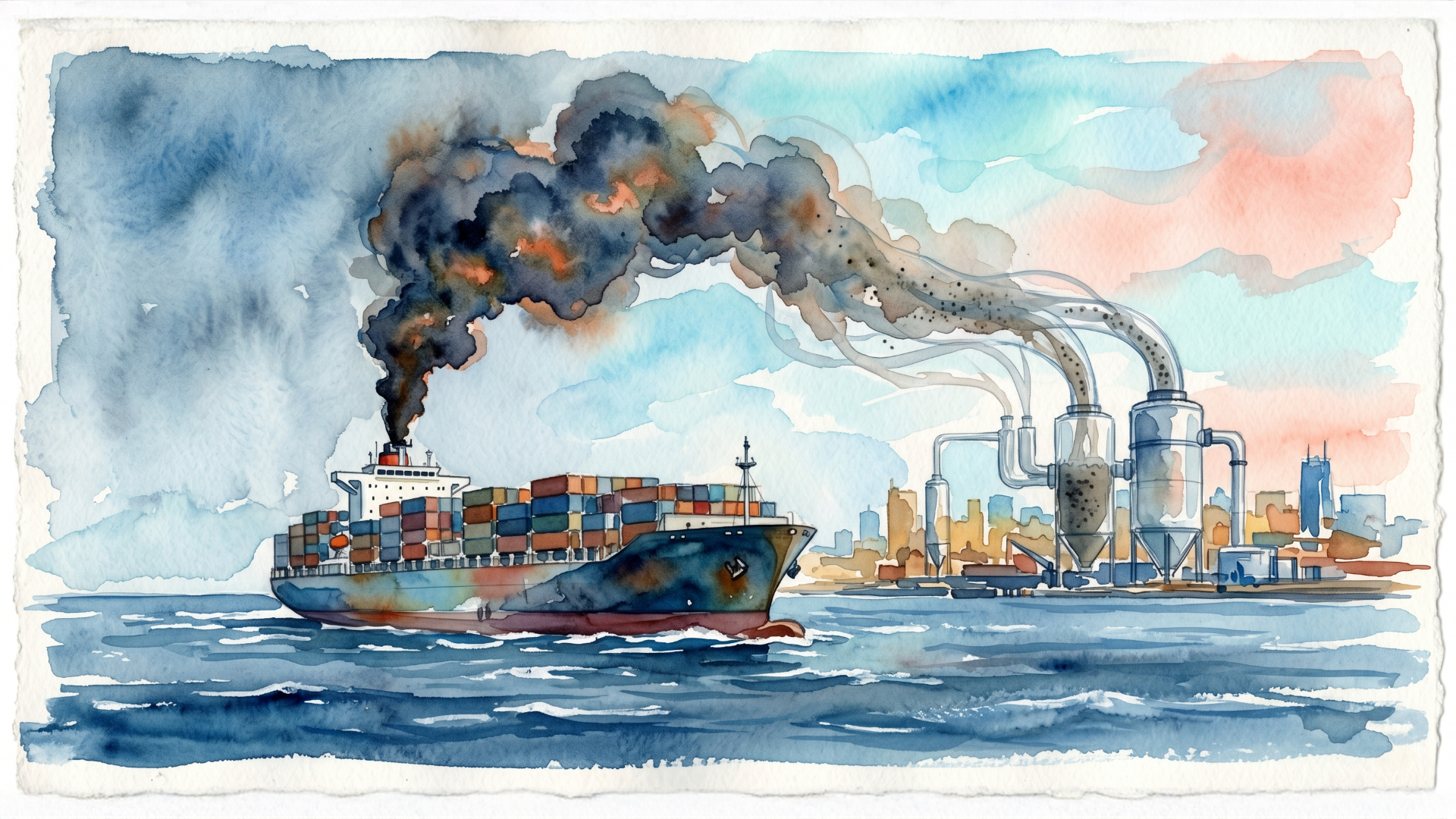
Port-Side Pollution: Now with 99% Less Carcinogens (Thanks, Fight Club)
Imagine a patient rolls into your ED with an exacerbation so bad you’d think they’ve been chain-smoking since the womb, but it turns out they just live near a port. That’s the "bunker fuel" special. Large container ships run on the bottom-of-the-barrel sludge that’s basically liquid asphalt, spewing a toxic cocktail of particulate matter (PM2.5), nitrogen oxides (NOx), and sulfur oxides (SOx) directly into the zip codes of vulnerable communities. We’re talking about a microscopic assault that doesn't just stop at "lung irritation"—it’s a direct ticket to systemic inflammation, oxidative stress, and a significantly hiked risk for everything from childhood asthma to bladder cancer. It’s the ultimate public health "final boss" because you can’t tell a patient to just stop breathing the air in their own community.
Enter Edward Norton, who apparently decided that playing a guy with multiple personalities wasn't enough of a challenge, so he co-founded STAX Engineering to fix the maritime exhaust pipe. Instead of waiting for the entire global shipping fleet to retroactively spend millions on shore-power plugs—which, let’s be honest, is about as likely as a resident getting a full eight hours of sleep—STAX uses these massive "green barges" that essentially act as a giant vacuum for ships at berth. They swing a 250-foot arm over the ship’s stack and capture 99% of the particulate matter before it can turn a local's pulmonary parenchyma into a soot-stained mess. It’s high-stakes "filter therapy" for the planet, proving that while we’re busy treating the symptoms with Albuterol and steroids, some guys are out there literally putting a mask on the source.

That's a Wrap on ResusX:2026!
Wow, what incredible energy! A massive thank you to everyone who joined us this year—whether you were crushing it with us in person or bringing the hype online from across the globe. You all made this year’s event absolutely unforgettable.
Missed out on the action?
We missed you too! If you couldn't make it to the live or online event, don't sweat it. You won't have to suffer from FOMO for much longer—we are putting the finishing touches on a replay option so you can catch every game-changing lecture and breakthrough moment at your own pace.
Details are coming your way soon, so keep your eyes glued to your inbox! Until then, keep saving lives and staying awesome.
Shout Out to Our All-Access Sponsor:


Stop Nebulizing Into a Closed Airway
When a patient rolls in with status asthmaticus, they look terrible — and your instinct is to reach for the usual toolkit: nebs, steroids, magnesium, NIV. But here's the problem nobody talks about enough: if that patient is so tight they're barely moving air, how is nebulized albuterol supposed to reach the beta receptors on that smooth muscle? It's not. You're essentially aerosolizing medication into a closed system and hoping for the best.
That's exactly where epinephrine earns its place. It's the original beta agonist — and the key advantage is you don't need the patient to inhale it. Given IM or IV, it delivers reliable beta agonism directly to the target organ, regardless of how obstructed that airway is. Once they start to bronchodilate and actually move air, you can transition back to your traditional nebulized albuterol strategy. This isn't a blanket recommendation for every asthma patient — this is for that select, critical population in true status asthmaticus, where you have a narrow window to turn things around before they go into respiratory failure.
Watch the full video here and leave a comment.
Don't forget to like and follow my IG, TikTok, YT, Facebook or LinkedIn accounts.


The cognitive response to a patient with refractory hypotension should never be the blind addition of a second vasopressor; rather, it requires a deliberate cognitive pause to identify and treat the true underlying pathology. Because vasoactive substances merely buy time instead of improving mortality, clinicians must look past the primary diagnosis (like sepsis) and embrace Hickam’s Dictum—remembering that a patient can have as many diseases as they please. When standard norepinephrine escalation fails, we must systematically investigate occult physiological disruptors, starting with severe acidosis, where standard bicarbonate pushes fail, and moving swiftly to screen for unrecognized hypothyroidism by evaluating clinical "pan-lows" like unexplained hypothermia.
Furthermore, the resuscitation team must actively rule out hidden confounding factors, such as iatrogenic anaphylaxis caused by administered antibiotics, underlying adrenal insufficiency requiring immediate stress-dose steroids, and profound hypocalcemia. Managing these cases effectively means dispelling clinical myths, such as the false belief that calcium gluconate acts slower than calcium chloride, and aggressively searching for hidden anatomical emergencies like occult retroperitoneal hemorrhage or the drug-accumulating effects of BRASH syndrome. Ultimately, the clinician must lower their threshold for advanced imaging and perform a complete, exhaustive ultrasound, ensuring they do not fall into the premature closure trap of stopping the assessment after finding only a single obvious pathology.
Check out this video of Dr. Anand Swaminathan from ResusX:ReUnion now!


Is Ketamine Effective Enough to Change How We Treat Refractory Status Epilepticus?
Refractory and super-refractory status epilepticus (RSE/SRSE) carry mortality rates as high as 30–50%, yet the role of IV ketamine as an adjunctive agent has remained poorly defined. This 2026 systematic review and meta-analysis pooled 14 studies and 388 adult patients to provide the most comprehensive evaluation to date. The primary finding is striking: ketamine achieved seizure cessation in 64% of patients (95% CI 49–76%) across a heterogeneous patient population and varied treatment protocols. Equally important is the timing signal — responders received ketamine a mean of 3.2 days after RSE/SRSE onset, compared to 4.3 days in nonresponders, a statistically significant difference of approximately 0.9 days (p < 0.0001). Critically, neither maintenance dose (mean 2.5 mg/kg/hr across both groups) nor infusion duration (approximately 5 days in both groups) differed between responders and nonresponders, suggesting that once ketamine is initiated, titrating dose or prolonging infusion does not compensate for delayed initiation. The drug was also remarkably well-tolerated: serious adverse events leading to discontinuation occurred in fewer than 1% of patients (3/388).
The clinical bottom line is nuanced but actionable. Ketamine appears to be a safe and meaningfully effective adjunct in RSE/SRSE when conventional anesthetics have failed. The mechanistic rationale is compelling — prolonged seizures drive GABA-A receptor internalization and NMDA receptor upregulation, creating a window during which early ketamine administration may interrupt excitotoxicity before it becomes irreversible. However, the authors are appropriately cautious: because all included studies are observational, causality cannot be established. The timing association may reflect disease severity (sicker patients both fail earlier agents and receive ketamine later) rather than a true therapeutic window effect. Prospective trials with standardized definitions and rigorous temporal data collection are urgently needed before ketamine is formally repositioned within SE treatment algorithms.
My Takeaway Points:
- Finding - Pooled seizure cessation rate with IV ketamine was 64% (95% CI 49–76%) across 14 studies and 388 adult patients with RSE or SRSE, with response rates comparable across RSE-only (70%), SRSE-only (51%), and mixed (60%) cohorts.
- Practice Impact - Responders received ketamine nearly a full day earlier than nonresponders (3.2 vs. 4.3 days; p < 0.0001), raising the question of whether earlier escalation to ketamine — rather than prolonged trials of conventional anesthetics — should be incorporated into SE treatment algorithms. Dose and duration did not differ between groups.
- Population - Adult patients (mean age 53–61 years across cohorts) with established RSE or SRSE refractory to benzodiazepines, multiple anti-seizure medications (ASMs), and in most cases midazolam and propofol infusions; approximately 31% had anoxic brain injury, which is a key subgroup with historically poor outcomes.
- Limitation - All 14 included studies are observational, and the timing association cannot be interpreted as causal — sicker patients may inherently receive ketamine later due to delayed escalation in the context of clinical complexity. Additionally, heterogeneous response definitions across studies (complete cessation vs. >50% reduction vs. avoidance of intubation) likely inflate the pooled response estimate and limit cross-study comparability.
Want to learn more? Read the full review Efficacy of IV Ketamine in Refractory/Super-Refractory Status Epilecticus (A Systematic Review and Meta-Analysis) by A.V. Lele, et al. in Neurology Clinical Practice.
Not All Intubations Are the Same: Choosing the Right Airway Strategy
This week Dr. Jain reminds us that intubation isn't a single procedure but a strategic decision matched to the patient's physiology, cooperation, and risk profile — and that reducing airway management to "just get the tube in" ignores hard-won lessons about hypoxia, aspiration, and hemodynamic collapse. RSI remains the ED workhorse and consistently delivers the highest first-pass success when preoxygenation is achievable and a brief apneic period is tolerable, though modern practice has softened the old "no ventilation at all costs" dogma in favor of gentle positive-pressure ventilation for hypoxemic patients. The recent paralytic-first sequencing debate is acknowledged but tempered: trial data show only about a 6-second time advantage, with real concerns about awareness and sympathetic surge if sedation lags, so guidelines still define RSI as near-simultaneous sedative plus paralytic.
The remaining three strategies fill specific gaps. DSI uses dissociative-dose ketamine (1–2 mg/kg IV) to preserve spontaneous breathing in agitated or air-hungry patients who can't tolerate preoxygenation, with a 2023 trauma RCT showing peri-intubation hypoxia dropping from 35% to 8% and first-pass success climbing from 69% to 83%. Awake intubation remains the gold standard for anticipated difficult airways, with success rates of 98–99%; the modern upgrades are titrated dexmedetomidine sedation, meticulous topicalization, and ultrasound-guided triple nerve blocks (glossopharyngeal, superior laryngeal, translaryngeal) that shorten time to intubation and cut coughing and gagging. Ketamine-only "breathing" intubation (KOBI), by contrast, has been demoted by registry data showing roughly 61% first-pass success and 32% adverse event rates — substantially worse than either RSI or awake approaches — making it a last-ditch niche rather than a routine middle ground. Dr. Jain closes by stating that most airway disasters come not from picking the wrong drug but from mixing mental models, so the team needs to name the strategy out loud and commit to it.
Read the full post here and review this week's Frontline clinical pearls on IG.
----------
Dr. Arihant Jain is an Emergency Medicine physician at All India Institute of Medical Sciences (AIIMS) in New Delhi, and the creator of Life on the Frontline, a blog sharing concise, evidence-based insights from the ED. He currently serves as a Decision Editor for CPC-EM, is among the youngest ATLS faculty in India, and an AHA-certified BLS/ALCS instructor.
Connect with Dr. Jain: @humans.of.em (IG)
Watch the May Videos Now!
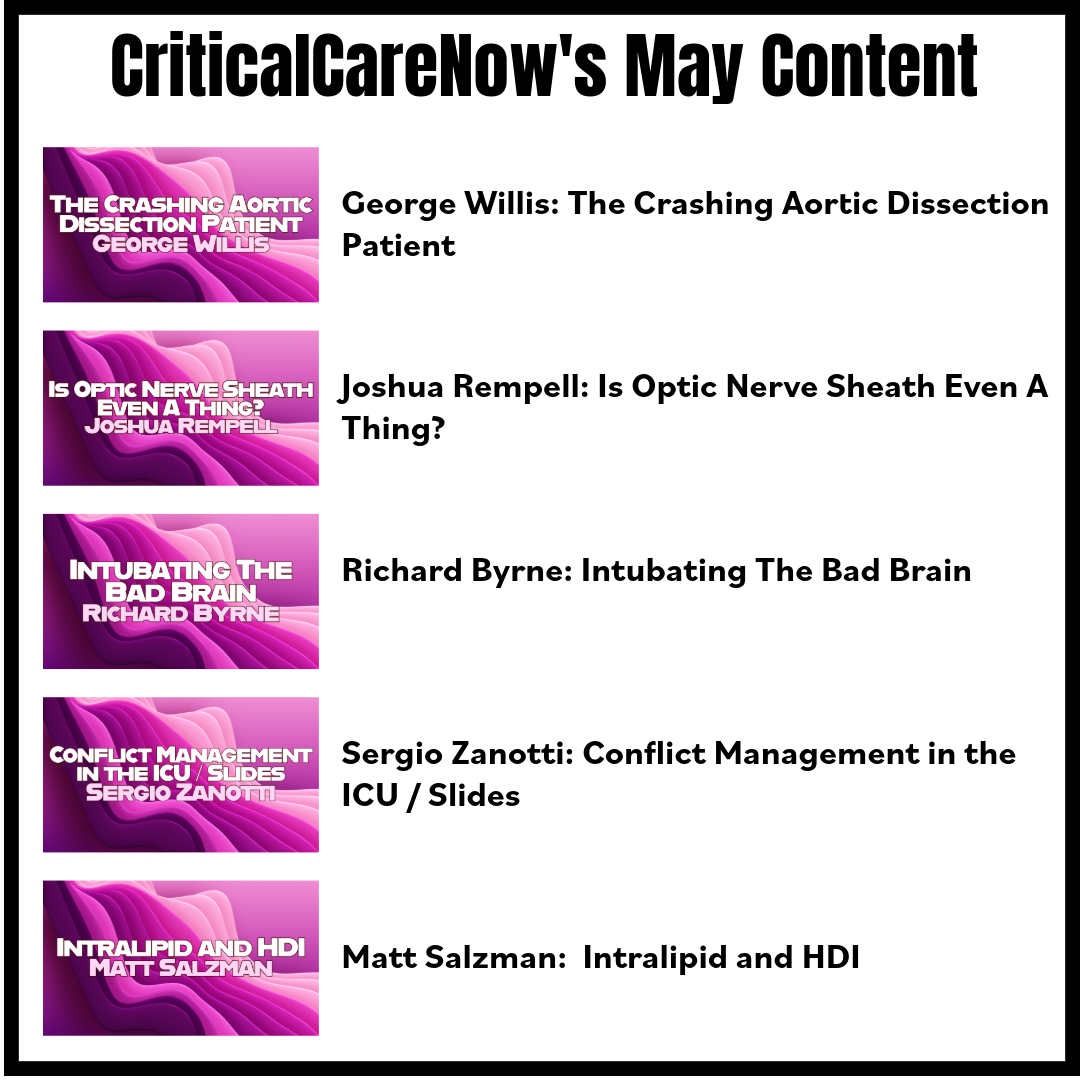
If you're an All-Access member, you're in for some great content this month. We have FIVE videos hand-picked by our staff that are high-yield and our most highly watched. We're featuring:
- Willis on "The Crashing Aortic Dissection Patient"
- Rempell on "Is Optic Nerve Sheath Even A Thing?"
- Byrne on "Intubating The Bad Brain"
- Zanotti on "Conflict Management in the ICU/Slides"
- Salzman on "Intralipid and HDI"
Each month we bring you fresh new content from the best of the best in resuscitation. If you're an All-Access member, go watch these videos NOW!


Responses