

CRISPR Just Made Pork the New
O-Negative
It’s 2 A.M., you’re running on two hours of terrible sleep and a warm Celsius from the breakroom, and your phone buzzes with a kidney offer. You answer, praying for a pristine organ, but instead, you get pitched a scarred, sub-optimal graft from a 68-year-old with poorly managed hypertension because the current transplant waitlist is a dystopian nightmare. Right now, over 100,000 people in the U.S. are facing the challenges of dialysis or struggling with the breathlessness of heart failure while transplant teams play a high-stakes game of regulatory roulette, terrified to take a risky organ because a drop below a 90% one-year survival rate gets the whole program shut down by UNOS. Enter xenotransplantation, which used to sound like a sci-fi fever dream but is currently keeping real-life clinical trial patients alive with pig kidneys and livers. And before you ask why we aren't harvesting primates: they breed way too slowly, present massive infection risks, and give off too many ethical red flags, whereas cows are absolute units, and cats are far too devious and would probably find a way to harvest our kidneys instead. Pigs are the Goldilocks option—perfectly sized, hyper-prolific, and already integrated into our supply chains.
The catch, as your Step 1 flashcards vividly remember, is that you can’t just plumb a standard pork chop into a human without the recipient's complement cascade throwing a catastrophic, hyperacute rejection tantrum over alpha-gal sugar molecules. Back in the '90s, trying to bypass this meant agonizing over primitive gene-editing techniques that took years, only to get totally defunded when investors panicked over porcine endogenous retroviruses causing a literal pandemic. But the modern era of CRISPR-Cas9 blew the doors wide open, allowing us to casually drop dozens of edits into a genome in just a few months, stripping those offensive pig sugars and dressing the organs up in human-passing immunological cloaks. We are rapidly hurtling toward a timeline where a patient gets diagnosed with end-stage organ disease, and a year later, a bespoke, CRISPR-modded organ is ready to rock with minimal immunosuppression required. It sounds completely wild, but human-to-human transplants looked like witchcraft to physicians in the 1950s too, so get ready to start adding "porcine genetic profile" to your future pre-op notes.

Introducing...EMX
Something new is coming this fall, and I think you're going to love it.
EMX is a brand-new emergency medicine conference I'm co-hosting with Dr. Anand Swaminathan — built for clinicians who want the whole emergency department sharpened, not just one narrow slice. Cardiology, stroke, peds, tox, endocrine, OB, MSK, airway — whatever walks through your door, EMX gets you ready for all of it.
And this isn't your standard lecture marathon. We're talking talk-show interviews, live media reads, real expert debates, audience polling — and our signature 🔥 Hot Ones segment. You'll be locked in from the first slot to the last.
The faculty lineup includes Amal Mattu, Reuben Strayer, Evie Marcolini, Tarlan Hedayati, Jenny Beck-Esmay, and more of the clinicians who actually shape how emergency medicine is practiced.
📅 September 15–16, 2026 | Philadelphia, PA
📍 Black Squirrel Club (a stunning restored 1890s steam plant in Fishtown) ✅ 9.5 CME/CEU Credits
Want to add a full afternoon with Amal Mattu + 3.5 CME/CEU credits? Grab a seat at the ECG Pre-Conference Workshop on September 14 — limited to 50 people.
🎟️ Early-bird pricing is live right now — and it won't last long.
And don't forget...new ResusNation Membership tiers are coming in July 2026! More CME, more clinical depth, and more access to the education that actually moves the needle in resuscitation medicine.

Stop Ordering Hydralazine PRN.
Here's What to Use Instead.
Let me be direct: stop using hydralazine as a PRN antihypertensive in the ICU. This is a genuine pet peeve of mine, and I see it happen all the time. Hydralazine is a direct arterial vasodilator — and the problem isn't just that it's unpredictable, it's that when you drop the afterload, you trigger reflex tachycardia. So congratulations, you brought the blood pressure down, but now the heart rate is climbing. In a critically ill patient, that trade-off is not acceptable. Unpredictable onset, unpredictable duration, and a compensatory tachycardia you didn't ask for — that's not a PRN medication, that's a liability.
The move is labetalol. It has both alpha and beta properties, so you get arterial vasodilation and heart rate control in the same drug — no reflex tachycardia, much more predictable response. The added bonus? There's both an IV and PO formulation, which makes titration elegant: use IV pushes for your PRNs, find the dose that works, then convert to PO at a 10:1 ratio — 10 mg IV equals 100 mg PO. The only real contraindication is the patient who's already bradycardic and hypertensive; in that case, you'd want a different tool. But for the vast majority of your ICU hypertension? Put down the hydralazine.
Watch the full video here and leave a comment.
Don't forget to like and follow my IG, TikTok, YT, Facebook or LinkedIn accounts.

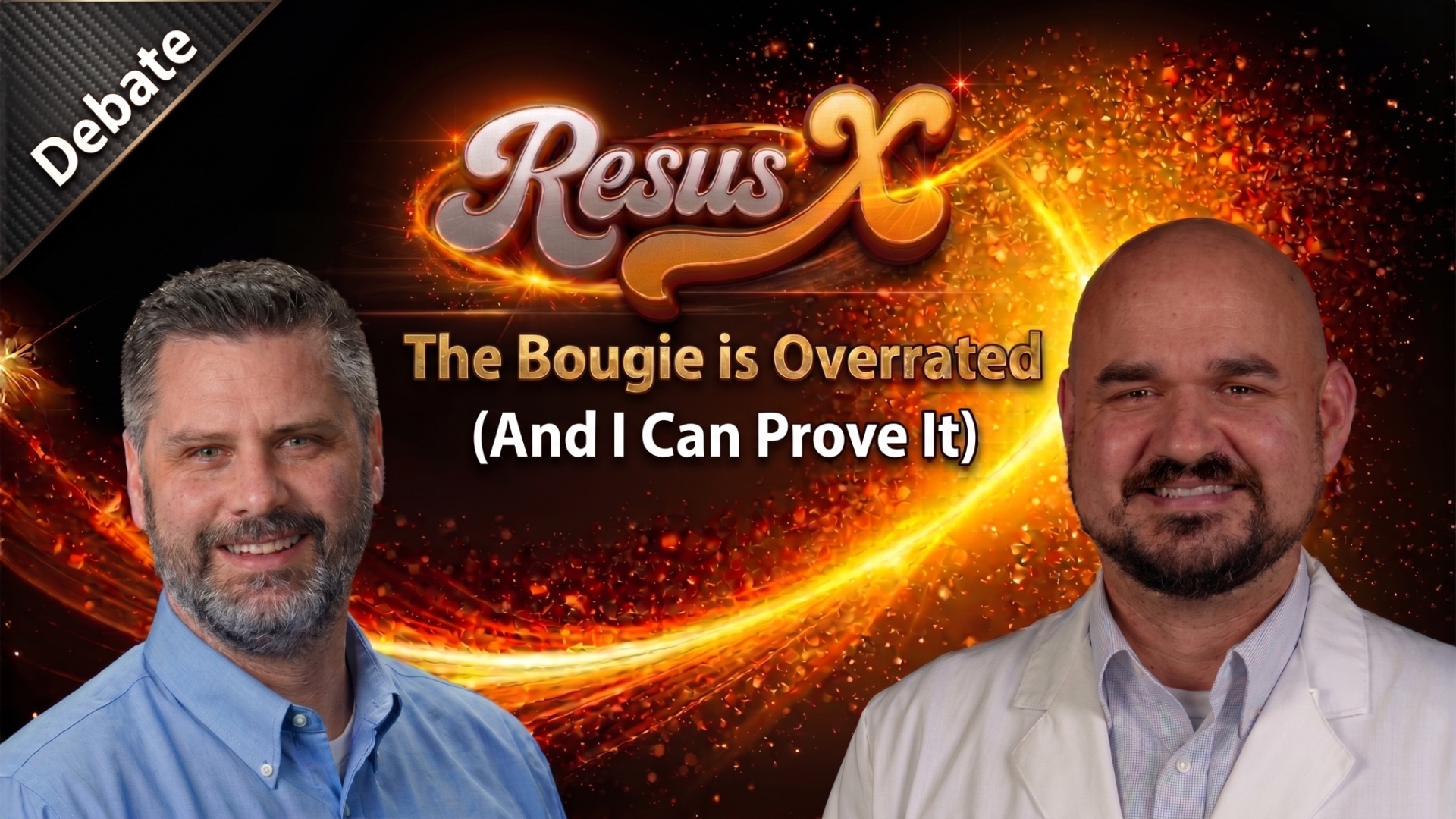
This fast-paced, highly entertaining debate tackles the controversial question of whether the bougie should be used as a primary device for all or most intubations in emergency settings. Dr. Steve Haywood opens the argument in favor of the "bougie first" approach, leaning on the principle of consistency and muscle memory. He argues that because the average emergency physician performs relatively few intubations per year, they must practice the same technique every single time to ensure mastery when high-stress, difficult airways arise. To support his stance, Dr. Haywood points to data from the landmark 2018 BEAM trial and a recent 2024 meta-analysis showing superior first-pass success rates when the bougie is used routinely rather than as a rescue device.
In a sharp and comedic rebuttal, Dr. Richard Byrne challenges the "bougie first" mandate, aggressively dismantling the generalizability of the supporting data. He highlights that the massive success rates in trials like BEAM were achieved at a single academic center (Hennepin County) by residents who explicitly train around the device, a dynamic that failed to replicate with the same success in multi-center trials. He cautions against the rare but serious complications of routine bougie use—such as a bougie-induced pneumothorax—and critiques operators for failing to look at the screen during video laryngoscopy. Ultimately, Dr. Byrne warns against the dogmatic "always" or "never" mentalities pushed by social media "podcast bros," concluding that while the bougie is an excellent tool for specific scenarios or unskilled operators, it should not be forced as a global mandate.
Check out this video of Dr. Richard Byrne and Dr. Steve Haywood from ResusX:2026 now!


Why Rigid Sepsis Protocols May Be Failing Your Most Complex Patients
Sepsis kills millions annually, and despite decades of bundle-based protocols, outcomes in severe presentations remain poor — largely because sepsis is a heterogeneous syndrome, not a single disease. Two landmark guideline releases, the updated German S3 guideline (DSG 2025) and the Surviving Sepsis Campaign 2026 (SSC 2026), now formally codify a shift from rigid algorithmic management toward flexible, physiology-guided, individualized care. The practical changes are immediately actionable: peripheral vasopressor initiation is explicitly endorsed over waiting for central access; capillary refill time (CRT) is elevated to a recommended bedside perfusion marker alongside lactate; and antibiotic timing is now risk-stratified by infection probability rather than reflexively maximized. Both guidelines also endorse prolonged beta-lactam infusion, integrate antimicrobial stewardship into standard care, and issue clear negative recommendations against vitamin C, IVIG, blood purification, and probiotics.
The most conceptually significant advance is the formalization of refractory septic shock as an action-guiding clinical entity. Defined by a recent SCCM/ESICM Delphi consensus, it identifies patients with persistent tissue hypoperfusion despite guideline-based therapy — characterized by sustained lactate above 2 mmol/L, prolonged CRT ≥3 seconds, fluid unresponsiveness, and norepinephrine equivalents exceeding 0.5 µg/kg/min. This designation functions as a structured trigger: reassess the diagnosis, confirm source control, and shift to individualized hemodynamic management targeting perfusion over pressure. Emerging trials including ANDROMEDA-SHOCK-2, ImmunoSep, and TIGRIS signal that phenotype-matched therapy — not uniform escalation — is where sepsis outcomes will be won next.
My Takeaway Points:
- Finding - Two major guideline updates (DSG 2025 and SSC 2026) converge on a staged sepsis management model in which standardized bundle-based care dominates the early phase while later-phase management increasingly requires individualized, perfusion-oriented, and phenotype-guided decision-making — a formal departure from the protocol-first paradigm that has defined sepsis care for two decades.
- Practice Impact - Clinicians should adopt 3 key bedside shifts now: initiate vasopressors via peripheral access without waiting for central line placement, use capillary refill time alongside lactate as a dynamic perfusion endpoint, and apply risk-stratified antibiotic timing rather than reflexive early administration in lower-probability sepsis cases — while discontinuing routine use of vitamin C, IVIG, and blood purification therapies.
- Population - Adult patients with sepsis and septic shock across the full spectrum of severity, with particular focus on those who fail to respond to initial guideline-based resuscitation — now definable as refractory septic shock by the new SCCM/ESICM consensus criteria (persistent lactate >2 mmol/L, CRT ≥3 seconds, fluid unresponsiveness, norepinephrine equivalents >0.5 µg/kg/min).
- Limitation - As a narrative review synthesizing two guidelines developed by partly overlapping author groups, this paper carries inherent risk of framing bias; the refractory septic shock definition remains a pragmatic research construct without consensus on duration thresholds or required prior treatment intensity, and robust RCT evidence for precision medicine approaches in sepsis remains nascent — meaning individualization in practice currently outpaces individualization in evidence.
Want to learn more? Read the full review The Evolution of Sepsis Care: From Protocol-Driven Management to Personalized Intensive Care by T. Rahmel, et al. in Infection.

The Most Underused Intervention On A Ventilated Patient
The patient was ventilating fine. Now they are not. The ventilator alarm is going off. Peak pressures are climbing. Tidal volumes are dropping. The patient looks uncomfortable and the waveforms are ugly.
Before you change a single setting, ask yourself one question: when did you last suction this patient?
In a well-resourced ICU, a respiratory therapist is at the bedside every few hours. In a rural or community emergency department at 2:00 a.m., that patient may have been intubated an hour ago and nobody has touched the airway since. Secretions accumulate. Mucus plugs form. The endotracheal tube, which is already a narrow, resistance-generating tube, becomes partially or fully obstructed.
When things change acutely, the first question is what changed in the patient. The ventilator does not know why it cannot deliver the breath. It just tells you something is wrong. Check the airway before you touch the vent.
Dopes: A Framework For Acute Deterioration
When a ventilated patient acutely deteriorates, use DOPES to work through the causes systematically:
- Displacement: Tube out of position or down the right mainstem.
- Obstruction: Secretions, mucus plug, kinked tube, or the patient biting down.
- Pneumothorax: Sudden deterioration with absent breath sounds on one side.
- Equipment Failure: Circuit disconnection, faulty valve, empty oxygen supply.
- Stacking: Auto-PEEP and breath stacking from inadequate expiratory time.
Obstruction is one of the most common and most fixable causes of acute deterioration in the emergency department. It is also the one that gets missed most often because clinicians go straight to adjusting settings rather than checking the airway.
Pass The Suction Catheter First
Before you adjust the respiratory rate, change the mode, increase the pressure support, or call for help, pass the suction catheter.
This takes thirty seconds. If you can pass the catheter easily and retrieve secretions, you have found your problem. Suction, reassess, and watch the numbers recover.
If you cannot pass the catheter, if it meets resistance or will not advance, you have a different problem. The tube may be kinked, the cuff may be herniated over the tip, or there may be a mucus plug requiring more aggressive management. At that point, consider direct laryngoscopy to visualize the tube, deflating and reinflating the cuff, or in extreme cases, changing the tube.
The Bottom Line
When the ventilator alarms and the numbers look wrong, your first move is not to turn a dial. It is to assess the patient, check the airway, and pass the suction catheter. Suctioning fixes more vent alarms than any settings change. In a rural emergency department without respiratory therapy coverage, this is one of the most important habits you can build.
Review this week's Vent pearls on IG.
----------
Dr. Shawn Segeren is a Canada-based Emergency Physician and founder of Dynamic Simulation. Dynamic Simulation partners with hospitals to sharpen clinicians and strengthen teams through high-stakes clinical simulation, and develops online ventilation education for emergency physicians working with limited RT & specialist backup.
Connect with Dr. Segeren: @dynamicsimulation.ca | @drsegeren (IG) | @dynamicsimeducation (IG) | linkedin.com/in/shawnsegeren
Watch the June Videos Now!
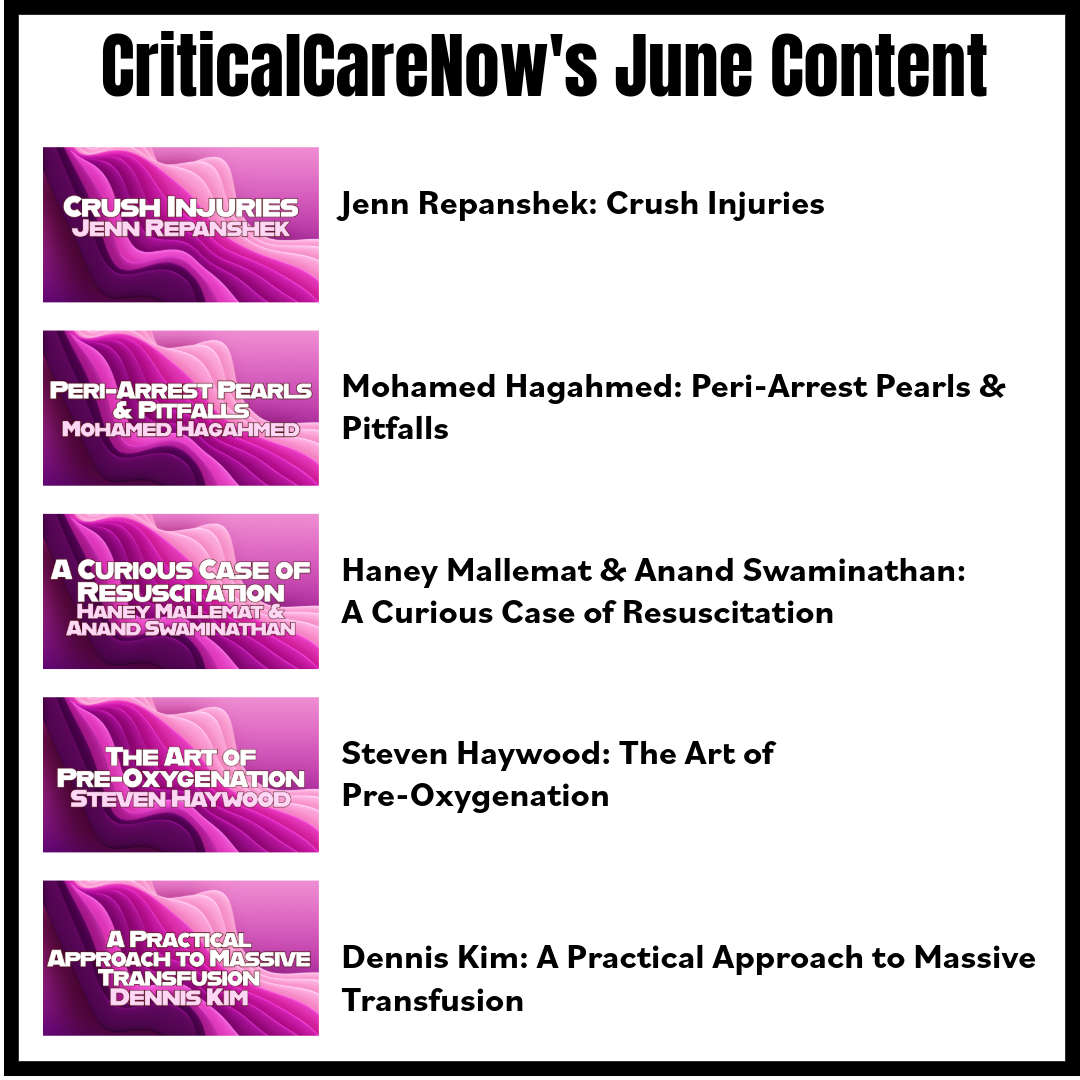
If you're an All-Access member, you're in for some great content this month. We have FIVE videos hand-picked by our staff that are high-yield and our most highly watched. We're featuring:
- Repanshek on "Crush Injuries"
- Hagahmed on "Peri-Arrest Pearls & Pitfalls"
- Mallemat & Swaminathan on "A Curious Case of Resuscitation"
- Haywood on "The Art of Pre-Oxygenation"
- Kim on "A Practical Approach to Massive Transfusion"
Each month we bring you fresh new content from the best of the best in resuscitation. If you're an All-Access member, go watch these videos NOW!


Responses