
A Welcome From Haney


Victorian Fainting: The Original
'I Literally Can't Even'
Imagine being a Victorian woman where your entire personality is essentially "fragile ghost." Back then, if you saw a suggestive ankle or heard a slightly loud noise, your primary physiological directive was to simply exit via a dramatic swoon. Between the internal organ Tetris caused by corsets cinched to the diameter of a Pringles can and the fact that practically every room was filled with lead paint and arsenic wallpaper, your oxygen saturation was probably fighting for its life. It wasn't just a vibe; it was a systemic failure of ventilation. You’d be mid-sentence about a local scandal, your diaphragm would hit a structural limit, and suddenly you’re waking up on a velvet chaise while some guy named Phineas waves "smelling salts"—which was basically just industrial-grade ammonia—directly into your brain cells.
The funniest part of this medical era was the "fainting couch," which is arguably the greatest piece of PR equipment ever designed for a vasovagal episode. While we now just pass out in a cold sweat on a linoleum hospital floor after a 24-hour shift, Victorian society turned a transient loss of consciousness into a high-stakes performance art. Doctors would show up with their leeches and "hysteria" diagnoses, completely ignoring the fact that these women were essentially being vacuum-sealed into silk dresses while breathing in coal smoke. It was a chaotic era where the clinical solution for everything was just "less thinking, more smelling salts," making it the 1800s equivalent of telling a burnt-out resident to just "try some yoga" while they're drowning in a 1:8 nurse-to-patient ratio.
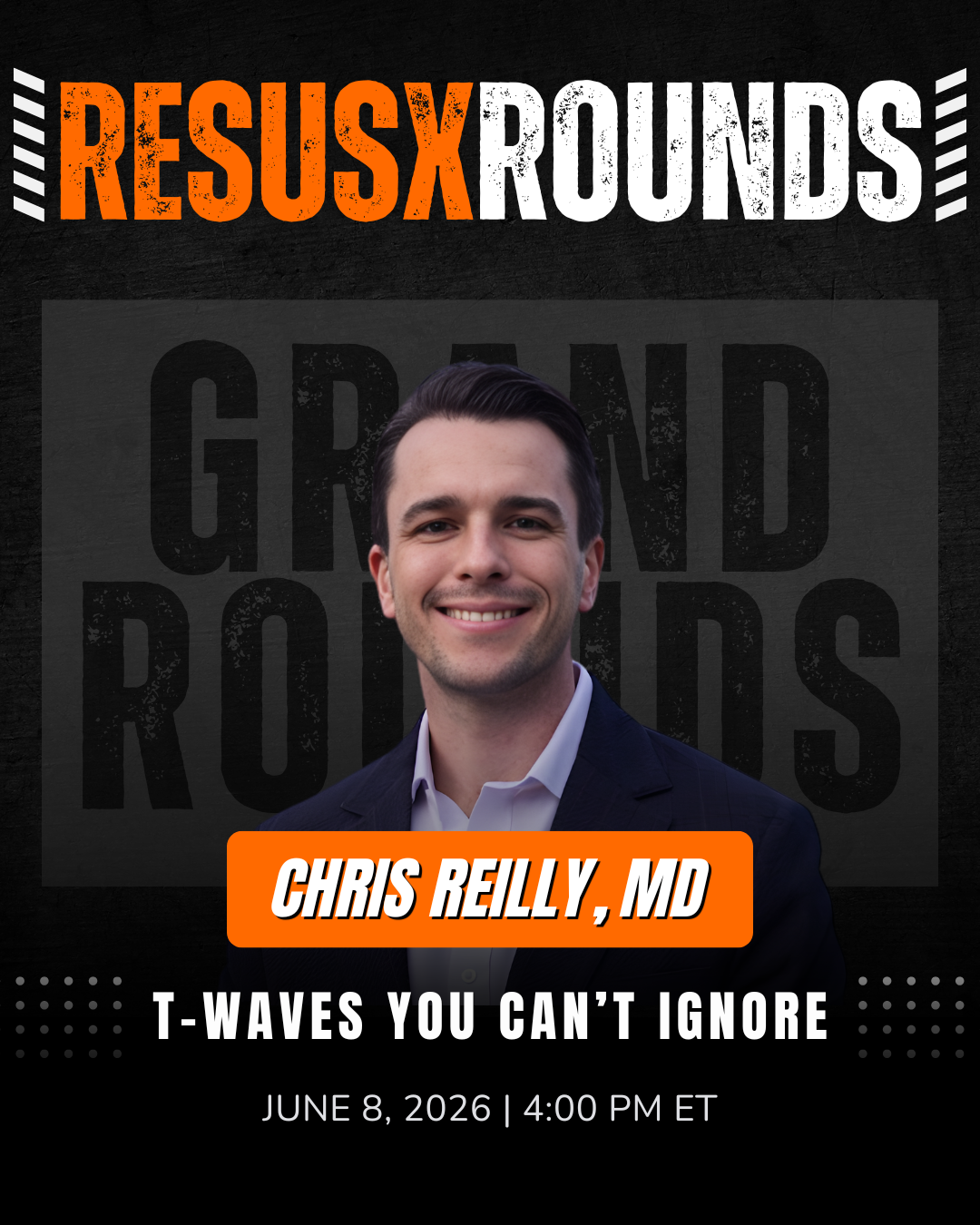
Get a Seat at Grand Rounds - On Us!
Something big is coming to ResusNation in July 2026.
We're launching new membership tiers built for clinicians who want more — more CME, more clinical depth, and more access to the education that actually moves the needle in resuscitation medicine.
Before we open the doors, we're giving you a front-row seat — FREE. Join us for a complimentary, virtual Grand Rounds session June 8, 2026 @ 4pm EST and experience exactly what ResusNation membership looks like in practice. No cost, no commitment — just high-yield clinical education, the way it should be.
June Grand Rounds will feature Dr. Chris Reilly as he cuts through the noise and delivers a focused, clinically actionable breakdown of T-wave pathology you can apply the next time you're on shift.

Before You Touch That Laryngoscope, Read This
Everybody wants to intubate in July — and I get it, I love the procedure too. But I have a deep respect for RSI because it can genuinely hurt patients if you're not prepared. Let me give you numbers that should stop you in your tracks: 25% of critically ill patients we intubate will experience post-intubation hypotension, and 3 in 100 will go into cardiac arrest. If you've been doing this long enough, you've seen it. The physiology isn't complicated once you understand it — your sick patient is running on sympathetic overdrive just to maintain their pressure, and the moment you push a sedative, you pull that drive away. Add vasodilation, venodilation, increased intrathoracic pressure from bagging and PEEP, rising acidosis from apnea, and hypoxemia from a prolonged attempt — and you've created a perfect hemodynamic storm.
So here's what I need you to remember: resuscitate before you intubate. Optimize that blood pressure before you ever pick up the laryngoscope — sometimes that means starting vasopressors before you even push your RSI meds. Pre-oxygenate aggressively with non-invasive positive pressure. Use the lowest effective doses of your induction agents. This isn't an exhaustive list, but if you're just starting your resuscitation career, I want you to carry a healthy fear of this procedure — because the tube itself can kill your patient if you haven't set them up to survive it.
Watch the full video here and leave a comment.
Don't forget to like and follow my IG, TikTok, YT, Facebook or LinkedIn accounts.


Mike Carunchio, a veteran flight medic, challenges decades of traditional EMS protocols, arguing that paramedics are aggressively intubating far too many patients in the field. Tracking the debate back to a flawed 2003 study on first-pass success rates, he explains how a rigid adherence to text-book guidelines—specifically the "anticipated clinical course" and the ubiquitous "GCS less than 8, intubate now" rule—has created a punitive, checklist-driven culture. This "hair-trigger" approach often causes paramedics to overlook critical patient physiology, leading to dangerous post-intubation crashes in austere environments when patients are forced through a positive-pressure paradigm without proper preparation.
To remedy this, Carunchio advocates for a massive shift away from viewing airway management as a zero-sum game, proposing instead a "resuscitation paradigm" where stabilizing the patient takes priority over capturing the glottis. He emphasizes that a threatened airway does not equal a lost airway, and that meaningful resuscitation—such as administering blood, BiPAP, or correcting acidosis—can and should be performed en route to the hospital rather than delaying definitive care on scene. Ultimately, he calls on medical directors and EMS educators to move past outdated training dummies and implement rigorous quality assurance that fosters superior clinical judgment, reminding the audience that a truly skilled provider uses judgment to avoid the need for high-risk interventions entirely.
Check out this video of Mike Carunchio, FP-C from ResusX:2025 now!


Why Holding Heparin Until the Cath Lab May Be the Wrong Call for Your STEMI Patient
One of the more underappreciated decisions in STEMI management is not whether to give heparin — it's when. The HEPARIN-STEMI trial asked a deceptively simple question: does moving the first UFH bolus to prehospital first medical contact (FMC) — rather than waiting until after the initial angiogram — improve infarct-related artery (IRA) patency before any wire has crossed? Six hundred STEMI patients with symptom onset under 6 hours were randomized to weight-based UFH (70–100 IU/kg) at FMC versus standard post-angiogram dosing. Prehospital UFH produced TIMI 2–3 flow in 43% versus 27% of controls — a relative risk of 1.59 (95% CI 1.27–1.98, p<0.001) and an absolute gain of 16 percentage points, meaning roughly 1 in 6 additional patients arrived in the lab with a partially open artery. This came without a meaningful bleeding penalty: Bleeding Academic Research Consortium (BARC) 3–5 events were 2.4% versus 2.0% (p=0.789). Secondary signals supported the finding — better ST-resolution (65% vs. 59%) and lower 24-hour troponin I, suggesting reduced infarct burden. The median FMC-to-angiography time of 60 minutes likely mattered; early thrombus is fresh and loosely organized, and heparin had time to work.
Context limits how broadly these results can be applied. This was a single center embedded in a mature STEMI network with unusually short symptom-to-FMC times around 70 minutes, and the trial excluded cardiogenic shock, post-arrest patients, and late presenters — so the findings apply to the hemodynamically stable, early-presenting patient. The trial was not powered for mortality or infarct size, and IRA patency at angiography, while a meaningful surrogate, is not a hard clinical endpoint. Still, the intervention is inexpensive, universally available, and already part of every STEMI protocol. The real question is whether systems are deploying it at the right moment.
My Takeaway Points:
- Finding - Prehospital UFH bolus at FMC increased IRA patency from 27% to 43% at initial coronary angiography (RR 1.59, 95% CI 1.27–1.98, p<0.001) without a significant increase in BARC 3–5 bleeding (2.4% vs. 2.0%).
- Practice Impact - In STEMI systems capable of prehospital ECG diagnosis and direct cath lab transfer, the timing of UFH administration should shift from the cath lab to the point of FMC — a simple protocol change with potentially meaningful arterial patency gains.
- Population - Hemodynamically stable adult STEMI patients presenting within 6 hours of symptom onset, enrolled through a high-volume single-center European STEMI network; excludes cardiogenic shock, post-arrest coma, and late presenters.
- Limitation - Single-center design in an unusually efficient STEMI network (median symptom-to-FMC ~70 min) limits generalizability to systems with longer transport times or less structured prehospital protocols; the trial was underpowered for mortality and lacked infarct size measurement by imaging.
Want to learn more? Read the full study Prehospital Heparin Administration in Patients With STEMI Undergoing Primary PCI: HEPARIN-STEMI Randomized Controlled Trial by M. Fister, et al. in Circulation.

Vasopressin in Septic Shock: Are We Still Starting It Too Late?
If you’re treating septic shock in the ED, you already know the drill: start norepinephrine first. But the question many clinicians still wrestle with is when to add vasopressin. Recent data suggest we may be waiting too long. But when exactly should we start it?
Guidelines!
The 2026 Surviving Sepsis Campaign guidelines from the Society of Critical Care Medicine (SCCM) and Infectious Diseases Society of America (IDSA) recommend:
-
Norepinephrine as the first-line vasopressor
-
Adding vasopressin in patients with “escalating doses of norepinephrine” rather than escalating norepinephrine when MAP remains inadequate
They add that most trials initiated vasopressin when norepinephrine doses reached ~0.25–0.5 mcg/kg/min, though the guidelines acknowledge that this threshold remains unclear because studies used different initiation points.
So, the traditional approach has been: Norepinephrine first → escalate dose → add vasopressin later.
But newer evidence is challenging that timeline.
The Question: Should We Start It Earlier?
Several newer studies suggest earlier initiation may improve outcomes.
A 2025 reinforcement-learning analysis of >10,000 septic shock patients found the optimal strategy was:
-
Starting vasopressin in 87% of patients
-
At a median norepinephrine dose of 0.20 mcg/kg/min
-
Around 4 hours after shock onset
In real-world practice, clinicians waited longer:
-
Median 5 hours
-
Median 0.37 mcg/kg/min norepinephrine
The earlier strategy was associated with lower hospital mortality (OR 0.81, 95% CI 0.73–0.91).
A 2025 multicenter target trial emulation examining early vasopressin (≤6 hours after norepinephrine) compared with usual care in septic shock found:
-
Early initiation was associated with a modest reduction in 30-day ICU mortality (18.45% vs 19.34%; RR 0.95, 95% CI 0.93–0.98)
-
Benefit appeared greatest when vasopressin was started at lower norepinephrine doses (<0.25 μg/kg/min)
Other observational studies have also shown:
-
Faster shock resolution
-
Shorter ICU stays
-
Reduced hospital length of stay
when vasopressin is started earlier in the shock course.
Why Earlier Might Make Physiologic Sense
Early septic shock often features relative vasopressin deficiency. Vasopressin levels initially rise but then fall within 24–48 hours, leaving patients dependent on catecholamines.
Starting vasopressin earlier may:
-
Reduce catecholamine exposure
-
Prevent catecholamine receptor saturation
-
Improve vascular responsiveness
In other words, it may work best before norepinephrine doses climb too high.
What This Means for the ED
Most septic shock patients spend their first several hours in the emergency department, which means ED clinicians are often the ones who decide when vasopressin starts.
While the SCCM guidelines still support adding vasopressin when norepinephrine is around 0.25–0.5 mcg/kg/min, newer evidence suggests benefit may occur earlier, around 0.20–0.25 mcg/kg/min and within the first 4–6 hours of shock.
Bottom Line
-
Norepinephrine remains first-line.
-
Vasopressin is still the recommended second vasopressor.
-
Newer data suggest we may benefit from starting it even earlier in the shock course, rather than waiting for very high norepinephrine doses.
And since septic shock management often begins in the ED, the decision about when vasopressin starts frequently happens there.
Review this week's Dose on IG or TikTok.
----------
Dr. Abbi Briscoe is an emergency department clinical pharmacist, pharmacy residency program coordinator, and affiliate professor in Montana. She is passionate about Emergency Medicine and Critical Care education, and is an avid mountain biker and skier in her free time.
Connect with Dr. Briscoe: @lilpharm2026 (IG) or @lilpharm2026 (Tiktok)
Watch the June Videos Now!
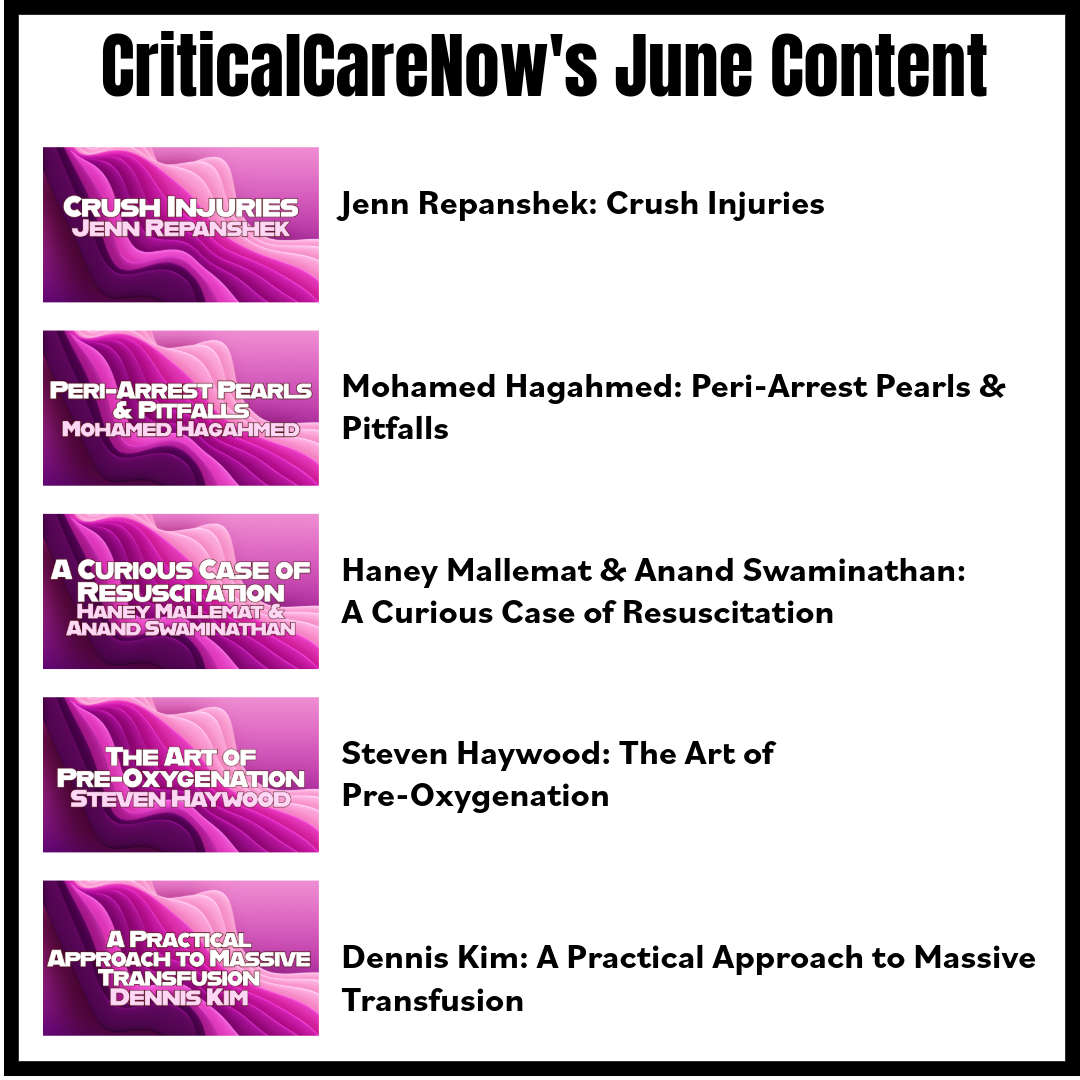
If you're an All-Access member, you're in for some great content this month. We have FIVE videos hand-picked by our staff that are high-yield and our most highly watched. We're featuring:
- Repanshek on "Crush Injuries"
- Hagahmed on "Peri-Arrest Pearls & Pitfalls"
- Mallemat & Swaminathan on "A Curious Case of Resuscitation"
- Haywood on "The Art of Pre-Oxygenation"
- Kim on "A Practical Approach to Massive Transfusion"
Each month we bring you fresh new content from the best of the best in resuscitation. If you're an All-Access member, go watch these videos NOW!


Responses