

Imagine Escaping the Plague Just to Die of Roommate Drama
Let’s be honest: if you think your last weekend on call was toxic, you haven’t seen the pure, unadulterated chaos of Netflix's The Decameron. The show takes Giovanni Boccaccio’s 14th-century classic and aggressively strips away the highbrow literature, leaving us with what is essentially a medieval Love Island set during the peak of the Black Death. While Florence is out there drowning in necrosis, sepsis, and floating corpses, a highly dysfunctional group of ultra-wealthy nobles and their deeply resentful servants retreat to a countryside villa to sit in isolation and entirely ignore the apocalypse. The depiction of the plague itself is shockingly visceral—complete with horrific lymphadenopathy (those classic, apple-sized buboes Boccaccio loved to describe) and self-flagellating cults roaming the hills—but it’s treated as a dark, slapstick backdrop for human stupidity.
The medical care in this villa is an absolute fever dream that will make any modern clinician want to report the entire cast to the board. We get Dioneo, masquerading as a physician, whose entire practice consists of enabling his insufferable, deeply misogynistic hypochondriac patient, Tindaro. Meanwhile, the rest of the cohort is busy trying to ward off Yersinia pestis with useless amulets because some local "expert" claimed the pestilence was just angry subterranean earthquake air. It’s a hilarious, frustratingly relatable satire on class division during a health crisis—reminding us that whether it's 1348 or the 2020s, the rich will always try to buy their way out of a pandemic while the rest of the staff is left scrubbing the metaphorical floors and dodging the infected.

Get Ready For a New Conference in
Fall 2026
EMX is a brand-new emergency medicine conference I'm co-hosting with Dr. Anand Swaminathan — built for clinicians who want the whole emergency department sharpened, not just one narrow slice. Cardiology, stroke, peds, tox, endocrine, OB, MSK, airway — whatever walks through your door, EMX gets you ready for all of it.
For our inaugural meeting, EMX will be held virtually — so no matter where you practice, you can be there. Everything else you'd expect from a world-class conference? Still here.
And this isn't your standard lecture marathon. We're talking talk-show interviews, live media reads, real expert debates, audience polling — and our signature 🔥 Hot Ones segment. You'll be locked in from the first slot to the last.
The faculty lineup includes Amal Mattu, Reuben Strayer, Evie Marcolini, Tarlan Hedayati, Jenny Beck-Esmay, and more of the clinicians who actually shape how emergency medicine is practiced.
📅 September 15–16, 2026 | Virtual / Online
📍 ✅ 9.5 CME/CEU Credits
Want to add a full afternoon with Amal Mattu + 3.5 CME/CEU credits? Grab a virtual seat at the ECG Pre-Conference Workshop on September 14 — limited to 50 people.
REGISTER FOR VIRTUAL EMX HERE!

It’s the Little Things
I want to share a story that might irritate some of you at first, but stick with me. A colleague told me about a rough overnight case: an elderly patient with severe sepsis, multiple pressors, methylene blue, a Swan-Ganz catheter, cardiogenic shock — the works. He'd fought all night and eventually had to sit down with the wife and tell her they weren't going to bring her husband home. It was as compassionate a conversation as you can have in that situation.
When I took over care the next morning and checked in with her, she wasn't upset about the clinical decisions or the outcome. She was upset that the attending had messy hair, wrinkled scrubs, and blood on them during that conversation. I know her grief may have misplaced her focus, but after 20+ years of this, I've heard versions of this before — families remember the little things. Now I check my hair before those conversations. I keep a white coat in my office I otherwise never wear, just for family meetings, because it signals authority. It's not about vanity — it's about giving families one less thing to hang onto in the worst moment of their lives. Presentation matters more than we like to admit.
Watch the full video here and leave a comment.
Don't forget to like and follow my IG, TikTok, YT, Facebook or LinkedIn accounts.


Evie Marcolini, MD focuses on a practical neurological examination for trauma patients, specifically those who are comatose. She outlines a systematic approach that prioritizes three key areas: depth of coma (assessing environmental and metabolic factors like medications, electrolyte imbalances, and seizures), brainstem function (evaluating breathing, eye movements, pupil responses, corneal reflexes, and cough reflex), and focal findings (motor examination of all extremities). Dr. Marcolini emphasizes starting with the assumption that patients can perform at their best level and working down systematically, avoiding time-consuming traditional neurological exams in favor of focused assessments. Her key recommendation includes performing a brief exam before intubation that checks pupils, extremity movement, and spontaneous breathing, rather than focusing solely on the GCS.
Check out this video of Dr. Evie Marcolini from ResusX:2026 now!


Stop Treating AKI as One Syndrome
Acute kidney injury (AKI) remains one of the most common and consequential complications in critically ill patients, yet decades of pharmacologic trials have failed to move the needle on survival or renal recovery. This new perspective from the Journal of Intensive Medicine argues the problem isn't a lack of effective drugs — it's how we've been conceptualizing AKI in the first place. Current diagnosis still leans on serum creatinine and urine output, markers that are delayed, indirect, and biologically nonspecific, meaning substantial injury has often already occurred by the time they rise. The author proposes reframing AKI as a three-dimensional space — the "AKI cube" — built on three independent axes: etiology (sepsis, ischemia, nephrotoxicity), time (early, established, recovery phase), and underlying biology (inflammation, tubular stress, endothelial dysfunction, maladaptive repair). Instead of asking "does this patient have AKI?", clinicians would ask "what type of AKI is this, and where does this patient sit within the disease space?" Two patients with identical creatinine values could occupy entirely different regions of the cube — one an early septic AKI dominated by inflammatory activation, the other a later-stage nephrotoxic injury shifting toward repair — with very different treatment implications. Central to this model is the concept of "treatable traits": biomarker-defined, measurable derangements (like inflammation or tubular stress) that are directly actionable, as opposed to biological features that are merely descriptive.
The bottom line for practice: this is a conceptual framework, not a bedside tool ready for tomorrow's rounds. Its real near-term value is in clinical trial design — enrolling biologically enriched, mechanism-matched populations rather than the heterogeneous, creatinine-defined cohorts that have diluted treatment effects in past AKI trials. Widespread biomarker-driven stratification at the bedside will depend on further validation and accessible testing, but the shift in thinking — from "does the patient have AKI" to "where in the disease space are they" — is already reshaping how future studies are being designed.
My Takeaway Points:
- Finding - AKI can be reconceptualized along three independent axes — etiology, time, and biology — rather than as a single binary diagnosis based on creatinine and urine output.
- Practice Impact - Shifts the framework from "treating AKI" broadly to identifying biomarker-defined "treatable traits" (inflammation, tubular stress, endothelial dysfunction) that may guide mechanism-targeted therapy and enrich future trial design.
- Population - Critically ill patients with AKI from any etiology (sepsis, ischemia, nephrotoxicity), across all disease phases from early injury through recovery.
- Limitation - This is a conceptual/perspective framework, not a validated clinical tool — precise "positioning" within the cube is difficult in practice since patients often have overlapping etiologies and biological mechanisms, and no prospective outcome data yet support its bedside use.
Want to learn more? Read the full article The AKI Cube: From Syndromic Diagnosis to Treatable Traits in Acute Kidney Injury by S. De Rosa in Journal of Intensive Medicine.

The PIPPEN Trial: Hallelujah!
Penicillin Allergy? New Data Say Pip-Tazo May Still Be an Option
New data challenge the longstanding caution around penicillin allergies and piperacillin cross-reactivity. Pharmacists everywhere are absolutely thrilled: no more defaulting to a carbapenem when you get that allergy warning. A retrospective study published in Antimicrobial Stewardship & Healthcare Epidemiology gives us insight into the real risks of trialing piperacillin in a patient with a penicillin allergy.
The PIPPEN trial, Piperacillin–Tazobactam Tolerability in Patients with a Labeled Penicillin Allergy, retrospectively evaluated 191 hospitalized patients at Surrey Memorial Hospital in British Columbia, Canada, who carried a documented penicillin allergy and received at least one dose of pip-tazo between November 2021 and January 2024. The finding: 98% tolerated pip-tazo without documented intolerance, regardless of allergy risk category.
The Pharmacological Rationale
Beta-lactam cross-reactivity is now understood to be driven by R1 side-chain similarity rather than the shared beta-lactam ring. Piperacillin's R1 side chain is structurally distinct from amoxicillin, ampicillin, and other common penicillins, making true immunologic cross-reactivity theoretically unlikely. Despite this, current guidelines have continued to advise avoidance, citing insufficient clinical evidence. This study starts to fill that gap.
What the Numbers Show
Across all risk stratifications, piperacillin was consistently tolerated: 99% in the low-risk group, 99% in the high-risk anaphylactic group, and 100% in the well-documented delayed reaction group. Most notably, all 29 patients with a history of anaphylaxis or anaphylactic-like reactions, including angioedema, shortness of breath, and swelling, tolerated one or more doses.
Of the four patients who did not tolerate pip-tazo, reactions were classified as “possible” or “probable” adverse drug reactions (ADRs), meaning pip-tazo causality could not be confirmed in any case. Additionally, all had immediate recovery with full resolution.
Why It Matters for Stewardship
Carbapenem resistance is increasing globally, and pip-tazo retains antipseudomonal activity that most carbapenem-sparing alternatives lack. A 98% rate of tolerability is a meaningful data point for risk-benefit conversations. It complements the PALACE trial's support for direct beta-lactam challenges and aligns with the 2022 Drug Allergy Practice Parameter acknowledging pip-tazo as a distinct, largely independent allergy entity. Prospective multicenter data are still needed before guidelines change, but PIPPEN moves the evidence in the right direction.
Review this week's Dose on IG or TikTok.
----------
Dr. Abbi Briscoe is an emergency department clinical pharmacist, pharmacy residency program coordinator, and affiliate professor in Montana. She is passionate about Emergency Medicine and Critical Care education, and is an avid mountain biker and skier in her free time.
Connect with Dr. Briscoe: @lilpharma2026 (IG) or @lil_pharma (Tiktok)
Watch the July Videos Now!
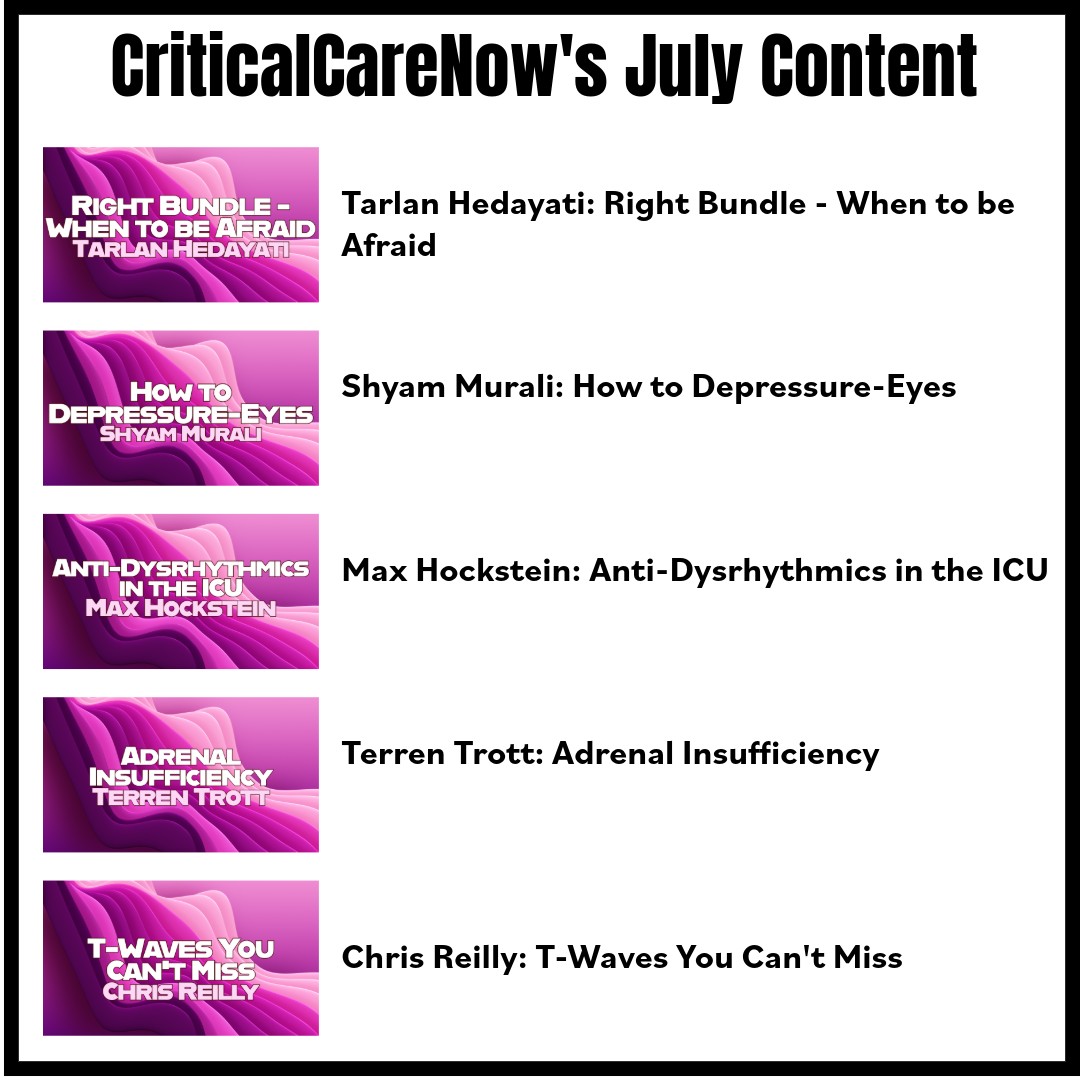
If you're an All-Access member, you're in for some great content this month. We have FIVE videos hand-picked by our staff that are high-yield and our most highly watched. We're featuring:
- Hedayati on "Right Bundle - When to be Afraid"
- Murali on "How to Depressure-Eyes"
- Hockstein on "Anti-Dysrhythmics in the ICU"
- Trott on "Adrenal Insufficiency"
- Reilly on "T-Waves You Can't Miss"
Each month we bring you fresh new content from the best of the best in resuscitation. If you're an All-Access member, go watch these videos NOW!


Responses