
Your C.O.D. Addiction Might Cure Cancer
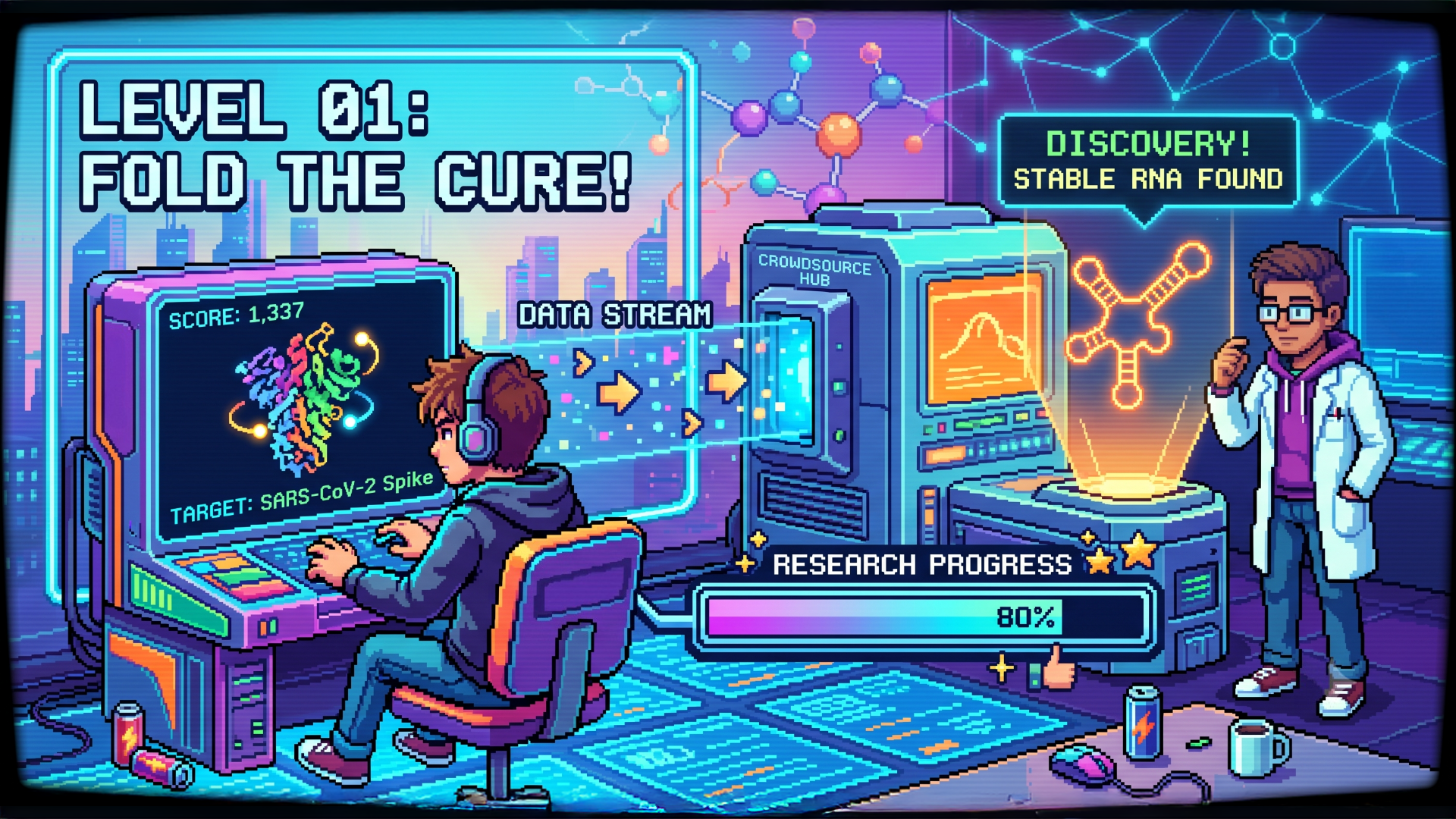
Picture this: you are working a brutal 28-hour shift, fueled entirely by stale hospital coffee and sheer spite, while some teenager in a dark room is aggressively min-maxing a biology puzzle game and casually solving the structural biology problems that have haunted PhDs for decades. It sounds like a fever dream born of sleep deprivation, but it’s actually the reality of citizen science platforms like Foldit and Eterna. Scientists realized that while computers are great at processing raw numbers, human evolutionary wiring makes us freakishly good at spatial problem-solving and finding narrow paths through complex action spaces. By turning the mind-numbing complexity of molecular folding into abstract, bonsai-like puzzle games with real-time scoring, researchers have effectively gamified drug discovery, unleashing millions of natural problem solvers on medicine's most stubborn enemies without requiring them to write a single tedious grant proposal.
The wild part is that this isn't just a gimmick to get kids interested in STEM—it actually works. During the pandemic, the Eterna community launched the "OpenVaccine Challenge," tasking players with redesigning RNA molecules to create COVID-19 vaccines that wouldn't immediately degrade at room temperature, fundamentally stabilizing the very molecules running our bodies. The players succeeded, proving that you don't need to spend a decade culturing cells or enduring residency to make a massive clinical impact; you just need a clear success condition, a set of digital tools, and the obsessive drive to get a high score. As cancer research increasingly morphs into a giant, interconnected tree of computational roadblocks, the future of medicine might not just live in sterile laboratories, but in the hands of everyday gamers threading the needle of molecular engineering one level at a time.

A New Conference Is Coming This Fall And You're Going To Love It!
EMX is a brand-new emergency medicine conference I'm co-hosting with Dr. Anand Swaminathan — built for clinicians who want the whole emergency department sharpened, not just one narrow slice. Cardiology, stroke, peds, tox, endocrine, OB, MSK, airway — whatever walks through your door, EMX gets you ready for all of it.
For our inaugural meeting, EMX will be held virtually — so no matter where you practice, you can be there. Everything else you'd expect from a world-class conference? Still here.
And this isn't your standard lecture marathon. We're talking talk-show interviews, live media reads, real expert debates, audience polling — and our signature 🔥 Hot Ones segment. You'll be locked in from the first slot to the last.
The faculty lineup includes Amal Mattu, Reuben Strayer, Evie Marcolini, Tarlan Hedayati, Jenny Beck-Esmay, and more of the clinicians who actually shape how emergency medicine is practiced.
📅 September 15–16, 2026 | Virtual / Online
📍 ✅ 9.5 CME/CEU Credits
Want to add a full afternoon with Amal Mattu + 3.5 CME/CEU credits? Grab a virtual seat at the ECG Pre-Conference Workshop on September 14 — limited to 50 people.

The Comment That Changed How I Practice
I'll never forget sitting in the back of a packed room at a national conference as a fellow, watching someone ask a legend of critical care which fluid he preferred for sepsis resuscitation — LR, normal saline, albumin, starches. Without blinking, he said he didn't care if you used dog piss to resuscitate a patient, as long as you picked the right fluid and gave the right amount — not one drop more. I've obviously never used dog piss on a patient, but that answer rewired how I think about fluids permanently.
The lesson is this: fluids are a medication, not a reflex, so why do we default to the same fluid bolus regardless of what the patient in front of us actually needs? Blindly pouring fluids into a septic patient isn't just ineffective — it's harmful. Dose your fluids like you'd dose any other drug: give your patients everything they need, and not one drop more.
Watch the full video here and leave a comment.
Don't forget to like and follow my IG, TikTok, YT, Facebook or LinkedIn accounts.


Joseph Corcoran, MD emphasizes that ACLS guidelines were designed to establish minimum standards for resuscitation, not to restrict clinical judgment. Since the initial 1974 release explicitly stated that deviations are acceptable with sound reasoning, clinicians should feel empowered to adapt their approach based on specific clinical situations. Dr. Corcoran argues for maximizing "real chest compression fraction" (rCCF) by focusing on adequate perfusion time rather than simply CPR duration, since it takes 40-45 seconds after pausing compressions for blood to circulate effectively again. Recommendations include checking rhythms instead of pulses when possible, using technology like arterial lines and ultrasound, announcing rhythm checks 15 seconds in advance, and extending CPR cycles beyond the standard 2 minutes unless there's a reasonable expectation of clinical change.
The talk challenges several standard ACLS practices regarding defibrillation and medication management. For defibrillation, anterior-posterior pad placement is preferred over anterolateral positioning because it captures more of the left ventricle where most arrhythmias originate, and dual-sequential defibrillation can further improve outcomes by decreasing impedance and increasing current. Regarding medications, Dr. Corcoran advocates limiting epinephrine to 2-3 doses maximum since it improves ROSC at the expense of neurological outcomes. When distinguishing between PEA and ROSC, he recommends starting high-dose Levophed during CPR and checking if a pulse becomes palpable at the next rhythm check, which confirms the patient was in severe shock rather than truly pulseless.
Check out this video of Dr. Joseph Corcoran from ResusX:2026 now!


Is a "Positive" Troponin Actually a Positive for MI?
Rapid high-sensitivity cardiac troponin (hs-cTn) algorithms transformed emergency department triage for suspected acute coronary syndrome, but this review of real-world data reveals a substantial gap between trial performance and daily practice. Derivation studies enrolled younger (ages 60–65), more clinically preselected patients with AMI prevalence around 10–15%, whereas real-world ED patients are older, carry more chronic kidney disease and pre-existing cardiac disease, and have AMI prevalence closer to 5–10%. As a result, nearly half of tested patients land in the ambiguous "gray zone," and the positive predictive value for AMI among "rule-in" patients falls well below the guideline target of 70%. The review's central message is that a troponin rise signals acute myocardial injury, not automatically acute coronary syndrome, as arrhythmias, sepsis, pulmonary embolism, Takotsubo syndrome, subarachnoid hemorrhage, and even ultramarathon running can drive troponin up without coronary occlusion. Age and renal function—not sex or ethnicity—emerge as the dominant confounders, and evidence supports doubling rule-in thresholds for patients over 65 and raising them 2- to 6-fold in advanced chronic kidney disease. The classic ">20% change" rule also appears outdated given improved assay precision, with smaller absolute deltas potentially performing better, though acute and chronic injury still overlap substantially in early or late presenters.
For clinicians, the practical takeaway is a structured, stepwise approach rather than reflexive reliance on a single cutoff. This means integrating serial troponin kinetics, ECG findings, bedside echocardiography, and clinical probability of coronary disease before committing to urgent angiography—particularly in older patients, those with renal impairment, and critically ill patients where ischemic and non-ischemic injury are hardest to distinguish. Emerging tools like troponin isoform testing and cTnI/cTnT ratios show promise for sharper discrimination, and AI-assisted risk models are being studied, but neither is ready to replace structured clinical assessment today.
My Takeaway Points:
- Finding - Approximately 50% of real-world ED patients tested with hs-cTn fall into the "gray zone," and rule-in positive predictive value for AMI is markedly lower than the ≥70% benchmark from derivation studies.
- Practice Impact - Age and renal-function-adjusted troponin thresholds (up to 2x for age ≥65, up to 2–6x for advanced CKD) meaningfully improve rule-in accuracy; sex and ethnicity-specific cutoffs do not show consistent net clinical benefit.
- Population - Real-world ED patients are older, less clinically preselected, and carry more chronic renal failure and pre-existing cardiac disease than patients in the multicenter trials that derived these algorithms.
- Limitation - The traditional >20% serial-change threshold for distinguishing acute from chronic myocardial injury may be outdated given improved assay precision, and substantial diagnostic overlap remains in early/late presenters — imaging and clinical context remain essential.
Want to learn more? Read the full article Clinical Gray Zones of Cardiac Troponin Interpretation in the Emergency Department: When Increased Concentrations Do Not Equal Acute Coronary Syndrome by J. Mair in Journal of Clinical Medicine.

What is Actually Between the Vent and the Patient?
Most clinicians focus on the ventilator settings. Fewer think carefully about what sits between the machine and the patient. In a rural or community emergency department where you are setting up the circuit yourself, knowing what each component does and why the order matters can save you time when things go wrong.
This is one way to assemble the distal circuit. Your institution may use a different configuration, and that is fine. The principles are the same.
The Assembly Sequence
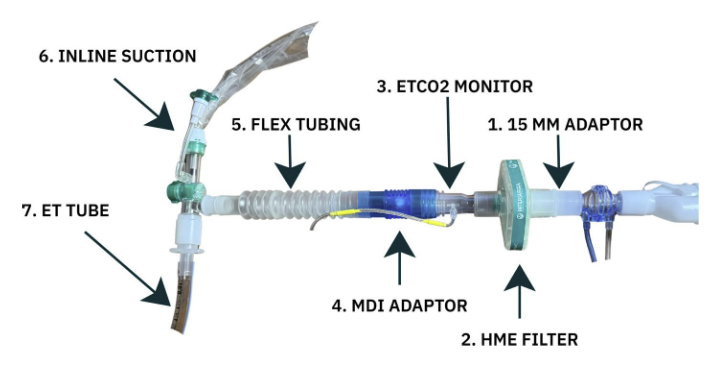
1) Circuit Adaptor
Connects the ventilator circuit to the HME. Ensures a secure fit. Not always required depending on your circuit.
2) HME Filter
Heat and moisture exchanger. Keeps the airway humidified and acts as an infection control barrier. Placed as close to the patient as possible.
3) EtCO2 Adapter
Connects directly after the HME for continuous end-tidal CO2 monitoring. Positioned here so it reads accurately without interference.
4) MDI Adapter
Provides a port for bronchodilator delivery. Placed after the EtCO2 adaptor so medication does not contaminate the capnography module.
5) Flex Tubing
Reduces strain on the ETT and allows repositioning without pulling on the airway. Helps prevent accidental extubation.
6) In-line Suction Catheter
Allows closed-circuit suctioning without disconnecting the patient from the ventilator. Connects directly to the flex tubing.
7) ETT
The final connection. Everything above is arranged to support airway stability and minimize dead space.
One Practical Tip
If CO2 is rising and you are running out of options, removing the MDI adaptor or the flex tubing reduces dead space quickly. These components add volume to the circuit that the patient has to re-breathe with each breath. In severe hypercapnia, stripping the circuit back to the essentials can make a meaningful difference.
The Bottom Line
The circuit is not just plumbing. Every component has a purpose, and the order matters. When alarms go off or ventilation is not working as expected, knowing what is between the machine and the patient gives you one more place to look.
Review this week's Vent pearls on IG.
----------
Dr. Shawn Segeren is a Canada-based Emergency Physician and founder of Dynamic Simulation
Connect with Dr. Segeren: @dynamicsimulation.ca | @drsegeren (IG) | @dynamicsimeducation (IG) | linkedin.com/in/shawnsegeren
Watch the July Videos Now!
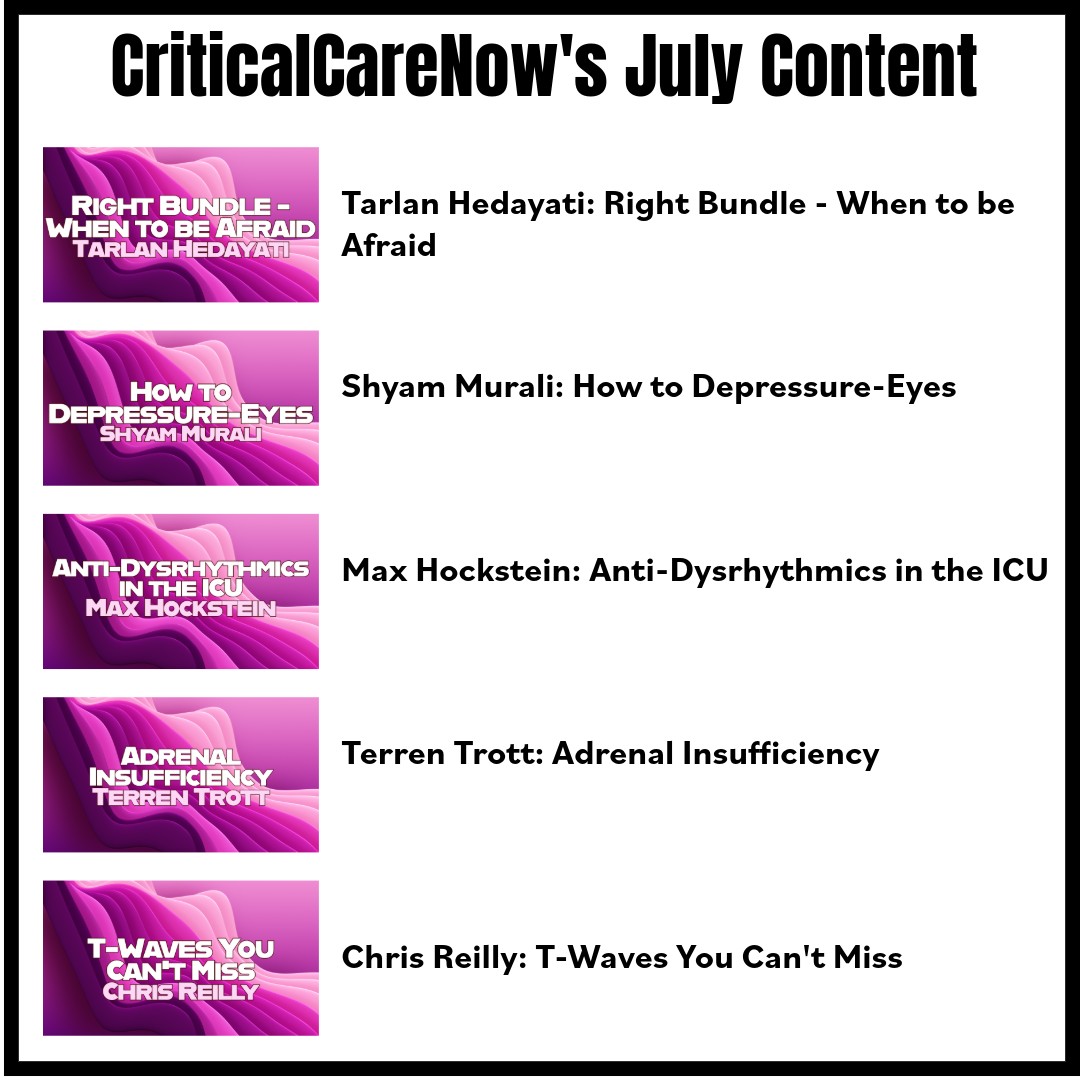
If you're an All-Access member, you're in for some great content this month. We have FIVE videos hand-picked by our staff that are high-yield and our most highly watched. We're featuring:
- Hedayati on "Right Bundle - When to be Afraid"
- Murali on "How to Depressure-Eyes"
- Hockstein on "Anti-Dysrhythmics in the ICU"
- Trott on "Adrenal Insufficiency"
- Reilly on "T-Waves You Can't Miss"
Each month we bring you fresh new content from the best of the best in resuscitation. If you're an All-Access member, go watch these videos NOW!


Responses