

Registration is Live!
Condado Beach, Puerto Rico ~ Feb 1-3, 2027
It's official. Registration for X on the Beach is open, and so is our conference room-block at the San Juan Marriott Resort & Stellaris Casino.
Three mornings of high-yield resuscitation, afternoons of CME by the beach, happy hours with faculty, a welcome reception January 31, and an after-party February 3. Up to 17.25 hours of CME, taught by Haney Mallemat, Jailyn Avila, Tarlan Hedayati, Sara Crager and George Willis!
Two things to know:
- Seats are capped at 50. It's first come, first served.
- You have 2 options to attend. Book your room through our room-block link and pay $797 for registration, or pay $1497 for registration if you choose to stay elsewhere.
Every registrant gets the same free bonuses: X on the Beach swag, limited-edition t-shirts, and lifetime access to ResusX:2025 with CME.
We can't wait to see everyone there!!

Your Hindbrain and Your Forebrain
Are Just Roommates
So here's a fact that's going to mess with you the next time you draw a brain on a whiteboard for med students: your forebrain and your brainstem might not be one organ that grew into two jobs. They might be two separate nervous systems that evolution mashed together and never bothered to merge. A team out of Stanford, led by developmental biologist Kyle Loh, went digging through week-old mouse embryos and found two totally distinct populations of brain progenitor cells, one marked by a gene called Otx2 that builds the forebrain and midbrain, the other marked by Gbx2 that builds the hindbrain. These cells don't just express different genes, they package their DNA differently too, like they're from two different offices that happen to share a building. And the same split shows up in chickens, zebrafish, and acorn worms, which puts the divergence somewhere between 550 and 700 million years ago. Jellyfish, for comparison, still keep their two nervous systems on opposite ends of their bodies, never having bothered to consolidate. We just got cheaper real estate and crammed ours into one skull.
Here's why you should actually care, beyond the fun fact at journal club: nobody could reliably grow human hindbrain neurons in a dish, which is a real problem when the hindbrain is the structure implicated in spinal muscular atrophy and ALS. Every lab kept trying to coax forebrain and midbrain progenitors into becoming hindbrain cells, and it kept not working, because according to this study that's a bit like asking a barista to also run your tax audit. Wrong starting cell, wrong lineage, no amount of coaxing fixes that. Once Loh's team, with co-author Rayyan Jokhai, figured out the hindbrain runs on its own separate progenitor pool, they became the first group to successfully turn human pluripotent stem cells into working hindbrain motor neurons. Not everyone's sold yet. Neurobiologist Alex Pollen points out it's hard to rule out that both cell types trace back to one short-lived common ancestor cell, and developmental biologist Cecilia Moens says she's personally watched cells swap fates mid-development, so "permanently separate" might be a little strong. Still, even the skeptics aren't arguing with the practical upshot: there's now a real way to grow brainstem neurons and actually study them, which is more than anyone had last year.

Why Tying Patient Care to a Paycheck
Is My Red Flag
Someone recently asked me a question I hear all the time: if you're going to take the extra time out of your shift to do interpretive point-of-care ultrasound, should you get paid more for it? My answer is simple; absolutely not. Look, if your hospital bills for it and you're compensated, great, take it. But that should never be the reason you're doing it in the first place. We do not get to make patient care contingent on reimbursement. Full stop.
Here's the thing. I pick up that probe because I know how to use it and because it makes my diagnostic picture better for that patient, not because someone's going to cut me a check. If billing isn't set up at your shop, or your hospital doesn't support it, that's not a license to skip the exam. Nothing we do at the bedside should hinge on whether or not we get paid to do it. I take the extra few minutes because it's the right call for the patient in front of me, and I'd bet most of you reading this would do exactly the same. So tell me, where do you land on this one?
Watch the full video here and leave a comment.
Don't forget to like and follow my IG, TikTok, YT, Facebook or LinkedIn accounts.


Anand Swaminathan, MD challenges traditional airway management by emphasizing that "resuscitation must precede intubation," breaking the historical dogma that airway (A) always comes before breathing (B) and circulation (C). Focusing on critically ill patients presenting with hypoxemia, hypotension, and acidosis, he highlights the physiological risks of immediate intubation and outlines actionable strategies to build safety margins. Key preparation steps include maximizing pre-oxygenation via non-invasive ventilation, upright patient positioning, performing point-of-care ultrasound (such as a RUSH exam) to uncover hidden pathologies, and aggressively targeting a higher pre-intubation MAP (>75 mmHg) using early vasopressors like push-dose epinephrine or norepinephrine.
Moving from hemodynamic stabilization to execution of the procedure, Dr. Swaminathan advocates for a rigorous, standardized approach to optimize first-pass success. This includes explicitly verbalizing a contingency plan using a "when, not if" mental framework, ensuring post-intubation sedation and analgesia are bedside before pushing paralytics, and favoring high-dose rocuronium (1.5 mg/kg) over succinylcholine to extend safe apneic time without contraindications. Finally, he champions standard geometry video laryngoscopy, the routine integration of the SALAD (Suction Assisted Laryngoscopy for Airway Decontamination) technique, and default bougie usage on every attempt, arguing that these small, incremental gains collectively prevent peri-intubation cardiac arrest and drastically improve patient outcomes.
Check out this video of Dr. Anand Swaminathan from ResusX:2026 now!

EMx Replay is Here
Did you miss EMx live? Don't sweat it....you can watch every single session on replay! Watch the complete conference fully edited, with audio remastering, indexed, and ready for you.
You have two options to choose from, 3-day access or unlimited, lifetime replay....just pick one and then press play.
CLICK HERE TO CHOOSE YOUR REPLAY


Is Faster Cooling After OHCA Actually Better?
For decades, hypothermic temperature control (HTC) after out-of-hospital cardiac arrest (OHCA) has rested on the assumption that earlier is better, since preclinical models suggest early cooling limits secondary ischemia-reperfusion injury. This systematic review and meta-analysis of 7 RCTs (3,288 patients) tested that assumption by comparing prehospital-initiated with in-hospital-initiated HTC. Prehospital cooling reached the 33°C target about 97 minutes sooner, and patients arrived at the hospital cooler (mean difference −0.76°C). That head start didn't improve outcomes. Favorable neurological recovery at discharge (OR 0.98, 95% CI 0.80–1.22) and survival to discharge (OR 0.98, 95% CI 0.83–1.17) were unchanged, and the null result held across every predefined subgroup: rhythm, EMS response time, cooling method, and intra-arrest vs. post-ROSC initiation.
Early cooling also carried real safety costs, with higher odds of recurrent cardiac arrest (OR 1.33, 95% CI 1.20–1.47) and pulmonary edema (OR 1.66, 95% CI 1.24–2.23). The harm tracked specifically with large-volume IV cold fluids (recurrent arrest OR 1.31). It did not reach significance with transnasal evaporative cooling (OR 1.41, n.s., only 2 studies), likely because that method avoids fluid loading. The primary outcomes are high-certainty evidence and the safety signals are moderate-certainty. Together they support the 2025 ERC-ESICM guidelines' stance against prehospital cooling with large-volume IV fluids. The finding argues against rushing cooling in the field with the wrong tool, not against HTC itself. Fluid-sparing approaches remain a plausible exception, and the PRINCESS 2 trial is now testing ultrafast transnasal cooling in shockable-rhythm OHCA.
My Takeaway Points:
- Finding - Prehospital-initiated HTC reached target temperature ~97 minutes faster than in-hospital initiation, but showed no significant difference in favorable neurological outcome (OR 0.98, 95% CI 0.80–1.22) or survival (OR 0.98, 95% CI 0.83–1.17).
- Practice Impact - Prehospital cooling, particularly with large-volume IV cold fluids, should be avoided; it significantly increased odds of recurrent cardiac arrest (OR 1.33) and pulmonary edema (OR 1.66) with no offsetting neurological benefit.
- Population - 3,288 adult OHCA patients across 7 RCTs, resuscitated by EMS and comatose on transport, heterogeneous initial rhythms and etiologies (traumatic arrests excluded).
- Limitation - Transnasal evaporative cooling appeared safer (no significant increase in recurrent arrest) but was supported by only 2 trials, too few to draw firm conclusions about a fluid-sparing alternative.
Want to learn more? Read the full analysis Timing of Hypothermic Temperature Control Does Not Affect Neurological Outcomes After Cardiac Arrest: A Systematic Review and Meta-Analysis by K. Csőke-Kabai, et al. in Intensive Care Medicine Experimental.
Pause Before You Push
Pre-Intubation Checklists in Rural and Community Hospitals
Picture a night shift in a small emergency department. A patient needs intubation. There are two nurses at the bedside and no respiratory therapist in the building. The medications are drawn up. The laryngoscope is ready.
But is the suction working? Who is preparing the ventilator? What happens if the first attempt fails?
This is where a pre-intubation checklist earns its place.
When RT support is limited or absent, the work they would usually help coordinate still needs to happen. Equipment preparation, oxygen delivery, capnography, and the transition to ventilation all need an owner. In a small team, it is easy for everyone to assume someone else has checked.
Here is a practical way to use the checklist on your next shift.
Name The People And Their Jobs
Identify the airway operator, medication nurse, and person watching the monitors. Say who will prepare the ventilator and read the checklist. People may need to double up. The important part is that everyone knows which jobs they own and when to call for help.
Prepare The Patient
Look beyond the airway anatomy. Review oxygenation, blood pressure, positioning, and the patient's physiology before induction. Choose a preoxygenation strategy appropriate to the patient and available resources. Address hemodynamic instability and have a plan for deterioration. A technically straightforward intubation can still be physiologically dangerous.
Check The Equipment With Your Hands
Turn the suction on. Check the bag-mask device and oxygen supply. Confirm that the laryngoscope works, the tube and appropriate introducer are ready, and rescue equipment is immediately available. Prepare waveform capnography for immediate confirmation and ongoing monitoring. If you will be managing the ventilator yourself, assemble and check it before induction whenever feasible.
Say The Backup Plan Out Loud
What will you do if the first attempt fails? How will you reoxygenate? Where is the supraglottic airway? Who can help, and how will you reach them? Confirm access to emergency front-of-neck airway equipment. A backup plan is much easier to use when the whole team has heard it before the saturation starts falling.
Plan For The Minutes After The Tube
Confirm post-intubation analgesia and sedation, with medications ready. Agree on initial ventilation, tube securement, and reassessment of oxygenation and blood pressure. These jobs need attention immediately, especially when the same small team is doing everything.
The Critical Pause
Before medications are pushed, read the checklist aloud and resolve any gaps the patient's condition allows. Ask: Is the patient optimized? Is the equipment ready? Does everyone know the plan?
Keep it brief and proportionate to urgency. A checklist should support timely airway care, never delay an immediately necessary intervention.
The Bottom Line
In a rural or community hospital, make preparation visible and give every task an owner. Keep the checklist with your airway equipment and practice using it with the team you actually work with. The best time to discover what is missing is before induction.
Review this week’s Vent pearls and download the free, printable pre-intubation checklist here.
----------
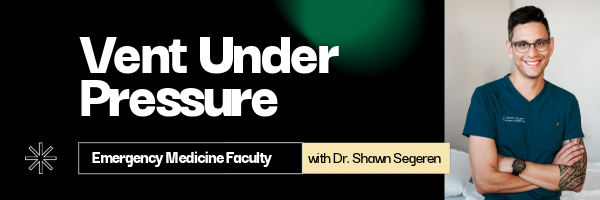
Dr. Shawn Segeren is a Canada-based Emergency Physician and founder of Dynamic Simulation. Dynamic Simulation partners with hospitals to sharpen clinicians and strengthen teams through high-stakes clinical simulation, and develops online ventilation education for emergency physicians working with limited RT & specialist backup.
Connect with Dr. Segeren: @dynamicsimulation.ca | @drsegeren (IG) | @dynamicsimeducation (IG) | linkedin.com/in/shawnsegeren
Watch the October Videos Now!
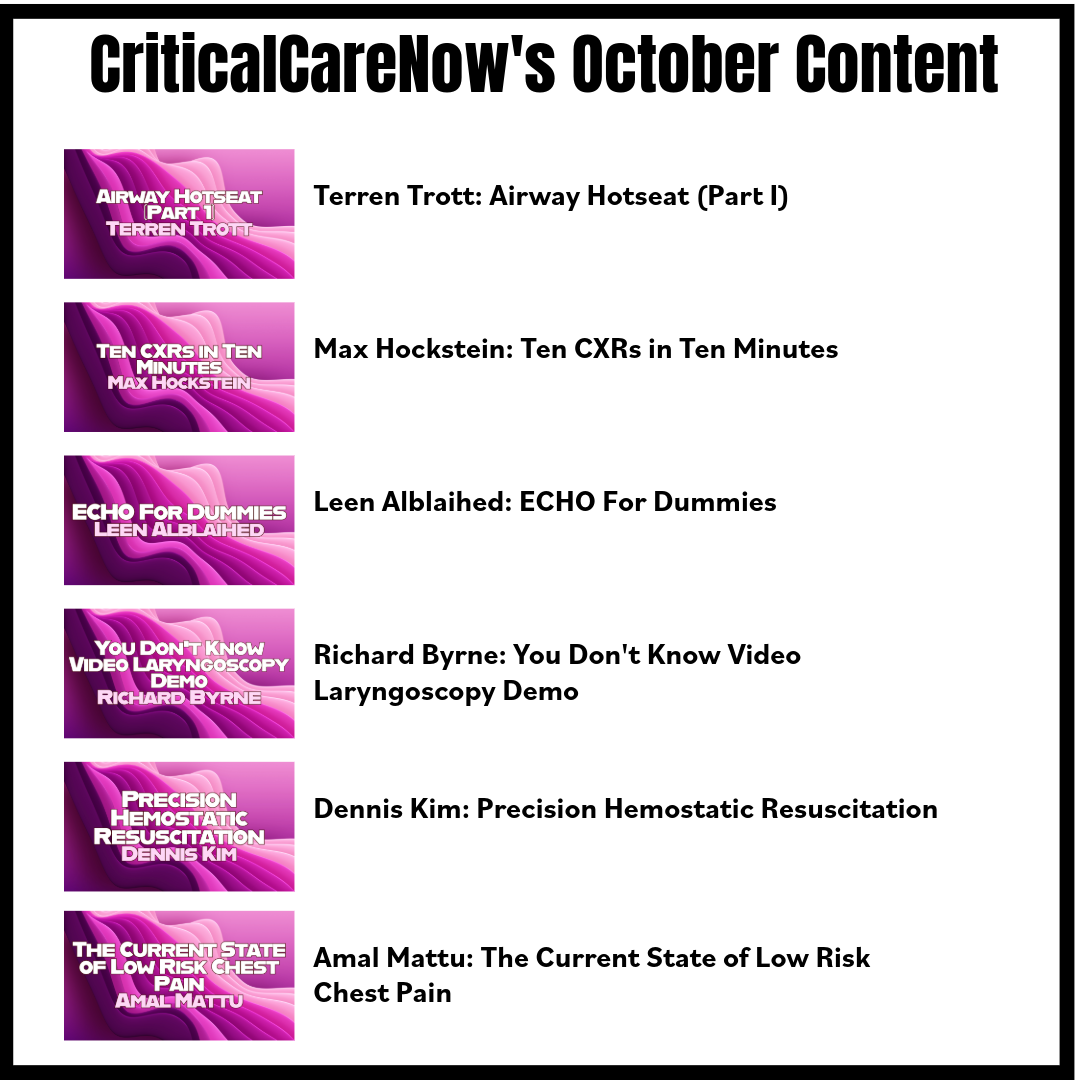
If you're a ResusNation paid Member (RN Video Pass or RN CME Pass), you're in for some great content this month. We have SIX videos hand-picked by our staff that are high-yield and our most highly watched. We're featuring:
- Trott on "Airway Hotseat (Part I)"
- Hockstein on "Ten CXRs in Ten Minutes"
- Alblaihed on "ECHO For Dummies"
- Byrne on "You Don't Know Video Laryngoscopy Demo"
- Kim on "Precision Hemostatic Resuscitation"
- Mattu on "The Current State of Low Risk Chest Pain"
Each month we bring you fresh new content from the best of the best in resuscitation. If you're a ResusNation paid Member, go watch these videos NOW!


Responses