

Registration is Live!
Condado Beach, Puerto Rico ~ Feb 1-3, 2027
It's official. Registration for X on the Beach is open, and so is our conference room-block at the San Juan Marriott Resort & Stellaris Casino.
Three mornings of high-yield resuscitation, afternoons of CME by the beach, happy hours with faculty, a welcome reception January 31, and an after-party February 3. Up to 17.25 hours of CME, taught by Haney Mallemat, Jailyn Avila, Tarlan Hedayati, Sara Crager and George Willis!
Two things to know:
- Only 7 seats left!!! It's first come, first served.
- You have 2 options to attend. Book your room through our room-block link and pay $797 for registration, or pay $1497 for registration if you choose to stay elsewhere.
Every registrant gets the same free bonuses: X on the Beach swag, limited-edition t-shirts, and lifetime access to ResusX:2025 with CME.
We can't wait to see everyone there!!
Your Hospital's Worst Roommate Is Terrible With Money
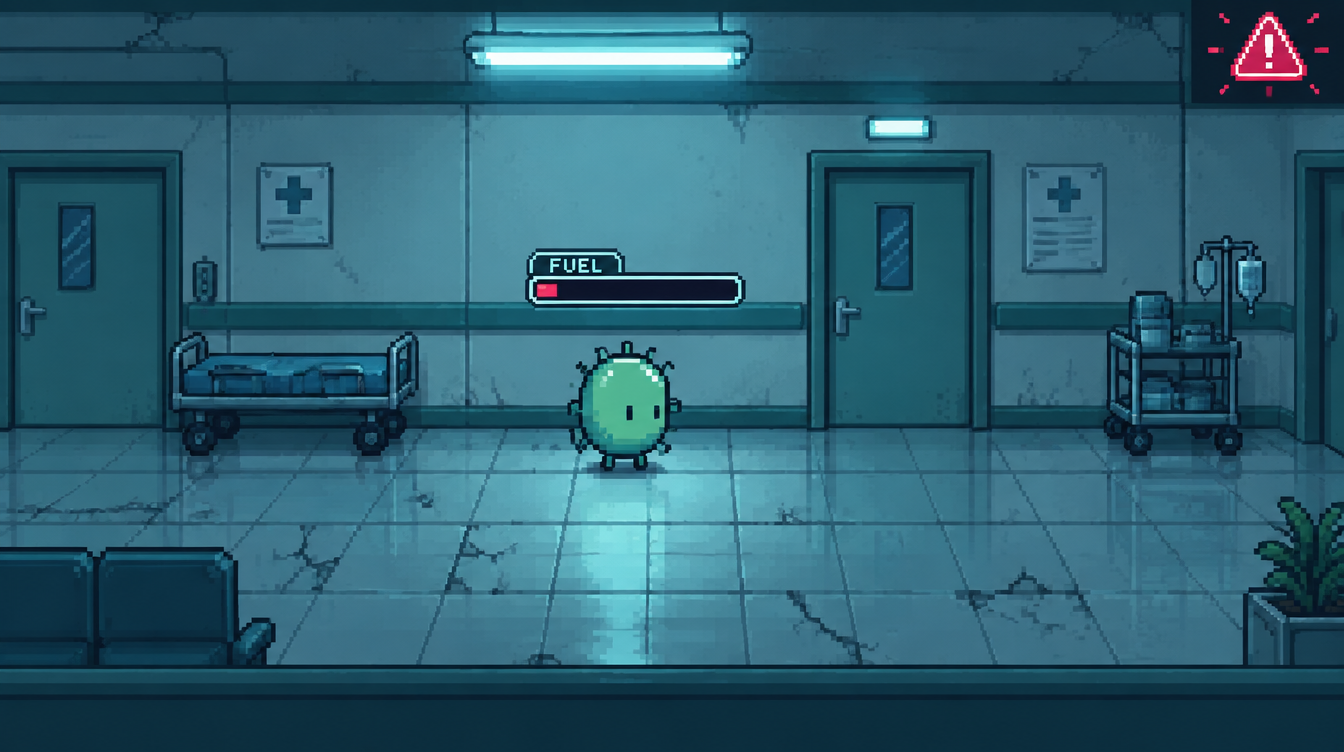
A spore is basically a bacterium that decided to become a seed. It shrinks down, wraps itself in protein armor, shuts off every chemical process it can live without, and goes to sleep for however long it takes. That dormant form can shrug off boiling water, desiccation, radiation, and the actual vacuum of space. It's also how Clostridioides difficile gets around a hospital ward; not by being fast or clever, just by being nearly indestructible while everyone's back is turned. The catch, according to a new energy accounting published in PNAS by Christopher Kempes and colleagues Jay Lennon and William Shoemaker, is that none of this comes cheap. Building a spore means paying out for every step: copying DNA, transcribing genes, assembling proteins, constructing a new membrane, all while giving up the chance to reproduce while the neighbors keep dividing. The researchers put a dollar figure on that whole process, and a second one on what it costs to come back from it.
That second bill is where things get interesting. A dormant spore wakes up holding almost no usable fuel, something like five orders of magnitude short of what it needs to finish the job on its own. It genuinely cannot restart from savings alone; it needs outside nutrients to close the gap. And the accounting shows exactly where that gap bites hardest; not at germination, the moment everyone pictures as the dramatic "waking up," but at the outgrowth stage right after, which eats up 88% of the entire revival budget. That's also probably why spore-forming genes don't survive long in bacteria that stop needing them. The genes still have to be copied every time the cell divides, so if a lab strain never has to dry out and wait a decade in the dirt, evolution quietly deletes the subscription within a few thousand generations. Bigger cells recoup the cost of building a spore faster than small ones do, which is a tidy explanation for why dormancy favors size, and which also implies there should be some bacterium too small to ever make spore-forming worth it. Nobody's gone looking for it yet.

5 Night Shift Tips I Wish I Knew Sooner
Night shift work is a reality for anyone in our field. Someone has to staff the hospital, but it comes with real physiologic costs if you don't manage it deliberately. I've put together my top 5 strategies that actually move the needle. First, wear true blackout wraparound sunglasses on your drive home, not your regular shades. Any UV hitting your retina resets your circadian rhythm and suppresses melatonin, undoing everything you're about to do to prepare for sleep. Second, skip the post-shift breakfast or drinks and go straight home. FOMO isn't worth the hit to your sleep routine. Third, engineer your sleep environment. Shoot for blackout shades, quality earplugs, an eye mask, white noise, and a room set to roughly 68°F (temperature matters more than people realize).
Once you're in that environment, the phone and tablet stay off. Blue light suppresses melatonin just as effectively as sunlight. If you absolutely must get online, blue-light-filtering glasses are a reasonable (if imperfect) workaround. Finally, tell your household you're sleeping; not optional. Everyone under your roof needs to know to stay quiet and leave you alone unless it's a true emergency. None of this is comprehensive, but these 5 habits are where I'd start if night shifts are wrecking your recovery.
Watch the full video here and leave a comment.
Don't forget to like and follow my IG, TikTok, YT, Facebook or LinkedIn accounts.

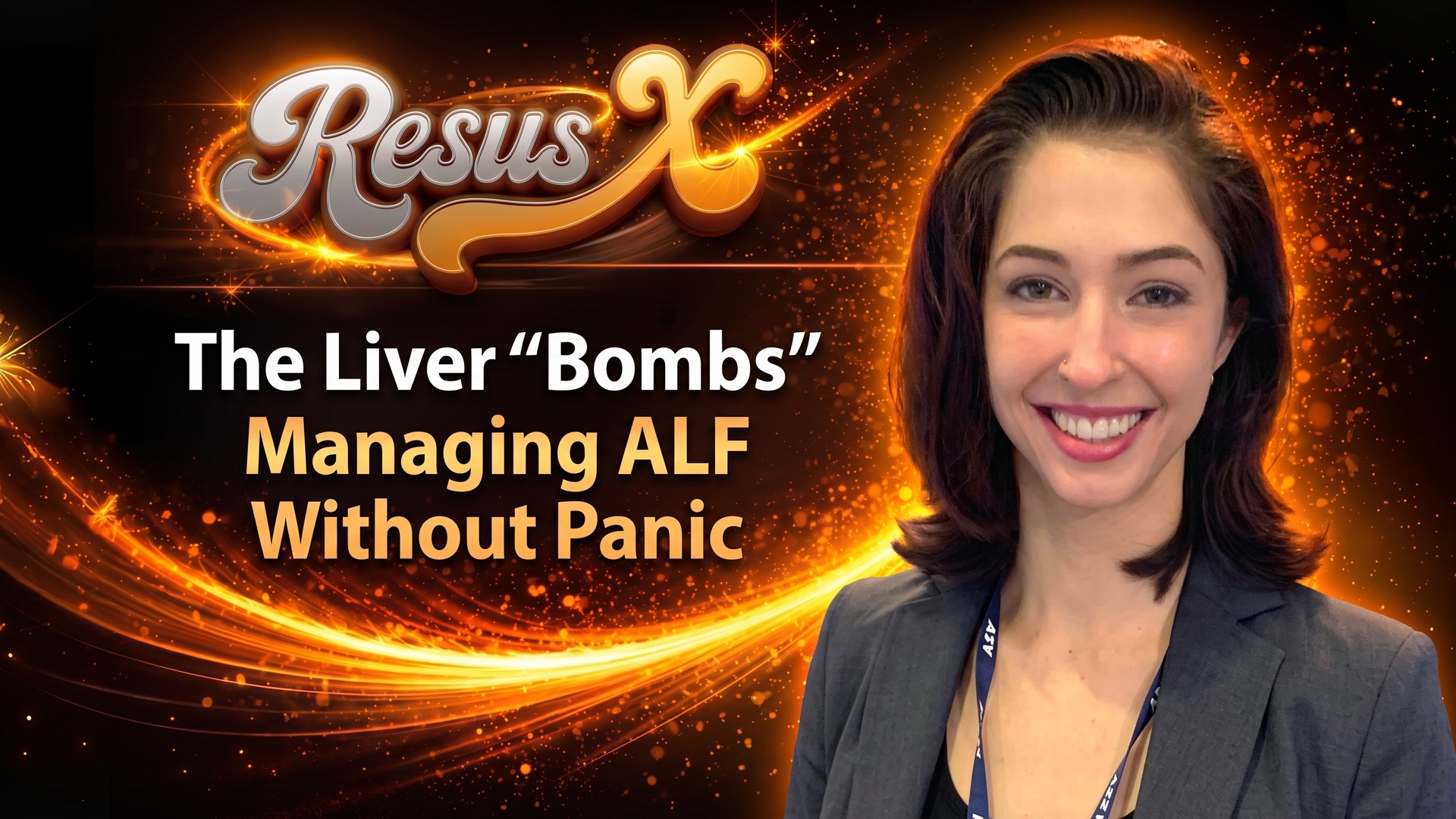
Acute liver failure, often referred to as a “liver bomb,” is a high-mortality critical condition occurring in patients without prior liver disease. It is defined by coagulopathy alongside hepatic encephalopathy, and mimics septic shock with low systemic vascular resistance and high cardiac output. However, it carries a rapid risk of death due to cerebral edema, multisystem organ collapse, and simultaneous bleeding and clotting. Nathalie van der Rijst, MD stresses that early recognition through physical exam findings like suboral mucosa jaundice and asterixis, coupled with immediate diagnostic workups (e.g. point-of-care ultrasound to rule out vascular causes like Budd-Chiari syndrome or right ventricular failure), is critical to initiating resuscitation before irreversible brain herniation occurs.
She explains that emergency management requires balancing five simultaneous crises: 1) traumatic brain injury, 2) septic shock, 3) DIC, 4) metabolic collapse, and 4) acute kidney injury. Intubation should be performed early for airway control and intracranial pressure management, while high ammonia levels are best managed via CRRT rather than relying on lactulose. Crucially, the INR is a prognostic marker rather than a bleeding metric, meaning routine plasma administration should be avoided to prevent volume overload. Because definitive survival depends on emergency liver transplantation, early initiation of N-acetylcysteine (NAC), aggressive hypoglycemia prevention with IV dextrose, and rapid transfer to a transplant center serve as the primary pillars of care.
Check out this video of Dr. Nathalie van der Rijst from ResusX:2026 now!

EMx Replay is Here
Did you miss EMx live? Don't sweat it....you can watch every single session on replay! Watch the complete conference fully edited, with audio remastering, indexed, and ready for you.
You have two options to choose from, 3-day access or unlimited, lifetime replay....just pick one and then press play.
CLICK HERE TO CHOOSE YOUR REPLAY


Is Kratom Use Behind Unexplained ALI?
Kratom use, including increasingly potent concentrated 7-hydroxymitragynine products, has risen steadily, but its pulmonary toxicity has never been systematically mapped. This review pooled 24 reports (14 clinical, 10 forensic) from 2011 to 2026 and proposed a two-tier phenotype framework. Tier A covers primary pulmonary syndromes in which the lung is the apparent target organ. This includes diffuse alveolar hemorrhage (n=3), ARDS/diffuse acute lung injury (n=3), and eosinophilic/hypersensitivity pneumonitis (n=2), all seen only in clinical patients, and all survived. Tier B covers secondary consequences of systemic toxicity such as opioid-type central respiratory depression (n=6), driven by mitragynine and 7-hydroxymitragynine acting as mu-opioid partial agonists, and postmortem pulmonary edema/congestion (n=10), found in every forensic case. Single-drug fatalities clustered at higher mitragynine concentrations (2,325-7,500 ng/mL) than polysubstance deaths, which is consistent with, but not proof of, additive toxicity lowering the lethal threshold. Causal attribution was Probable in 9 reports, Possible in 13, and Unlikely in 2; none reached "Certain" because rechallenge data were nearly absent (one eosinophilic pneumonitis case with positive rechallenge was the strongest causal signal).
This is a hypothesis-generating framework built on case-level, publication-biased evidence, not an established taxonomy. Still, it gives clinicians a practical reason to ask specifically about kratom and 7-hydroxymitragynine in unexplained acute lung injury, alveolar hemorrhage, eosinophilic pneumonitis, or opioid-type respiratory depression. Especially since these exposures are missed by routine immunoassay screens and require targeted liquid chromatography-mass spectrometry (LC-MS). Standard competing diagnoses (infection, autoimmune disease, cardiogenic edema, aspiration) must still be excluded first.
My Takeaway Points:
- Finding - All 10 forensic kratom-associated deaths showed pulmonary edema/congestion at autopsy; all 14 clinical cases (spanning 3 distinct primary lung injury phenotypes plus respiratory depression) survived.
- Practice Impact - Consider kratom/7-hydroxymitragynine in the differential for unexplained ARDS, diffuse alveolar hemorrhage, eosinophilic pneumonitis, or opioid-type respiratory depression; order targeted LC-MS, since routine immunoassay screens won't catch it.
- Population - Single-patient reports skewed young-to-middle-aged (median 32, range 17–69) and male (68%); polysubstance exposure was common (15 of 24 reports).
- Limitation - Evidence base is entirely case reports, conference abstracts, and forensic series with no comparison groups; strong publication bias toward severe/fatal presentations, and causality grading (Naranjo/WHO-UMC) wasn't validated for this setting.
Want to learn more? Read the full review Kratom-Associated Pulmonary Toxicity: A Systematic Review of Case Reports and Forensic Series with a Proposed Clinical Phenotype by V. Kanchustambham, et al. in Journal of Medical Toxicology.
What Is The Rise Time?
Physiology & Bedside Application
Rise time determines how quickly airway pressure increases from baseline PEEP to the targeted inspiratory pressure. In pressure modes, both NIPPV and IMV, the rate of pressurization influences early inspiratory flow and how effectively the ventilator meets the patient’s inspiratory demand.
Why Does Rise Time Matter?
When a patient initiates inspiration, respiratory muscle contraction generates a pressure gradient that drives airflow. If rise time is too slow, airway pressure increases gradually, potentially failing to meet inspiratory flow demand. The patient continues generating effort despite receiving ventilatory assistance. This may produce increased work of breathing, air hunger, tachypnea, and a concave pressure-time waveform.
If rise time is too fast, rapid pressurization generates excessive early inspiratory flow, potentially causing pressure overshoot, discomfort, coughing, or worsening synchrony. The goal is not necessarily to deliver flow faster. The goal is to match ventilator flow delivery to the patient’s inspiratory demand.
Rise Time in NIV
During NIV, pressure must be transmitted through the circuit and interface before generating effective inspiratory assistance. In patients with COPD and high inspiratory demand, faster pressurization may reduce inspiratory muscle effort. In restrictive disease or neuromuscular weakness, more gradual pressurization may improve comfort. Mask leaks and helmet compliance can alter pressure transmission, making waveform assessment particularly important.
Rise Time in Invasive Ventilation
Rise time is most relevant in pressure control and pressure support ventilation. A faster rise time may improve synchrony when inspiratory flow demand is high. A slower rise time may help when rapid pressurization produces pressure overshoot or discomfort. In volume control, inspiratory flow delivery and flow acceleration are the more relevant variables.
Applying This at the Bedside
-
Evaluate the pressure and flow waveforms.
-
Identify whether delivered flow meets inspiratory demand.
-
Assess respiratory effort, comfort, and synchrony.
-
Adjust rise time incrementally and reassess.
-
Evaluate triggering, cycling, pressure support, and leaks before attributing all abnormalities to rise time.
The Takeaway
Rise time is fundamentally about matching the rate of ventilator pressurization to the patient’s inspiratory demand. Too slow, and the patient continues doing unnecessary work. Too fast, and the ventilator may create discomfort or asynchrony. There is no universally optimal setting. Respiratory mechanics, inspiratory effort, and waveform morphology should guide adjustment.
Review this week's pearls on IG.
----------
Dr. Nicholas Ghionni is a Pulmonary and Critical Care physician, nationally recognized vent educator, and host of The Peak Inspiration Podcast. He teaches a year-long ventilation preceptorship, focusing on respiratory physiology, ventilator mechanics, and waveform interpretation. Dr. Ghionni is passionate about translating complex mechanical ventilation concepts into practical bedside education for clinicians at all levels.
Connect with Dr. Ghionni: @pulmtoilet IG / YT / Spotify / Apple / Patreon
Watch the October Videos Now!
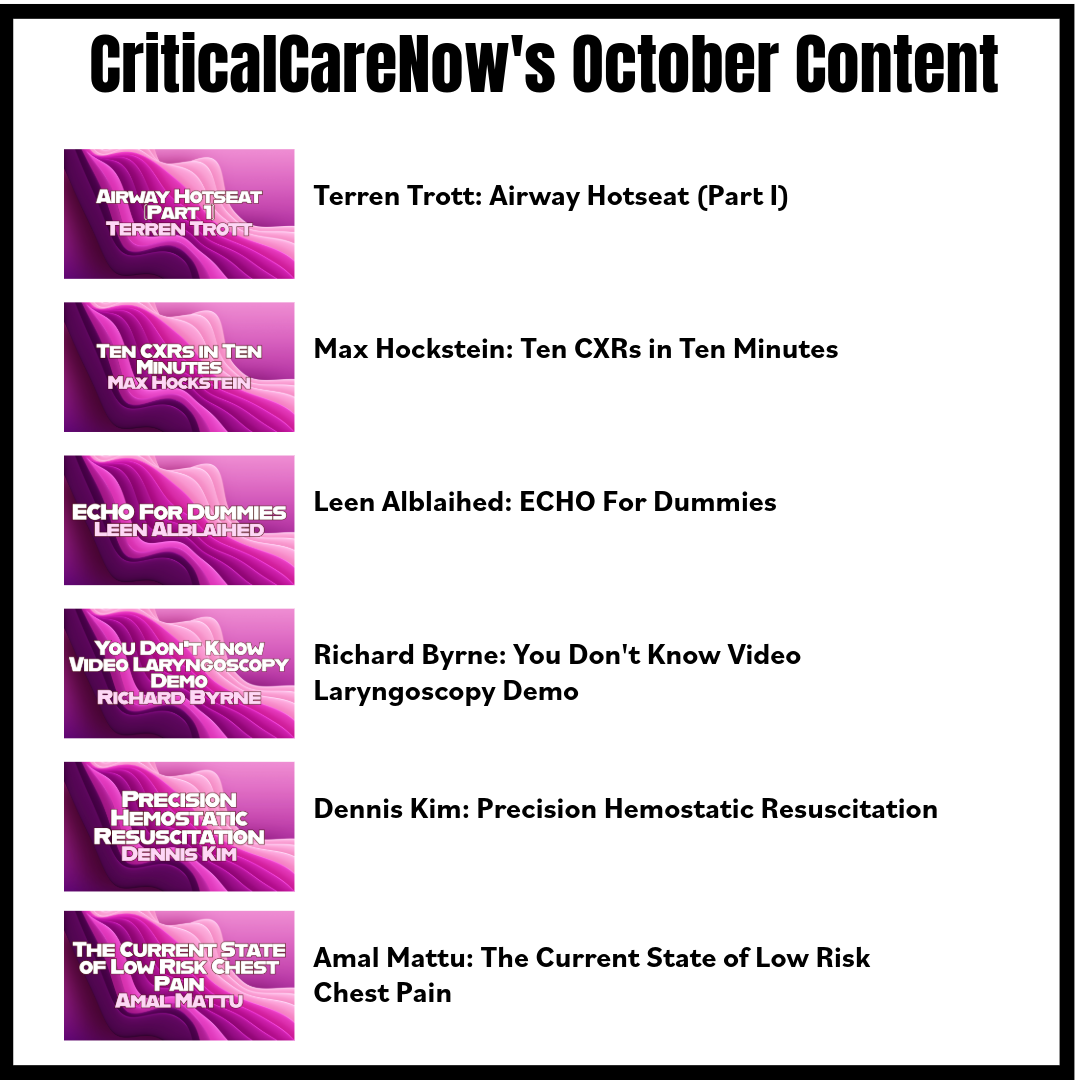
If you're a ResusNation paid Member (RN Video Pass or RN CME Pass), you're in for some great content this month. We have SIX videos hand-picked by our staff that are high-yield and our most highly watched. We're featuring:
- Trott on "Airway Hotseat (Part I)"
- Hockstein on "Ten CXRs in Ten Minutes"
- Alblaihed on "ECHO For Dummies"
- Byrne on "You Don't Know Video Laryngoscopy Demo"
- Kim on "Precision Hemostatic Resuscitation"
- Mattu on "The Current State of Low Risk Chest Pain"
Each month we bring you fresh new content from the best of the best in resuscitation. If you're a ResusNation paid Member, go watch these videos NOW!


Responses