

Welcome To The ResusNation CME Pass Membership
Membership Includes:
✔️ Monthly ResusX:Rounds – Attend live and access the full replay library
✔️ The Debrief: Live – Twice monthly to discuss cases, questions, or whatever's on your mind
✔️ Exclusive Videos – 6 resuscitation-focused videos each month
✔️ Chawk Tawks Library – On-demand whiteboard teaching
✔️ QuickCrits – Daily resuscitation tips and tricks emailed to you
✔️ Weekly Article Review – Summaries of cutting-edge articles, broken down, reviewed, and delivered to your inbox
✔️ Case Simulator – Hand-picked weekly scenarios; guide real-time resuscitations by talking directly to your patient and care team
✔️ AI Journal Club MC – Discuss the article of the week with our interactive AI moderator; just like being in a live journal club
Already a ResusNation Basic or Plus Member? DO NOT use the link above, check your inbox for more details on how to upgrade your membership.
EMx is LIVE Next Week!
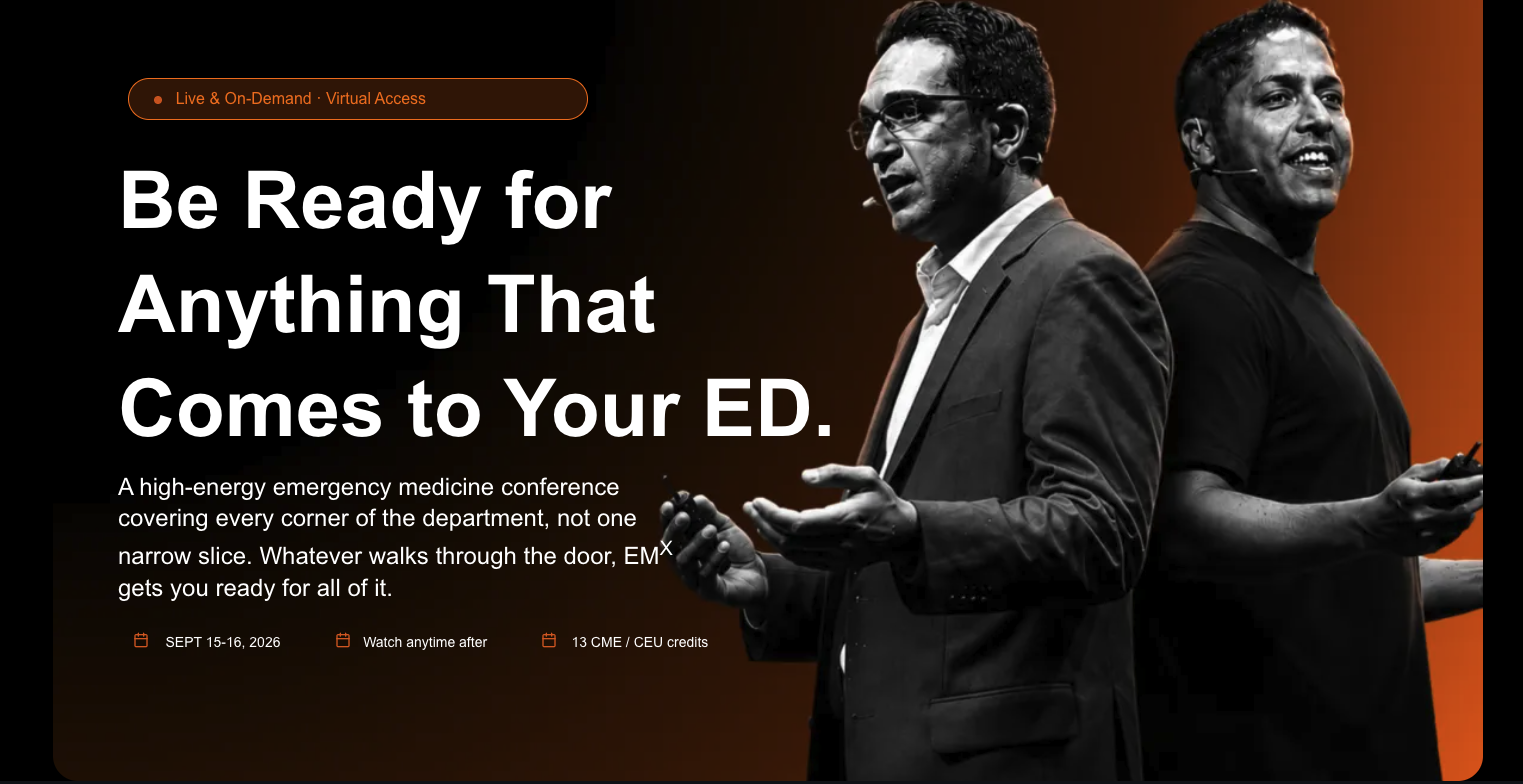
EMX is a new emergency medicine conference I'm co-hosting with Dr. Anand Swaminathan — built for clinicians who want the whole emergency department sharpened, not just one narrow slice. Cardiology, stroke, peds, tox, endocrine, OB, MSK, airway — whatever walks through your door, EMX gets you ready for all of it.
For our inaugural meeting, EMX will be held virtually — so no matter where you practice, you can be there. Everything else you'd expect from a world-class conference? Still here.
And this isn't your standard lecture marathon. We're talking talk-show interviews, live media reads, real expert debates, audience polling — and our signature 🔥 Hot Ones segment. You'll be locked in from the first slot to the last.
The faculty lineup includes Amal Mattu, Reuben Strayer, Evie Marcolini, Tarlan Hedayati, Jenny Beck-Esmay, and more of the clinicians who actually shape how emergency medicine is practiced.
📅 September 15–16, 2026 | Virtual / Online
📍 ✅ 9.5 CME/CEU Credits
Want to add a full afternoon with Amal Mattu + 3.5 CME/CEU credits? Grab a virtual seat at the ECG Pre-Conference Workshop on September 14 — limited to 50 people.

The 3-Foot Humans Who Hunted Pygmy Elephants
Imagine that you're a large bodied Homo erectus who washes up on the Indonesian island of Flores about a million years ago. You look around, see giant Komodo dragons, no Wi-Fi, and painfully limited food, and your DNA decides the answer is to shrink. That's Homo floresiensis, nicknamed the "Hobbits," who spent a few hundred thousand years shrinking through island dwarfism until they topped out around 3.5 feet tall, with a brain roughly the size of a grapefruit. A 700,000 year old miniature arm bone and some tiny teeth found in 2024 show they actually started shrinking much earlier than researchers had assumed. Sometimes the winning survival move isn't getting bigger and stronger, it's cutting your caloric needs so you don't starve while dodging giant prehistoric rats.
Being 3 feet tall wasn't a quirky look. It was a genuine Stone Age survival problem. Despite a brain that would make a modern neurologist wince, these small hominins made stone tools, used fire, and hunted in groups to take down pygmy elephants, all while sharing their island with 10 foot crocodiles. They held on for hundreds of thousands of years, then vanished from the fossil record around 50,000 years ago. The leading theories are a severe drought or the arrival of Homo sapiens, who may have simply outcompeted them for the same caves and food. They survived actual dragons, but they couldn't survive us.

ResusX Goes To Puerto Rico!
Condado Beach, Puerto Rico ~ Feb 1-3, 2027
Get your spot now for a CME getaway that is like no other conference that you've ever attended. X on the Beach takes the best parts of ResusX but makes it more intimate and interactive. On February 1-3 we are taking a group of only 50 people to Puerto Rico for three days of conference, socializing and fun in the sun. Join Haney Mallemat, Jailyn Avila, Tarlan Hedayati, George Willis, Sara Crager and more for this unique vacation getaway. CME and CEUs will be offered. There's only 50 tickets available and it's first come, first serve so if you are interested in attending secure your spot now. Once we sell out, that's it.
✅ Full CME included
✅ Beachfront resort setting
✅ Limited spots — this won't be a big-arena crowd
There are still some spots available. If you want in, tell us in 30 seconds by clicking below:
I'm interested - SAVE MY SPOT!
When the interest form closes, you'll receive a follow up email with additional details on how to register.

Stop Giving 2L In Elevated Lactate
If your patient's lactate is elevated, the first thing you should reach for isn't a bag of crystalloid. I know this one will draw comments, but hear me out: an elevated lactate is telling you something. It just isn't always telling you the patient is hypoperfused. We make lactate every single day. It's part of normal metabolism. The reason our lactates aren't elevated is that we clear it, mostly through the liver, with some help from the kidneys and skeletal muscle.
So question one is a clearance question. Is this patient making a normal amount of lactate, or slightly more, and simply not clearing it? If clearance looks intact, move to question two: why is the lactate up? Type A is anaerobic metabolism: hypoxemia, poor tissue perfusion, cyanide, carbon monoxide, anything that keeps the cell from using oxygen. Type B involves triggers such as by albuterol, epinephrine, certain leukemias and cancers, and some alcohols. Always ask yourself those 2 questions, in order, before giving 2 liters.
Watch the full video here and leave a comment.
Don't forget to like and follow my IG, TikTok, YT, Facebook or LinkedIn accounts.

A Video Gift From Haney
Four talks from the ResusX:2025 stage are now free. Steven Haywood takes apart pre-oxygenation, which feels routine right up until the patient crashes on induction. Amal Mattu walks through STEMI mimics, the ones that don't announce themselves and that the machine happily reads as normal. Shaila Quazi makes pacemaker rhythms readable in real time, so you're not calling cardiology at 3am to ask what you're looking at. And George Willis covers modern DKA management, including the parts that quietly moved on after your residency.
No charge, no credit card. Go to the link below and get access to your videos; they arrive instantly! That's it, nothing else gets sent to you. Watch them in any order, at your own pace, whenever or wherever you like! These are yours for life!

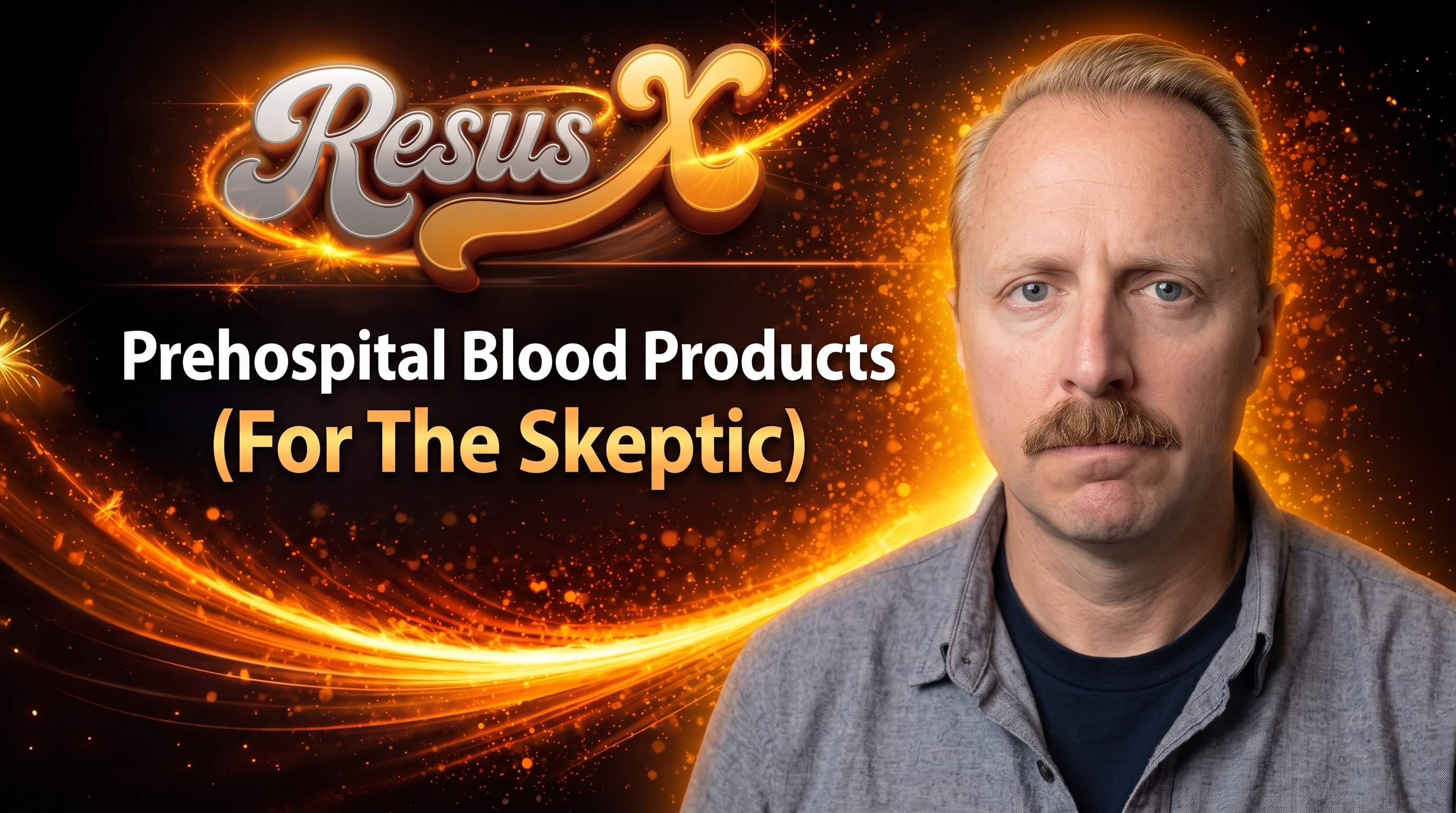
In this deep dive, Mike Carunchio, FP-C exposes the flawed studies and political roadblocks preventing EMS from using life-saving blood products in hemorrhagic shock. Prehospital blood products are becoming widespread and represent a significant advancement in emergency care. However, politics, ego, and profit sometimes interfere with implementation. Some EMS systems, air medical programs, and trauma centers have restricted access to prehospital blood based on competitive concerns rather than patient care considerations. Despite skepticism about cost and wastage, successful programs use regionalization rather than placing blood on every vehicle (specialized blood units rendezvous with responding ambulances en route to hospitals), and buyback agreements with blood banks keep wastage rates at or below the hospital average of 1-5%. Studies show dramatic results, with the New Orleans trial demonstrating double-digit mortality improvements and blood administration 12 minutes faster than in-hospital care.
Critics cite UK studies (RePHILL and SWIFT) showing minimal benefit from prehospital blood products, but these studies have significant methodological flaws. The RePHILL study was underpowered due to early termination, mixed crystalloid use in the blood product group, and had scene times averaging 26 minutes before blood administration. The SWIFT study reported high mortality and transfusion-related adverse events, but most deaths occurred days later in hospitals from non-hemorrhagic causes, and "adverse events" were broadly defined to include unrelated complications up to 14 days post-transfusion. Both UK studies featured extremely long scene times (26-38 minutes) that likely undermined any potential benefit. When implemented properly with appropriate quality assurance, blood bank partnerships, and strategic regionalization, prehospital blood products demonstrably save lives.
Check out this video of Mike Carunchio, FP-C from ResusX:2026 now!


Does NS Slow Down DKA?
Every ED and ICU runs the same reflex in diabetic ketoacidosis: hang saline, start insulin, watch the gap close. The physiologic argument against that reflex has been around for years; 0.9% saline carries 154 mmol/L of chloride, well above plasma, and large volumes reliably produce a hyperchloremic, non-anion-gap acidosis that can mask the very recovery you're trying to measure. This systematic review and meta-analysis pooled 11 randomized trials published between 2011 and 2025, spanning adult and pediatric DKA across seven countries, to ask whether swapping to a balanced crystalloid actually gets patients out of DKA faster. It doesn't, at least not measurably. Across six RCTs and 491 patients, balanced crystalloids shortened time to DKA resolution by a mean of 1.50 hours, but the confidence interval crossed zero (95% CI −3.79 to 0.79; p=0.15), with moderate heterogeneity (I² = 36.2%). The prediction interval is the number worth sitting with: −5.44 to 2.44 hours, meaning the next trial could plausibly show either a five-hour benefit or a two-hour harm.
The biochemical signal, by contrast, was clean and consistent. Serum bicarbonate at 12 hours rose 2.50 mmol/L higher with balanced fluids (95% CI 1.51 to 3.48; p=0.004) with zero heterogeneity across trials; exactly what you'd predict from the lower chloride load and the buffer precursors, and exactly the finding that can fool you into thinking the patient is doing better than they are. Hypokalemia trended lower with balanced fluids (OR 0.49; 95% CI 0.23–1.02; p=0.057), which makes physiologic sense given saline's potassium-free, chloride-rich composition. AKI, ICU admission, and hospital length of stay all showed no difference. Nothing here forces a protocol change: GRADE certainty was low for the primary outcome and moderate for bicarbonate, and most trials were open-label with baseline imbalances in chloride and strong ion difference. If you already reach for LR or Plasma-Lyte, keep doing it; there's no signal of harm and a plausible electrolyte advantage in patients getting large volumes. If you use saline, you aren't hurting anyone either. What should change is your interpretation of the bicarbonate trend, not your fluid choice. A rising bicarb on balanced fluids partly reflects the fluid, not the ketosis.
My Takeaway Points:
- Finding - Balanced crystalloids did not significantly shorten time to DKA resolution (MD −1.50 hours; 95% CI −3.79 to 0.79; p=0.15; 6 RCTs, n=491), despite a significantly greater 12-hour bicarbonate rise (+2.50 mmol/L; 95% CI 1.51–3.48; p=0.004).
- Practice Impact - Fluid choice stays a judgment call, but stop reading a faster bicarbonate correction on balanced fluids as proof of faster ketoacidosis resolution. It reflects strong ion difference, not metabolic recovery.
- Population - 11 RCTs, adults and children with DKA in ED and ICU settings; three of five primary-outcome studies were pediatric. Interventions included Ringer's lactate, Plasma-Lyte, and Hartmann's solution.
- Limitation - GRADE certainty was low for the primary outcome. DKA resolution was defined differently in nearly every trial, most were open-label, one cluster trial had 40% protocol compliance, and the prediction interval (−5.44 to 2.44 hours) includes both benefit and harm.
Want to learn more? Read the full analysis Balanced Crystalloids Versus Normal Saline for Initial Fluid Resuscitation in Diabetic Ketoacidosis: A Systemic Review and Meta-Analysis of Randomized Controlled Trials by K. Ahmed Reda Soliman, et al. in the Journal of Critical Care Medicine.
Does High-Flow Nasal Cannula Actually Provide PEEP?
High-flow nasal cannula (HFNC) is frequently described as providing approximately 1 cm H₂O of PEEP for every 10 L/min of flow. Following this logic, 60 L/min of HFNC would provide roughly 6 cm H₂O of PEEP. While convenient, this relationship oversimplifies the physiology.
HFNC does generate positive airway pressure, and increasing flow generally increases that pressure. However, unlike CPAP or mechanical ventilation, HFNC is an open system. There is no expiratory valve maintaining a predetermined pressure and no sealed interface preventing leak. The clinician controls flow, not pressure. The resulting airway pressure is therefore an effect of flow interacting with the patient's airway rather than a directly controlled variable.
Parke et al. demonstrated this relationship by measuring nasopharyngeal pressure during HFNC. With the mouth closed, mean airway pressure increased from 1.93 cm H₂O at 30 L/min to 3.31 cm H₂O at 50 L/min. Opening the mouth substantially reduced this pressure, demonstrating the importance of leak (Parke et al., 2011). More recent measurements of pharyngeal and tracheal pressure similarly demonstrate increasing airway pressure as HFNC flow increases, but considerable variability based on mouth position and other patient factors (Villalba et al., 2024).
This is why assigning a specific PEEP to a specific HFNC flow is problematic. The pressure generated depends on flow, mouth position, cannula-to-nares relationship, airway anatomy, and leak. Two patients receiving 60 L/min may therefore experience very different airway pressures.
More importantly, positive airway pressure is only one mechanism through which HFNC works. High flow washes expired gas from the upper airway, reducing nasopharyngeal dead-space rebreathing. It can better meet a patient's inspiratory flow demand, reducing entrainment of room air and improving the stability of delivered FiO₂. Heated humidification may improve comfort and airway function. Together, these mechanisms can reduce respiratory effort and improve gas exchange independent of any PEEP effect (Dysart et al., 2009; Spoletini et al., 2015).
This distinction becomes particularly important when we increase HFNC from 40 to 60 L/min. The patient may improve partly because airway pressure increased, but higher flow also increases dead-space washout and may better match inspiratory demand. We should therefore be cautious about attributing the response entirely to “more PEEP.”
Review this week's pearls on IG.
----------
Dr. Nicholas Ghionni is a Pulmonary and Critical Care physician, nationally recognized vent educator, and host of The Peak Inspiration Podcast. He teaches a year-long ventilation preceptorship, focusing on respiratory physiology, ventilator mechanics, and waveform interpretation. Dr. Ghionni is passionate about translating complex mechanical ventilation concepts into practical bedside education for clinicians at all levels.
Connect with Dr. Ghionni: @pulmtoilet IG / YT / Spotify / Apple / Patreon
Watch the September Videos Now!
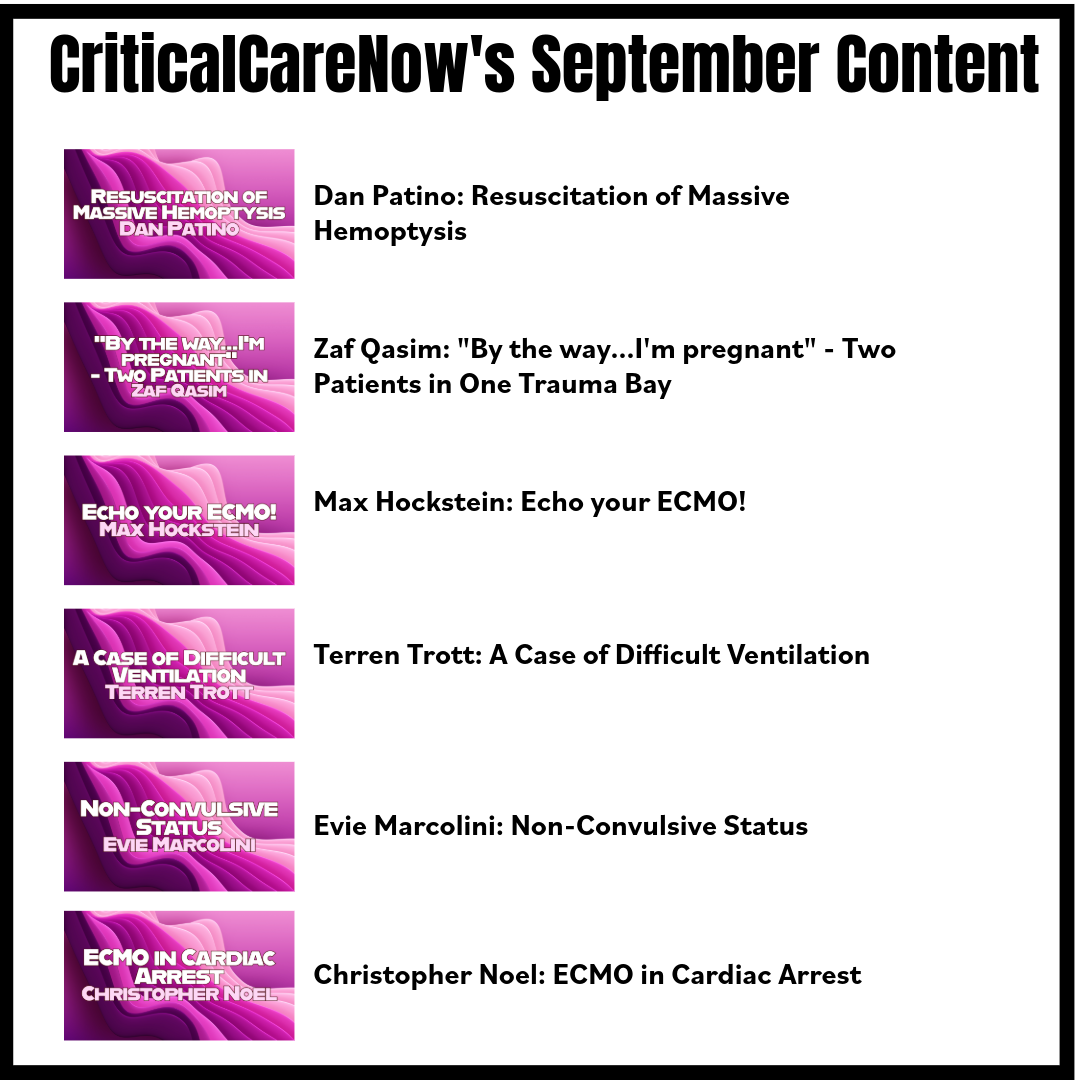
If you're a ResusNation paid member, you're in for some great content this month. We have SIX videos hand-picked by our staff that are high-yield and our most highly watched. We're featuring:
- Patino on "Resuscitation of Massive Hemoptysis"
- Qasim on "By the way...I'm pregnant" - Two Patients in One Trauma Bay"
- Hockstein on "Echo your ECMO!"
- Trott on "A Case of Difficult Ventilation"
- Marcolini on "Non-Convulsive Status"
- Noel on "ECMO in Cardiac Arrest"
Each month we bring you fresh new content from the best of the best in resuscitation. If you're a ResusNation paid member, go watch these videos NOW!


Responses