
A Welcome From Haney
(Click image below to play video)


Get Ready For a New EM
Conference in Fall 2026
EMX is a brand-new emergency medicine conference I'm co-hosting with Dr. Anand Swaminathan — built for clinicians who want the whole emergency department sharpened, not just one narrow slice. Cardiology, stroke, peds, tox, endocrine, OB, MSK, airway — whatever walks through your door, EMX gets you ready for all of it.
For our inaugural meeting, EMX will be held virtually — so no matter where you practice, you can be there. Everything else you'd expect from a world-class conference? Still here.
And this isn't your standard lecture marathon. We're talking talk-show interviews, live media reads, real expert debates, audience polling — and our signature 🔥 Hot Ones segment. You'll be locked in from the first slot to the last.
The faculty lineup includes Amal Mattu, Reuben Strayer, Evie Marcolini, Tarlan Hedayati, Jenny Beck-Esmay, and more of the clinicians who actually shape how emergency medicine is practiced.
📅 September 15–16, 2026 | Virtual / Online
📍 ✅ 9.5 CME/CEU Credits
Want to add a full afternoon with Amal Mattu + 3.5 CME/CEU credits? Grab a virtual seat at the ECG Pre-Conference Workshop on September 14 — limited to 50 people.

Cabbage Causes Nightmares?
It's the end of a 14-hour shift, someone has just explained why they're treating their UTI with essential oils, and you're starting to suspect human intellect peaked sometime before the Renaissance. Katherine Harvey's new book, The Medieval Guide to Healthy Living, will not help with that suspicion. Fourteenth-century peasants turn out to have had a firmer grip on preventative medicine than half your census. We picture the Middle Ages as a mud-covered nightmare where everyone rubbed dirt in their wounds and waited for the plague. But, they were actually obsessed with wellness centuries before anyone in LA figured out how to monetize it: washing regularly, taking care of their teeth, guarding their mental health, and trying to balance the environmental factors they called the "non-naturals." Digestion was understood as a three-stage internal furnace (part cooking, part distillation, part combustion), and people adjusted their daily routines to keep their humors from collapsing.
The dietary rules are where it gets really good. Food was sorted on a matrix of hot/cold and wet/dry, which determined what it did to your GI tract. Cabbage was hazardous material, blamed for severe melancholy and night terrors. Lettuce was too cold and moist to be safe. Turnips and parsnips were restricted because they caused catastrophic flatulence and unbridled lust. The food-pairing math makes modern fad diets look lazy: beef was naturally dry, so you boiled it to add moisture, and pork was moist, so you roasted it to dry it out. Next time you get a dietary consult for a guy eating nothing but raw meat because a podcaster told him to, remember that a medieval serf would have roasted that pork, skipped the aphrodisiac parsnips, and finished his second and final meal of the day before sundown. Respect.

ResusX Goes To The Beach!
Puerto Rico, Late Jan/Early Feb 2027
Trade the conference-room fluorescents for ocean views. We're planning a 3-day destination CME event on a beachfront resort in Puerto Rico: small group, big learning, and lots of future memories!
✅ Full CME included
✅ Beachfront resort setting
✅ Limited spots — this won't be a big-arena crowd
We're gauging interest before we lock in the dates and venue. If you want in, tell us in 30 seconds by clicking below:
I'm interested - SAVE MY SPOT!
No commitment yet; just helping us plan the right size event. However, those who complete the form will get first dibs when registration goes live!

The Case for Vasopressin
Vasopressin is my second favorite vasopressor, and it's not close. Here's why: every other pressor on the shelf is stuck working alpha and beta receptors, the same pathway your own adrenals are already hammering when you're in a stress state. Hang norepinephrine and you're just adding more of what the body's already doing. Vasopressin plays a completely different game. It hits the V1 receptor on vascular smooth muscle, works the collecting tubule to help you resorb water in volume-depleted states, acts as an anti-inflammatory in syndromes like sepsis, and bumps von Willebrand factor if your patient's bleeding. 4 mechanisms, 1 drug.
But the real differentiator, the reason I reach for it specifically, is what it does not do. Every other vasopressor constricts the pulmonary arterial vasculature right along with the systemic side, which is a real problem if your patient has pulmonary hypertension and a strained RV. Vasopressin doesn't touch the pulmonary arterial resistance. That makes it the tool of choice when you're managing a patient who's systemically hypotensive but also fighting pulmonary arterial hypertension, a clinical scenario where your other options can actively hurt you.
Watch the full video here and leave a comment.
Don't forget to like and follow my IG, TikTok, YT, Facebook or LinkedIn accounts.

A FREE Gift From Haney
Four talks from the ResusX:2025 stage are now free. Steven Haywood takes apart pre-oxygenation, which feels routine right up until the patient crashes on induction. Amal Mattu walks through STEMI mimics, the ones that don't announce themselves and that the machine happily reads as normal. Shaila Quazi makes pacemaker rhythms readable in real time, so you're not calling cardiology at 3am to ask what you're looking at. And George Willis covers modern DKA management, including the parts that quietly moved on after your residency.
No charge, no credit card. Go to the link below and get access to your videos; they arrive instantly! That's it, nothing else gets sent to you. Watch them in any order, at your own pace, whenever or wherever you like! These are yours for life!


Brain death determination is a critical clinical assessment that requires extreme care and precision, yet studies show that 5-10% of patients admitted to donor ICUs have their brain death diagnosis questioned or reversed. While these patients typically have devastating neurologic injuries and won't make functional recoveries, they are not actually brain dead, making it essential for clinicians to avoid this potentially catastrophic error. The examination itself is relatively straightforward, but the challenging aspects are properly preparing the patient and ruling out confounders. The updated American Academy of Neurology (AAN) guidelines provide comprehensive recommendations, emphasizing that clinicians should approach these assessments with humility and use checklists to prevent mistakes.
Five critical principles must be followed to avoid misdiagnosis. First, patients must have radiographic evidence of catastrophic brain injury compatible with brain death, as drug overdoses can mimic brain death without structural damage. Second, core temperature must be maintained at 36°C (96.8°F) for 24 hours before testing. Third, adequate time must elapse to clear sedatives and metabolic disturbances, typically five half-lives of any administered medications, which requires consultation with clinical pharmacists to account for factors like renal/hepatic impairment, obesity, or hypothermia. Fourth, hemodynamic stability is crucial, with particular attention to diabetes insipidus, which commonly develops in these patients and can cause severe hypovolemia if unrecognized. Fifth, the apnea test requires bedside presence of the primary clinician with continuous arterial line monitoring, proper pre-oxygenation, and careful technique. Throughout the process, clinicians must maintain therapeutic alliance with families, clearly explaining that the test determines whether death has occurred while expressing hope that brain function remains.
Check out this video of Dr. Casey Albin from ResusX:2026 now!


YEARS Algorithm vs CTPA-Only in Cancer Patients
Current guidelines tell clinicians to skip clinical decision rules and go straight to CTPA when cancer patients present with suspected PE, largely because of concerns that D-dimer-based algorithms miss more clots in this high-risk population. The Hydra study, a multicenter, open-label, noninferiority RCT across 21 hospitals in six countries, put that assumption to the test. Investigators randomized 698 patients with active cancer and suspected acute PE to either the YEARS algorithm (clinical gestalt items plus a probability-adjusted D-dimer threshold) or CTPA for everyone. The results challenge reflexive imaging.
In the per-protocol analysis, 3-month VTE/PE-related death occurred in just 1.8% of the YEARS group versus 5.5% of the CTPA-only group, an absolute risk difference of −3.7%, comfortably meeting noninferiority (P = 3.4 × 10⁻⁵). The intention-to-diagnose analysis told the same story (−2.6% difference). Critically, 22% of patients managed with YEARS avoided CTPA entirely, with no difference in negative-scan rates between groups (83% vs 83%), meaning the algorithm didn't sacrifice diagnostic yield to save scans. For cancer patients with suspected PE, the YEARS algorithm is as safe as blanket CTPA and meaningfully reduces radiation exposure, contrast risk, and ED length of stay for roughly 1 in 5 patients. Extrapolated nationally, the authors estimate 70,000–80,000 fewer CT scans annually if adopted broadly. This is a strong signal for a guideline shift (expect ESC/ESMO recommendations to be revisited), though patients with life expectancy under 3 months weren't studied and shouldn't be assumed to fit this pathway.
My Takeaway Points:
- Finding - YEARS algorithm noninferior to CTPA-only (1.8% vs 5.5% failure rate; absolute risk difference −3.7%, 99.9% CI −8.8% to 1.4%)
- Practice Impact - 22% of cancer patients with suspected PE avoided CTPA entirely using YEARS, with no drop in diagnostic yield
- Population - 698 patients with active cancer (median age 65, 60% female) across EDs, inpatient units, and outpatient clinics in 6 European countries
- Limitation - Patients with life expectancy <3 months were excluded, and open-label design (no blinding of treating physicians) could introduce bias despite blinded outcome adjudication
Want to learn more? Read the full article YEARS Algorithm for Diagnosis of Suspected Pulmonary Embolism in Patients with Cancer: A Randomized Clinical Trial by B. Akerboom, et al. in JAMA.

Stop Guessing And Just Do the Math
You are the only physician in a rural ED at 2am. You just intubated a patient with a severe COPD exacerbation. You set your initial ventilator settings, stabilized the hemodynamics, and sent off the first post-intubation blood gas.
Thirty minutes later, the gas comes back: pH 7.15, pCO₂ 85.
The patient is acidotic and hypercapnic. You need to clear more CO₂.
The reflex is to make a small adjustment and wait for the next blood gas. When you have no RT backup and a crashing patient, you cannot afford to wait through another thirty-minute cycle to find out if a minor tweak was enough. You can calculate exactly what the ventilator needs to do.
The One Equation You Need
CO₂ clearance is entirely dependent on minute ventilation (MV). Minute ventilation is your respiratory rate (RR) multiplied by your tidal volume (Vt). If you know your current MV, your current CO₂, and the CO₂ you want to hit, you can calculate the exact MV required to get there.
Desired MV = Current MV × (Current pCO₂ / Desired pCO₂)
How To Use It At The Bedside
Apply it to the case above. Your blood gas shows pCO₂ 85. You want to target pCO₂ 60. Your current tidal volume is 400 mL and your respiratory rate is 15, giving a minute ventilation of 6.0 L/min.
Desired MV = 6.0 L/min × (85 / 60) = 6.0 × 1.41 = 8.5 L/min
To bring the CO₂ down to 60, you need to deliver 8.5 L/min of minute ventilation.
The Action
Adjust your settings to hit that target. You can increase respiratory rate, tidal volume, or both. The choice matters.
In COPD, the most common lever is increasing the respiratory rate. More breaths per minute means more CO₂ cleared per minute. However, increasing RR reduces the time available for exhalation. If you simply add breaths without adjusting the inspiratory time, you shorten the expiratory phase and risk air trapping.
When you increase RR in an obstructed patient, you must also shorten the inspiratory time (Ti) to preserve the I:E ratio. Target a Ti of 0.8 seconds (or even less if needed) and an I:E ratio of at least 1:2, ideally 1:3 or greater. Then watch the expiratory flow waveform. If the flow does not return to baseline before the next breath, you are trapping air. Reduce the RR or shorten the Ti further.
New RR = Desired MV / Current Vt = 8.5 L/min / 0.4 L = 21 bpm
Set RR to 21. Shorten Ti to 0.8 sec. Confirm the expiratory flow returns to baseline.
One more important point: in COPD, your target CO₂ is not 40. These patients often live with a chronically elevated CO₂ and compensatory metabolic alkalosis. Targeting a normal CO₂ in a chronic hypercapnic patient will cause alkalemia. Target their baseline, or accept permissive hypercapnia with a pH above 7.25 to 7.30. The equation still works, just plug in the right target.
----------
Dr. Shawn Segeren is a Canada-based Emergency Physician and founder of Dynamic Simulation. Dynamic Simulation partners with hospitals to sharpen clinicians and strengthen teams through high-stakes clinical simulation, and develops online ventilation education for emergency physicians working with limited RT & specialist backup.
Connect with Dr. Segeren: @dynamicsimulation.ca | @drsegeren (IG) | @dynamicsimeducation (IG) | linkedin.com/in/shawnsegeren
Watch the August Videos Now!
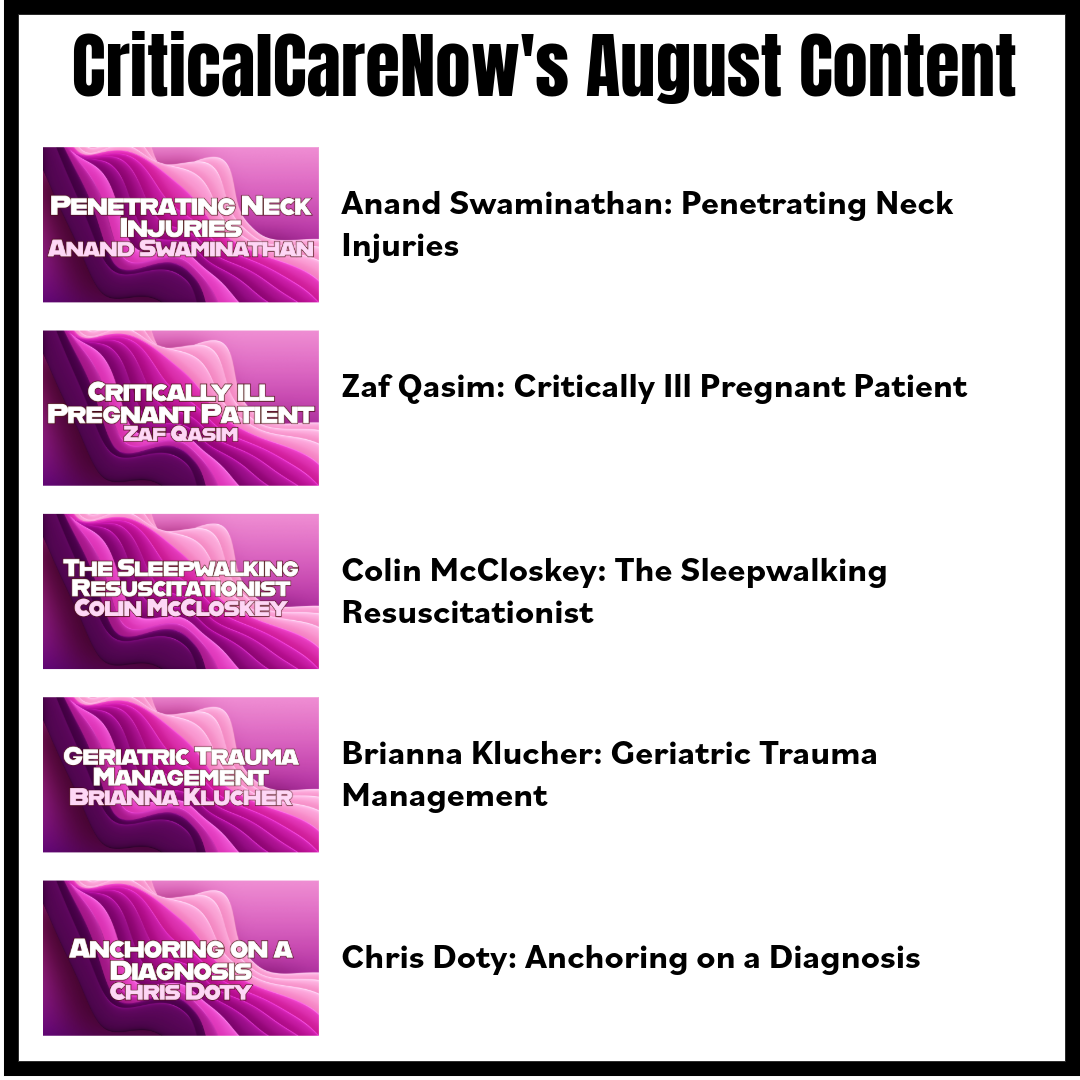
If you're an All-Access member, you're in for some great content this month. We have FIVE videos hand-picked by our staff that are high-yield and our most highly watched. We're featuring:
- Swaminathan on "Penetrating Neck Injuries"
- Qasim on "Critically Ill Pregnant Patient"
- McCloskey on "The Sleepwalking Resuscitationist"
- Klucher on "Geriatric Trauma Management"
- Doty on "Anchoring on a Diagnosis"
Each month we bring you fresh new content from the best of the best in resuscitation. If you're an All-Access member, go watch these videos NOW!


Responses