

ResusX Goes To Puerto Rico!
Condado Beach, Puerto Rico ~ Feb 1-3, 2027
A BIG thanks to those of you who already expressed interest in the conference and secured your spot at the early bird price. X on the Beach is now fully greenlit! Early bird pricing will end soon; this is your last call to grab a spot before general registration goes live for everyone. Keep an eye on your inbox for an email from us with the link to register and book your room at the San Juan Marriott Resort & Stellaris Casino. In the meantime, secure your spot using the link below. Once ticket sales go live, early bird pricing will end.
So, grab your spot now for a CME getaway that is like no other conference that you've ever attended. X on the Beach takes the best parts of ResusX but makes it more intimate and interactive. On February 1-3 we are taking a group of only 50 people to Puerto Rico for three days of conference, socializing and fun in the sun. Join Haney Mallemat, Jailyn Avila, Tarlan Hedayati, George Willis, Sara Crager and more for this unique vacation getaway. CME and CEUs will be offered. There's only 50 tickets available and it's first come, first served so if you are interested in attending, click below NOW!

A Video Game That Perfectly Captures the Misery of Intern Year
You just survived four years of medical school, moved to a freezing small town where you know literally no one, and now you're the newest junior resident at St. Ursula Hospital. Also, you're a pigeon named Finley. Fall of Porcupine is a gorgeously animated 2D trauma simulator disguised as a cozy indie game, leaning hard into the soul-crushing realities of modern medicine. You spend your days juggling a micromanaging attending (Dr. Krokowski, who absolutely has a one-star rating on RateMDs), grabbing post-shift beers with a hot-headed nurse who happens to be a ram, and navigating a hospital system that's actively collapsing. There's a mysterious outbreak, the townspeople are staging an angry protest against the lack of medical care, and your little bird legs have to walk everywhere because there's no fast travel. Forcing you to get your steps in while dealing with overwhelming workplace anxiety might be the most medically accurate part of the whole aesthetic.
But where the game stops being a cute woodland escape and starts feeling like a targeted attack on your central nervous system is the clinical minigames. Every time Finley sees a patient, you're subjected to a gauntlet of aggressively repetitive tasks that mirror the daily grind of an understaffed ward: calculating pill dosages, frantically hunting for veins for an injection, and (trigger warning) getting forced into a demonic, high-speed Guitar Hero-style rhythm game just to read an EKG, all while your attending grades your performance. You'll panic-mash your keyboard/controller. You'll score a solid C-minus. You'll feel the cold sweat of imposter syndrome wash over you from the comfort of your own couch. It's a beautifully scored tribute to healthcare workers that lets you clock out of your real 12-hour shift just to log into a virtual one where the charting is somehow worse.

My Desert Island Vasopressor
Let's build the best vasopressor ever made. Start with the components. You need peripheral arterial vasoconstriction, so it has to work on the alpha receptors. Then add venoconstriction; that's the piece people underestimate. 75% of our blood supply sits in capacitance veins, outside the circulation. Squeeze that down and you've just given your patient an autologous bolus of blood delivered straight to the heart. Now you've got tone and you've got preload, so you need the heart to squeeze harder against it: good beta activity to drive contractility and stroke volume. And you want blood going to the brain, the heart, and the kidneys; not stolen from the gut and skin.
One more thing. It has to run peripherally, so you can start it early and get effect fast. Not in a hand or finger vein, but the antecubital is fine. If you're sitting there thinking, wait, we already have a drug that does all of that. You're absolutely right; it's norepinephrine. Norepi is my desert island vasopressor. It doesn't work in every shock state, but it's pretty good in most of them.
Watch the full video here and leave a comment.
Don't forget to like and follow my IG, TikTok, YT, Facebook or LinkedIn accounts.

A Free Gift From Haney
Four talks from the ResusX:2025 stage are now free. Steven Haywood takes apart pre-oxygenation, which feels routine right up until the patient crashes on induction. Amal Mattu walks through STEMI mimics, the ones that don't announce themselves and that the machine happily reads as normal. Shaila Quazi makes pacemaker rhythms readable in real time, so you're not calling cardiology at 3am to ask what you're looking at. And George Willis covers modern DKA management, including the parts that quietly moved on after your residency.
No charge, no credit card. Go to the link below and get access to your videos; they arrive instantly! That's it, nothing else gets sent to you. Watch them in any order, at your own pace, whenever or wherever you like! These are yours for life!

Joshua Rempell, MD discusses the general approach to using ultrasound for undifferentiated hypotensive patients, covering several established protocols developed over the years. These include early protocols such as Ultrasound Hypotension Protocol (UHP), and ACES (Abdominal & Cardiac Evaluation with Sonography in Shock), as well as more recent protocols like RUSH (Rapid Ultrasound for Shock & Hypotension) / HI-MAP. All systematically examine the heart, IVC, lungs, abdomen, and aorta to identify causes of hypotension. Dr. Rempell illustrates the utility of ultrasound through several case examples, including patients with pericardial effusion and tamponade, massive pulmonary embolism, aortic dissection, and DVT; demonstrating how ultrasound can dramatically change clinical management by quickly narrowing the differential diagnosis and guiding treatment within minutes.
While early studies showed that ultrasound effectively narrows differential diagnoses and increases diagnostic certainty in hypotensive patients, a larger 2018 study conducted in South Africa and North America failed to demonstrate mortality benefit. Despite the lack of proven mortality improvement, likely due to study design limitations and patient selection (many had occult sepsis rather than dramatic findings), Dr. Rempell maintains that ultrasound remains extremely valuable in clinical practice. The technology helps reduce cognitive load, provides rapid diagnostic information, causes no harm, and fundamentally changes how clinicians approach and manage critically ill patients.
Check out this video of Dr. Joshua Rempell from ResusX:2026 now!
Welcome To The ResusNation CME Pass Membership
Membership Includes:
✔️ Monthly ResusX:Rounds – Attend live and access the full replay library
✔️ The Debrief: Live – Twice monthly to discuss cases, questions, or whatever's on your mind
✔️ Exclusive Videos – 6 resuscitation-focused videos each month
✔️ Chawk Tawks Library – On-demand whiteboard teaching
✔️ QuickCrits – Daily resuscitation tips and tricks emailed to you
✔️ Weekly Article Review – Summaries of cutting-edge articles, broken down, reviewed, and delivered to your inbox
✔️ Case Simulator – Hand-picked weekly scenarios; guide real-time resuscitations by talking directly to your patient and care team
✔️ AI Journal Club MC – Discuss the article of the week with our interactive AI moderator; just like being in a live journal club
Already a ResusNation Basic or Plus Member? DO NOT use the link above, check your inbox for more details on how to upgrade your membership.


Aggressive vs. Conservative BP Reduction in ICH
Intracerebral hemorrhage is the second most common stroke subtype and one of the deadliest, and blood pressure control remains one of the few levers we can pull early. The tension is familiar from every neuro ICU handoff: lower the pressure hard to limit hematoma expansion, or hold back to protect perihematomal perfusion. Semione and colleagues pooled eight randomized open-label blinded-endpoint trials enrolling 12,669 patients (median age 63, 60% male), defining aggressive management as a systolic target below 150 mm Hg and conservative as below 220 mm Hg.
The headline finding is a wash on the outcomes we care most about. Excellent functional recovery (mRS 0–1 at 90 days) occurred in 34% of aggressively managed patients versus 31.5% of conservatively managed ones (RR 1.07; 95% CI, 0.99–1.16); good functional outcome (mRS 0–2) was 44.2% vs. 41.5% (RR 1.09; 95% CI, 0.99–1.20; p = 0.07); 90-day mortality was 13.3% vs. 14.6% (RR 0.90; 95% CI, 0.77–1.05); and substantial hematoma growth (≥30%) was 20.5% vs. 23.6% (RR 0.85; 95% CI, 0.66–1.10). Every one of those confidence intervals crosses 1.0. What did separate the groups was safety, and in the opposite direction from the usual fear: adverse events within 24 hours occurred in 19.1% of the aggressive arm versus 22.1% of the conservative arm (RR 0.87; 95% CI, 0.76–0.99; p = 0.03), strengthening when the CHASE trial was excluded (RR 0.81; 95% CI, 0.74–0.88; p < 0.01, I² = 0%). Notably, none of the included trials reported acute kidney injury cases, the complication most often invoked as the reason to go easy. The practical read is that aggressive lowering doesn't buy you a better 90-day outcome, but it doesn't hurt patients either, and the old worry about perihematomal ischemia looks softer than the teaching suggests. Nothing here forces a protocol rewrite, but it gives you cover to hit a sub-150 target promptly in a patient who tolerates it, rather than tiptoeing toward 180 out of habit.
My Takeaway Points:
- Finding - Across 8 RCTs and 12,669 patients, aggressive (SBP <150) and conservative (SBP <220) strategies produced statistically indistinguishable rates of excellent functional outcome (RR 1.07; 95% CI, 0.99–1.16), good functional outcome (RR 1.09; 95% CI, 0.99–1.20), 90-day mortality (RR 0.90; 95% CI, 0.77–1.05), and hematoma growth (RR 0.85; 95% CI, 0.66–1.10). The one significant difference favored aggressive lowering on 24-hour adverse events (19.1% vs. 22.1%; RR 0.87; 95% CI, 0.76–0.99; p = 0.03).
- Practice Impact - The safety argument against rapid BP reduction weakens considerably. Reaching a sub-150 systolic target early is defensible and appears well tolerated. But, since functional recovery and mortality were unchanged, this is permission to lower confidently, not a mandate to chase a number in every patient. Choice of strategy should still be individualized to hematoma burden, baseline pressure, and hemodynamic reserve.
- Population - Adults with acute spontaneous ICH enrolled in randomized open-label blinded-endpoint trials conducted between 2005 and 2023; median age 63 years, 60% male; 6,147 randomized to aggressive control and 6,763 to conservative. Seven of eight trials enrolled ICH patients exclusively; one included ischemic stroke as well. Seven trials carried a low risk of bias by RoB 2, one moderate.
- Limitation - Results were fragile under sensitivity analysis. The favorable mRS 0–2 signal (RR 1.05; 95% CI, 1.01–1.10) emerged only after removing INTERACT-4 as an outlier and was not confirmed in subgroup analysis (RR 1.09; 95% CI, 0.97–1.23; p = 0.14). Trim-and-fill analysis of the adverse-event outcome shifted the effect estimate by 10.6%, confirming meaningful publication bias in the very endpoint that reached significance. Heterogeneity in the hematoma-growth analysis stayed above 35% in every scenario, and the authors could not perform subgroup analyses by age, hematoma volume or location, or baseline SBP. Read this as inconclusive evidence, not proof of equivalence.
Want to learn more? Read the full analysis Aggressive vs. Conservative Blood Pressure Reduction in Acute Intracerebral Hemorrhage: A Systematic Review and Meta-Analysis of Randomized Controlled Trials by G. Semione, et al. in Critical Care Medicine.
Troponin is Not an MI Test: Part I
This week Dr. Jain challenges the longstanding clinical reflex of treating a "positive troponin" as synonymous with myocardial infarction. Drawing on the Fourth Universal Definition of Myocardial Infarction (UDMI), he makes the case that troponin detects myocardial injury, not MI, and that the two are fundamentally distinct. MI requires evidence of ischemia on top of injury, while a host of non-coronary conditions (sepsis, PE, arrhythmia, renal failure, heart failure, and more) can elevate troponin without any ischemic process at play. Dr. Jain’s proposed "Troponin Triangle" reframes the clinical question from "does this patient have an MI?" to a three-step sequential inquiry: Is there myocardial injury? Is that injury acute or chronic? And is there evidence of ischemia?
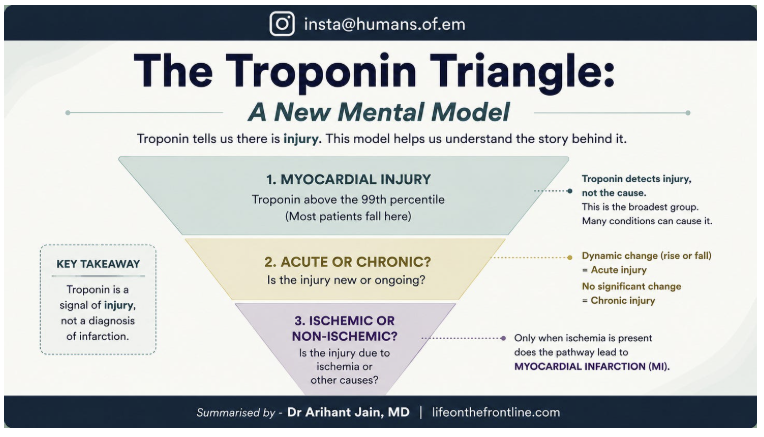
He refers to the acute-versus-chronic distinction as the most underappreciated question in acute care medicine, and emphasizes that trajectory matters more than absolute value. Both a rising and a falling troponin indicate an active process, while a stable elevation points toward chronic injury. Dr. Jain also clarifies when to use absolute delta changes (preferred near the 99th percentile and in standard-risk patients) versus percentage changes (e.g. the "20% rule," reserved for patients with chronically elevated baselines such as in CKD or heart failure). Stay tuned for Part II, which will tackle whether an injury is ischemic and introduce a practical bedside algorithm for distinguishing Type 1 from Type 2 MI.
Read the full post here and review this week's Frontline clinical pearls on IG.
----------
Dr. Arihant Jain is an Emergency Medicine physician at All India Institute of Medical Sciences (AIIMS) in New Delhi, and the creator of Life on the Frontline, a blog sharing concise, evidence-based insights from the ED. He currently serves as a Decision Editor for CPC-EM, is among the youngest ATLS faculty in India, and an AHA-certified BLS/ALCS instructor.
Connect with Dr. Jain: @humans.of.em (IG)
Watch the September Videos Now!
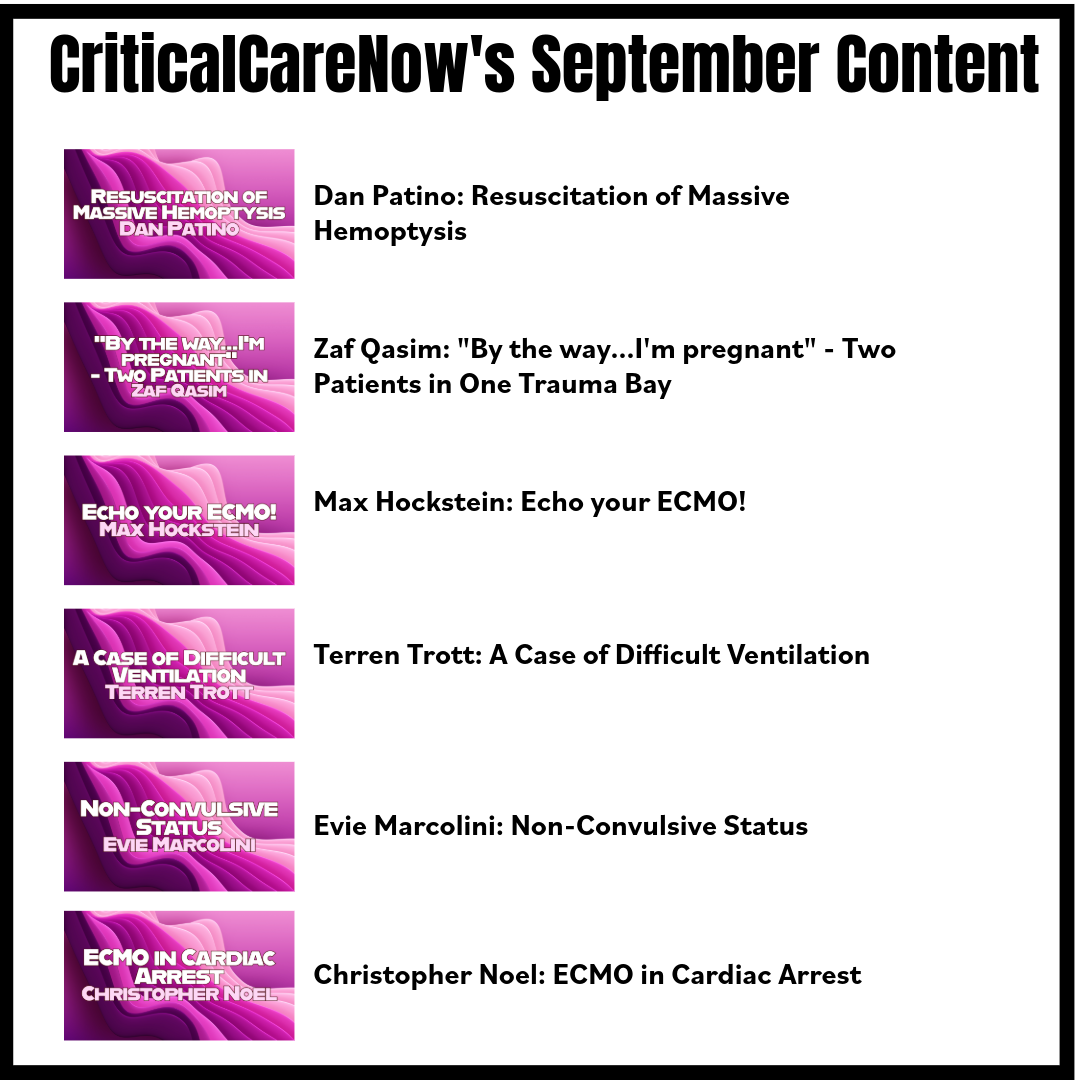
If you're a ResusNation paid member, you're in for some great content this month. We have SIX videos hand-picked by our staff that are high-yield and our most highly watched. We're featuring:
- Patino on "Resuscitation of Massive Hemoptysis"
- Qasim on "By the way...I'm pregnant" - Two Patients in One Trauma Bay"
- Hockstein on "Echo your ECMO!"
- Trott on "A Case of Difficult Ventilation"
- Marcolini on "Non-Convulsive Status"
- Noel on "ECMO in Cardiac Arrest"
Each month we bring you fresh new content from the best of the best in resuscitation. If you're a ResusNation paid member, go watch these videos NOW!


Responses