

Registration is Live!
Condado Beach, Puerto Rico ~ Feb 1-3, 2027
It's official. Registration for X on the Beach is open, and so is our conference room block at the San Juan Marriott Resort & Stellaris Casino.
Three mornings of high-yield resuscitation, afternoons of CME by the beach, happy hours with faculty, a welcome reception January 31, and an after-party February 3. Up to 17.25 hours of CME, taught by Haney Mallemat, Jailyn Avila, Tarlan Hedayati, Sara Crager, George Willis and just added, Salim Rezaie!
Two things to know:
- We added 10 more seats!!! It's still first come, first served.
- You have 2 options to attend. Book your room through our room block link and pay $797 for registration, or pay $1497 for registration if you choose to stay elsewhere.
Every registrant gets the same free bonuses: X on the Beach swag, limited-edition t-shirts, and lifetime access to ResusX:2025 with CME.
We can't wait to see everyone there!!

Scientists Gave Mice Human Brains. Don’t Worry, They’re Fine.
Roughly half the brains of some otherwise unremarkable-looking lab mice are made of human neurons. How did it happen? A Stanford team led by neuroscientist Sergiu Pașca engineered mice to be born without a cortex or hippocampus, basically moving out before the furniture ever got delivered. At two days old, those mice got injected with lab-grown human organoids, each built from around 100,000 human-derived cells, straight into the vacant real estate. This fixes the big problem from their earlier rat experiments, where human and rodent tissue were forced to compete for the same space and the rodent cells simply grew faster and crowded the human cells out. No competition this time. Within a few months, the human cells had claimed more than 90% of the cortex and wired themselves into the native circuitry. The mice performed normally on behavioral testing, which is either a triumph of regenerative medicine or the most polite hostile takeover in neuroscience history.
And the payoff isn't just "look, a mouse with a human brain," it's that this thing is now a disease model that didn't really exist before. Some of the transplanted tissue spontaneously differentiated into Von Economo neurons, a cell type researchers have never managed to grow in a dish, and these cells happen to be among the first to die in frontotemporal dementia. Pașca's next move is using the model to interrogate exactly why. The mice also turned out to be shockingly good stand-ins for cerebral palsy. Mice don't naturally get oxygen-deprivation injuries the way human fetuses do, but expose the xenocortical mice to low oxygen and you get motor coordination deficits that actually resemble the human condition. Unsurprisingly, a mouse with a human brain draws ethics committees like a code draws residents, so the team brought in independent bioethicist review and deliberately implanted into brains that were already structurally developed. Even outside experts are on record saying the oversight here was handled seriously. So, not a horror movie premise; just possibly the best model yet for diseases that, until now, only had one reliable subject, which was us.

Why I Don't Pre-Read Charts
I'll admit this one's a little unconventional. It's not about vasopressors or compressions, it's about something I've noticed creeping into how residents approach patients: pre-reading the chart before walking in the room. With everything digital now, it's easy to pull up the chief complaint, vitals, and every past visit before you've said a single word to the patient. But here's my problem with that, you've already biased yourself before the encounter even starts. If a patient with chest pain has a chart full of prior chest pain visits, they're going to have a hard time convincing you today is different because you've already anchored on everything that came before.
For me, this ruins one of the last truly sacred things about emergency medicine, walking into a room with a completely undifferentiated patient and figuring out what's actually going on, label-free. I'm not saying ignore the chart; use it. I'm saying get the patient's story first, untainted by anyone else's prior opinion, form your own conclusion, then go back and review the data. I'll be upfront, this is pure opinion, no RCTs behind it, just my read on cognitive bias in clinical medicine. I want to hear where you land on this one.
Watch the full video here and leave a comment.
Don't forget to like and follow my IG, TikTok, YT, Facebook or LinkedIn accounts.

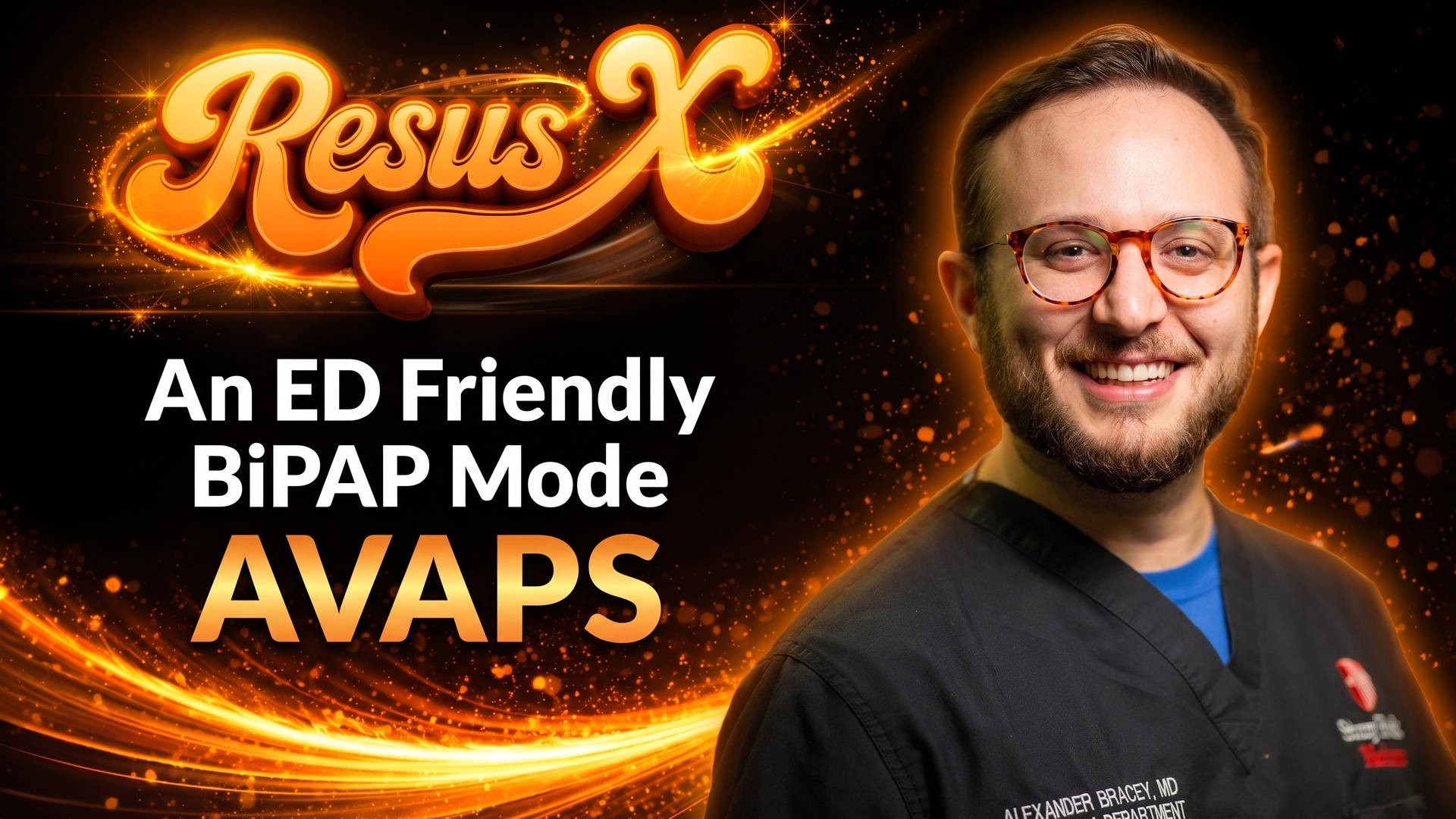
Alex Bracey, MD discusses the practical application of Average Volume-Assured Pressure Support (AVAPS) as an ED-friendly non-invasive ventilation mode. He addresses the common clinical pitfall of applying a standard "10 over 5" Spontaneous-Timed (S/T) BiPAP setting for all hypercapnic encephalopathy cases. While S/T mode fixes pressure and leaves volume variable, it requires constant provider adjustments to maintain minute ventilation. AVAPS automatically adjusts pressure support in the background to consistently deliver a targeted tidal volume, significantly reducing manual input and preventing ventilation drift when patients shift positions or fatigue.
Dr. Bracey outlines the clinical evidence, trial outcomes, and procedural safeguards essential for using AVAPS safely in emergency settings. While evidence shows AVAPS normalizes arterial CO2 and GCS scores faster than traditional S/T mode without increasing harm, proper patient selection remains vital. Excited respiratory distress is a contraindication, as undershooting volume targets can cause severe patient-ventilator dyssynchrony. Key operational safety guidelines include capping maximum IPAP at 20 cmH2O to mitigate aspiration risks from lower esophageal sphincter breakdown, aggressively managing air leaks through proper mask sizing and beard trimming, positioning patients upright or in reverse Trendelenburg, and maintaining frequent clinical monitoring for these high-acuity patients.
Check out this video of Dr. Alex Bracey from ResusX:2025 now!
Fallout From the Fallout:
Treating Radiation Injuries
A patient is brought from a dirty bomb incident after inhaling cesium-137-containing material. The emergency team decides to administer Prussian Blue while further assessment is arranged. What is the mechanism described for this treatment?
A. It chelates cesium in plasma and increases renal excretion.
B. It neutralizes gamma emissions from the bloodstream.
C. It stimulates marrow recovery by increasing hematopoietic growth-factor release.
D. It binds cesium-137 secreted through bile into the gut, limiting reabsorption and increasing fecal elimination.
Scroll to the end of the newsletter for the answer.
EMx Replay is Here
Did you miss EMx live? Don't sweat it....you can watch every single session on replay! Watch the complete conference fully edited, with audio remastering, indexed, and ready for you.
You have two options to choose from, 3-day access or unlimited, lifetime replay....just pick one and then press play.
CLICK HERE TO CHOOSE YOUR REPLAY


How POCUS Can Guide Sepsis Resuscitation
Two questions dominate the first hour of ED sepsis care: 1) where is the infection, and 2) will more fluid help or hurt? This narrative review proposes a two-arm POCUS framework to answer both, as a parallel, trigger-based adjunct to antibiotics, cultures, and source control rather than a replacement. The first arm is source-oriented; a focused scan of the lung/pleura, biliary system, kidneys/bladder, or soft tissue, chosen by clinical suspicion rather than as a blanket screen. The second arm is physiology-guided; focused cardiac ultrasound (FoCUS), passive leg raise (PLR) with LVOT VTI, and serial lung ultrasound (LUS) to reassess fluid responsiveness and tolerance after the initial bolus.
The evidence is strongest for rule-in diagnostics (biliary, renal obstruction, and abscess vs. cellulitis). On hemodynamics, the authors lean on CLASSIC and CLOVERS to argue that restrictive post-resuscitation fluid strategies are not harmful, reframing the question after the 30 mL/kg bolus as fluid tolerance rather than just responsiveness. PLR-LVOT VTI is favored over static IVC measurements, and VExUS is optional given thin ED data. The bottom line is that this is a structured way to think about bedside scanning, not a validated algorithm. No POCUS-guided sepsis pathway has been shown to improve mortality, length of stay, or organ support. Negative scans don't rule out serious pathology; positive scans trigger escalation to CT, specialists, or formal imaging rather than standing alone. Implementation-wise, the framework is attainable now (source scan + FoCUS + LUS as the "minimum dataset"), while PLR-LVOT VTI and venous Doppler require additional training and governance before they're ready for routine adoption.
My Takeaway Points:
- Finding - POCUS performs well as a rule-in tool across organ systems (e.g., high specificity for cholecystitis, good accuracy distinguishing abscess from cellulitis) but has not been shown to improve patient-centered outcomes when used to guide ED sepsis pathways.
- Practice Impact - After the initial 30 mL/kg crystalloid bolus, shift the bedside question from "is the patient fluid responsive?" to "is the patient fluid tolerant?" Use FoCUS, PLR-LVOT VTI, and serial lung ultrasound to decide between more fluid, earlier vasopressors, or watchful reassessment.
- Population - Adult ED patients with sepsis or septic shock, particularly those with an unclear infectious source or an uncertain/poor response to initial fluid resuscitation (e.g., known heart failure, hypoxemia, suspected RV strain).
- Limitation - This is a non-systematic narrative review built mostly on observational, diagnostic-accuracy, and ICU/perioperative studies rather than ED sepsis-specific interventional trials; venous Doppler/VExUS evidence in particular remains largely observational and non-ED-specific.
Want to learn more? Read the full review Point-of-Care Ultrasound in Emergency Department Sepsis and Septic Shock: A Pragmatic Framework for Source-Oriented Assessment and Physiologic Reassessment by W. Chen, et al. in Frontiers in Medicine (Intensive Care Medicine & Anesthesiology).
Answer: D
Explanation: Prussian Blue is described as an oral agent that binds cesium secreted in bile into the gut, preventing reabsorption and enhancing fecal elimination. The chelation/renal-excretion mechanism is more consistent with DTPA for certain metal radionuclides, not Prussian Blue for cesium. Prussian Blue does not neutralize radiation emissions. Likewise, it is not a hematopoietic growth factor.
DOI: https://doi.org/10.1186/s40779-021-00349-w
Review this week's minute on EMBLLM.
----------
Greg Weingart MD, FACEP, is the founder of Embllm, a microlearning medical education app that converts new literature into a multiple-choice question bank to earn CME from your phone. He is also an Assistant Professor in the Department of Emergency Medicine at EVMS/ODU, Partner at Emergency Physicians of Tidewater, and the Assistant Medical Director at Sentara Norfolk General Hospital.
Connect with Dr. Weingart: @Embllm_MedED (X) / LinkedIn / Facebook
Watch the October Videos Now!
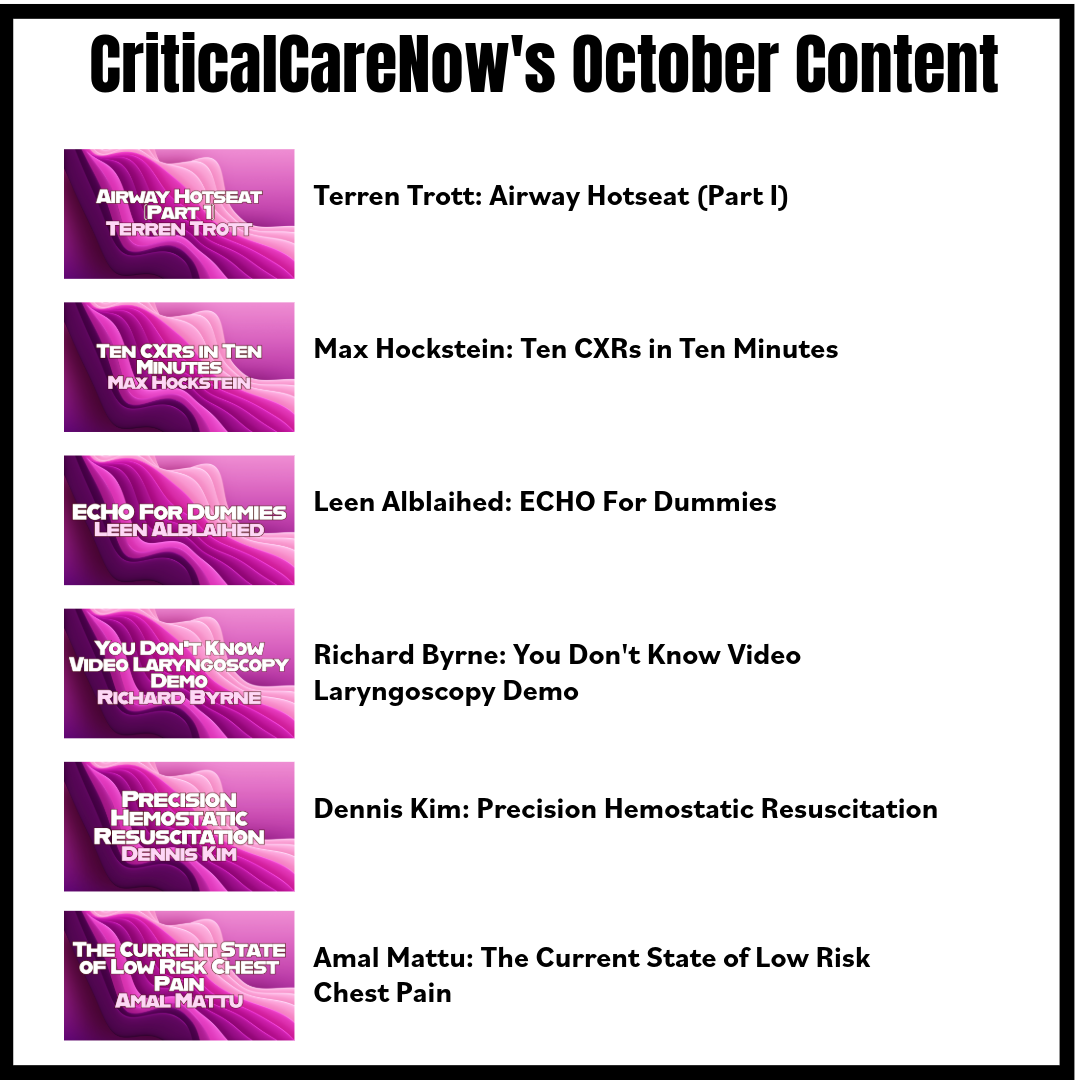
If you're a ResusNation paid Member (RN Video Pass or RN CME Pass), you're in for some great content this month. We have SIX videos hand-picked by our staff that are high-yield and our most highly watched. We're featuring:
- Trott on "Airway Hotseat (Part I)"
- Hockstein on "Ten CXRs in Ten Minutes"
- Alblaihed on "ECHO For Dummies"
- Byrne on "You Don't Know Video Laryngoscopy Demo"
- Kim on "Precision Hemostatic Resuscitation"
- Mattu on "The Current State of Low Risk Chest Pain"
Each month we bring you fresh new content from the best of the best in resuscitation. If you're a ResusNation paid Member, go watch these videos NOW!
Login or Get a 7-Day FREE Trial Now


Responses