

New Cast Member Just Dropped!
Condado Beach, Puerto Rico ~ Feb 1-3, 2027
Three mornings of high-yield resuscitation, afternoons of CME by the beach, happy hours with faculty, a welcome reception January 31, and an after-party February 3. Up to 17.25 hours of CME, taught by Haney Mallemat, Jailyn Avila, Tarlan Hedayati, Sara Crager, George Willis and just added, Salim Rezaie!
Two things to know:
- Registration is still open. We added 10 more seats!!! As always, first come, first served.
- You have 2 options to attend. Book your room through our room block link and pay $797 for registration, or pay $1497 for registration if you choose to stay elsewhere.
Every registrant gets the same free bonuses: X on the Beach swag, limited-edition t-shirts, and lifetime access to ResusX:2025 with CME.
We can't wait to see everyone there!!

Parlay, Prediction Market, Psych Consult
Ontario legalized online betting on individual sporting events in 2021, and a group led by Ryan Forrest, a public-health doctoral student at the University of Toronto, wanted to know what that did downstream. In the American Journal of Preventive Medicine, they projected how many gambling-disorder ER visits the province should have expected each year, then compared that to what actually showed up. Visits ran 154% above projection, which is roughly a doubling. Most patients were men, concentrated in the 10 to 44 age range, and almost a third of the visits ended in admission. Many of them carried major depression or suicidality, and ER docs noted that gambling had fed into other mental health and substance use diagnoses too. A second analysis from some of the same researchers found calls to ConnexOntario, the province’s free 24-hour mental health and addictions line, came in 200% above projection, with callers almost entirely boys and men aged 15 to 44. Forrest called this “two data sources telling us there is a real health signal happening here,” which is the polite academic way of saying the call is coming from inside the house.
The US picture looks like a preview with a worse regulatory environment. Since the Supreme Court struck down the federal ban on most state-authorized sports gambling in 2018, dozens of states have legalized it, and Birches Health, described as the largest US provider specializing in gambling disorder treatment, reports its clients aged 18 to 34 have more than doubled since 2024. Prediction markets let people as young as 18 wager, while sports betting is generally 21 and over, and Birches says clients mention them 200% more often than last year. Meanwhile, studies cited in the piece put suicide risk at 5 to 10 times higher in people with gambling disorder, and the standard treatment is CBT, though many patients don’t know this is a mental health condition or that insurance may cover care. Forrest says Canada set aside no money to track the public-health effects of legalization, unlike the grants that monitored cannabis. Most apps lack automatic spending limits and rarely step in on warning signs, and a ProPublica reporter posing as a problem gambler found the app pushed him to keep betting instead of flagging him. Cynthia Grant of Birches summed it up as “just not a regulated environment out there.” In other words, don’t be surprised if your psych consults increase on the next shift.

The 5-Step Scan for Every Shock Patient
If you're picking up the probe without a protocol, you honestly have no idea what you're doing. I don't care which protocol you use, as long as you use one every time. For every patient in shock, I use HIMAP. H is for heart: whether I get one view or all four, I'm looking at LV function, RV function, the pericardial space, and the valves. The I used to stand for IVC, but the IVC is a terrible tool for judging volume responsiveness. So, I've changed it to assessing intravascular volume status, which deserves a video of its own.
M is for Morrison's pouch, along with the splenorenal, subxiphoid, and suprapubic views, to look for free fluid in the abdomen. A is for the aorta, big red. I'm checking for dissection, aneurysm, and its general state, because missing any of those can be catastrophic. P used to mean pneumothorax, but I make it pulmonary, because I'm looking for much more than that. I'm checking the thoracic spaces for effusion, especially hemothorax, and scanning the lung fields for pneumonia and B-lines. Run the same sequence every time, and you'll stop missing the diagnosis right in front of you.
Watch the full video here and leave a comment.
Don't forget to like and follow my IG, TikTok, YT, Facebook or LinkedIn accounts.


Modern pediatric fever algorithms were engineered under the assumption of high community vaccination rates, meaning standard low-intervention protocols can fail to protect unvaccinated infants from invasive bacterial infections. In this session, Alfred Sacchetti, MD examines how clinicians must adapt diagnostic thresholds when evaluating febrile, unvaccinated children across key developmental stages. While modern inflammatory markers like procalcitonin offer diagnostic utility, the lack of contemporary data on unvaccinated populations (combined with localized drops in herd immunity) often demands a return to aggressive investigation, including comprehensive septic workups, early parenteral antibiotics, and lower thresholds for lumbar punctures in infants beyond four weeks of age.
The conversation expands beyond fever of unknown origin into reviving vigilance for previously suppressed vaccine-preventable illnesses, such as Bordetella pertussis and Haemophilus influenzae. Dr. Sacchetti highlights the distinct clinical presentations of pertussis-induced post-tussive emesis and severe dehydration, emphasizing immediate hospital admission, macrolide therapy, and the public health opportunity to initiate household post-exposure prophylaxis. Concluding with high-stakes airway emergencies like epiglottitis and bacterial tracheitis, he issues a direct challenge against clinical complacency, urging emergency clinicians to actively identify vaccination status, recognize regional transmission pockets, and maintain a high index of suspicion for rapidly fatal pathogens.
Check out this video of Dr. Alfred Sacchetti from EMx:2026 now!
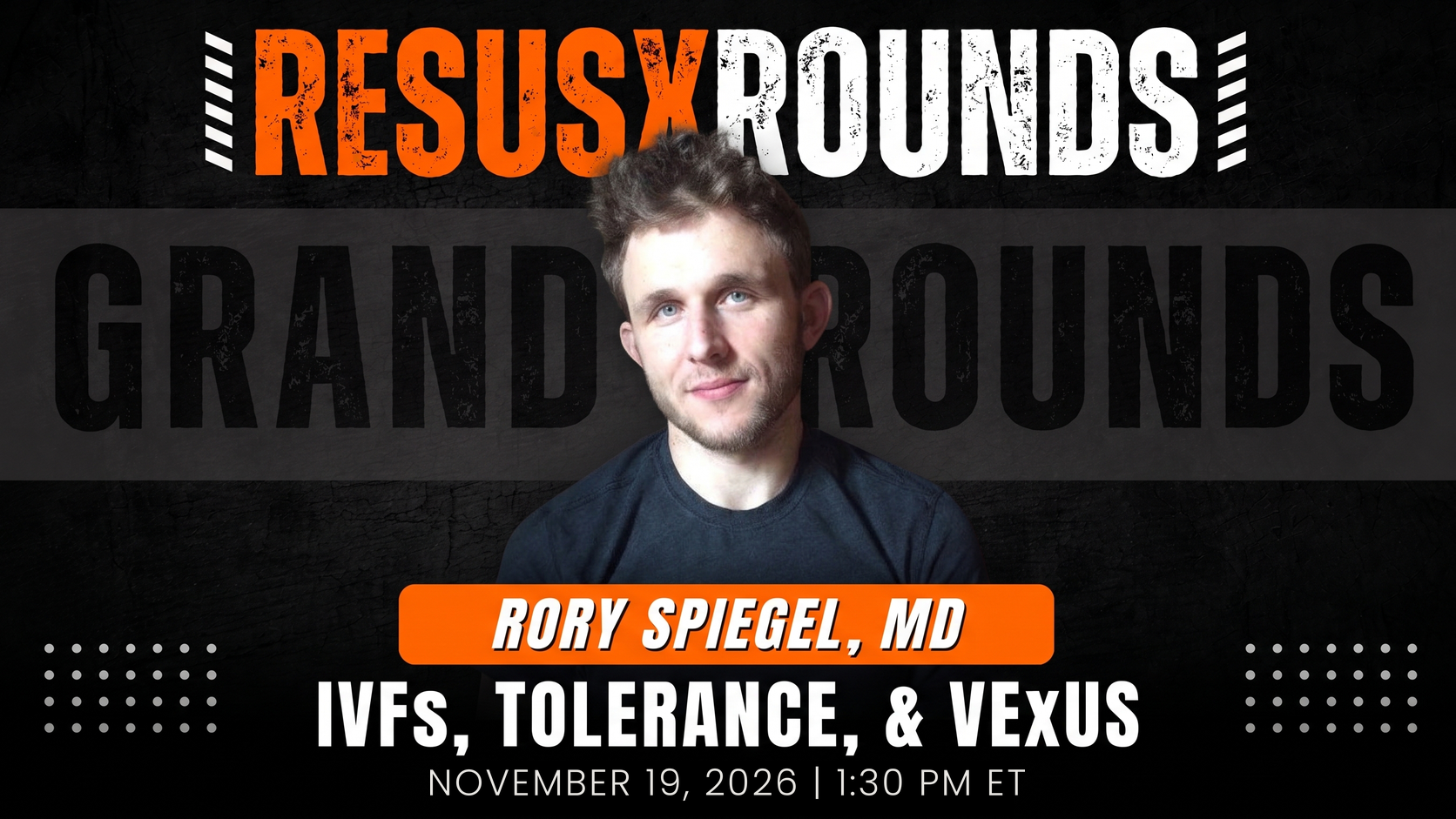
Join Us For November ResusX:Rounds!!
This month we're featuring Rory Spiegel, MD on November 19, 2026 at 130p ET, sharing his knowledge on fluid resuscitation. Live Rounds are now open to BOTH Video Pass and CME Pass members! We're also hosting a hangout session for our CME Pass members right before rounds, at 1230p.
We hope to see you there!


Rest and Recheck vs Immediate Antihypertensives
Few numbers trigger a reflex like a blood pressure of 190/115 in a patient who feels fine, and clinicians often reach for labetalol, hydralazine, or clonidine even though major guidelines now favor gradual outpatient control. Those guidelines rest mostly on physiology and expert opinion, so Tangpaisarn and colleagues ran a PROSPERO-registered systematic review comparing immediate pharmacologic lowering with observation in adults with severe hypertension (typically SBP ≥180 and DBP ≥110 mmHg) and no acute target-organ damage. Seven studies qualified (one randomized trial and six observational cohorts), and treating the number did not consistently improve short-term outcomes. In the ED, serious events were rare regardless of treatment: Grassi found zero MACE at 72 hours among 549 patients, Sricharoen found 1 versus 3 events at 7 days (OR 0.23, 95% CI 0.01–4.18), and Lin’s cohort of nearly 23,000 patients showed no reduction in 7-day revisit or admission (adjusted HR 0.94, 95% CI 0.84–1.06). The lone RCT found two hours of seated rest lowered pressure about as well as telmisartan, with roughly 69% responding in each arm.
On the wards, the signal leaned toward possible harm: IV antihypertensives were linked to a ≥30% MAP drop within 6 hours (HR 1.38, 95% CI 1.15–1.67) and more myocardial injury (5.9% vs 3.6%; HR 1.52, 95% CI 1.08–2.14), with no difference in stroke, AKI, or death. For the asymptomatic patient with a scary reading, rest, recheck, treat pain and anxiety, and arrange outpatient follow-up. Reflexive IV pushes on the floor deserve a second look. The caveats matter, though: no benefit is not proven equivalence, events were too rare to exclude small effects, and the inpatient findings come from two overlapping, confounded cohorts, so a definitive randomized trial is still needed.
My Takeaway Points:
- Finding - Immediate treatment did not reduce short-term events or utilization in the ED. MACE was near zero in both arms (0/374 vs 0/175 at 72 h; OR 0.23, 95% CI 0.01–4.18 at 7 days), and 7-day revisit or admission was unchanged (adjusted HR 0.94, 95% CI 0.84–1.06).
- Practice Impact - In asymptomatic patients without target-organ damage, rest and recheck before reaching for drugs. Two hours of rest matched oral telmisartan (~69% response in both arms), and about a third of Grassi's patients responded to rest alone. On inpatient wards, IV therapy was associated with excessive MAP drops (HR 1.38) and myocardial injury (HR 1.52).
- Population - Adults with SBP ≥180 and DBP ≥100–120 mmHg and no acute target-organ damage, across 7 studies from Argentina, the USA, Taiwan, South Korea, and Thailand. Mean age 49–74, with a high burden of chronic hypertension and cardiovascular comorbidity. ED and inpatient populations were analyzed separately.
- Limitation - Only one small RCT; six observational studies carry serious-to-moderate risk of confounding by indication. Rare events produced wide confidence intervals, no meta-analysis or GRADE assessment was done, and the two inpatient studies drew on overlapping cohorts, so the IV harm signals are not independent replications and are not causal proof.
Want to learn more? Read the full review Acute Pharmacologic Treatment Versus Observation for Severe Asymptomatic Hypertension in Emergency and Acute Care Settings: A Systematic Review of Short-Term Outcomes by T. Tangpaisarn, et al. in BMC Emergency Medicine.
The Trauma Patient Who Didn’t Need More Blood…Or Did He?
This week, Dr. Jain reviews the case of a 50-year-old man brought in after a high-speed MVC with no history, family, or witnesses. He was hypotensive, and eFAST showed abdominal free fluid and a pneumothorax. The team placed a chest drain and started a blood transfusion, which was the right call. After about a liter of blood, his oxygen saturation dropped, and repeat lung ultrasound showed diffuse bilateral B-lines, consistent with pulmonary edema. A focused cardiac scan estimated his ejection fraction at roughly 20%. The patient’s family later brought records confirming dilated cardiomyopathy. Hidden heart disease changed how he tolerated resuscitation, even though the injuries and the treatment were appropriate.
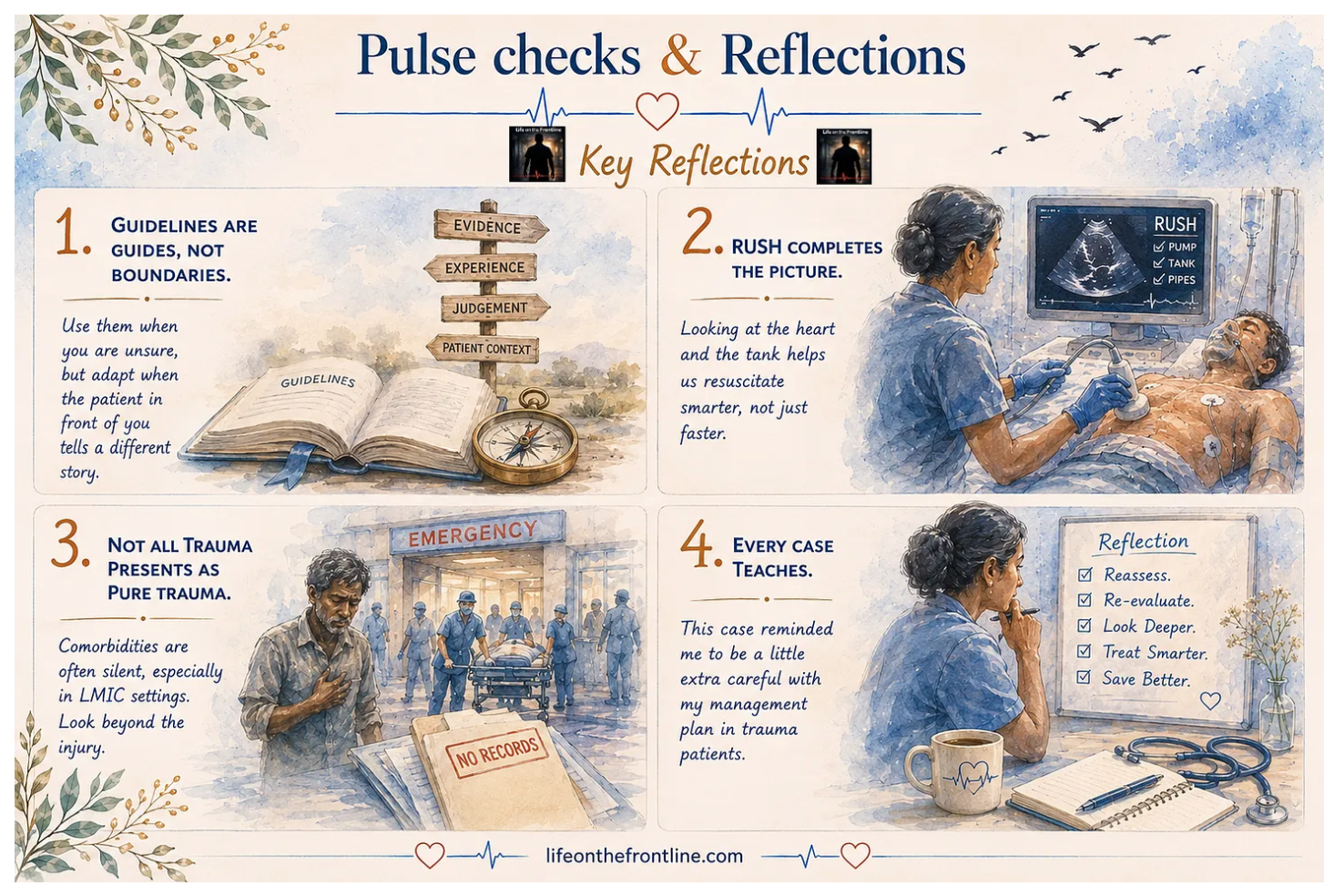
Dr. Jain's takeaway is that eFAST should stay the core ultrasound tool in hypotensive trauma. It is well validated for finding bleeding and thoracic injury, but it shows where the problem is, not how well the heart can tolerate resuscitation. He suggests adding a brief RUSH-style exam to look at the heart and lungs in select patients: those whose physiology seems out of proportion to their injuries, older patients with unknown history, those with persistent shock or worsening respiratory status, and those responding unexpectedly to blood. Early data on RUSH in polytrauma is encouraging, but it hasn't been shown to beat eFAST on outcomes. It is equally important to remember that in low- and middle-income settings, undiagnosed cardiovascular disease is common, so hypotension isn't always simple hemorrhagic shock. Bottom line: trauma explains why the patient is there, while underlying physiology shapes how they respond to treatment.
Read the full post here and review this week's Frontline clinical pearls on IG.
----------
Dr. Arihant Jain is an Emergency Medicine physician at All India Institute of Medical Sciences (AIIMS) in New Delhi, and the creator of Life on the Frontline, a blog sharing concise, evidence-based insights from the ED. He currently serves as a Decision Editor for CPC-EM, is among the youngest ATLS faculty in India, and an AHA-certified BLS/ALCS instructor.
Connect with Dr. Jain: @humans.of.em (IG)
Watch the November
Videos Now!
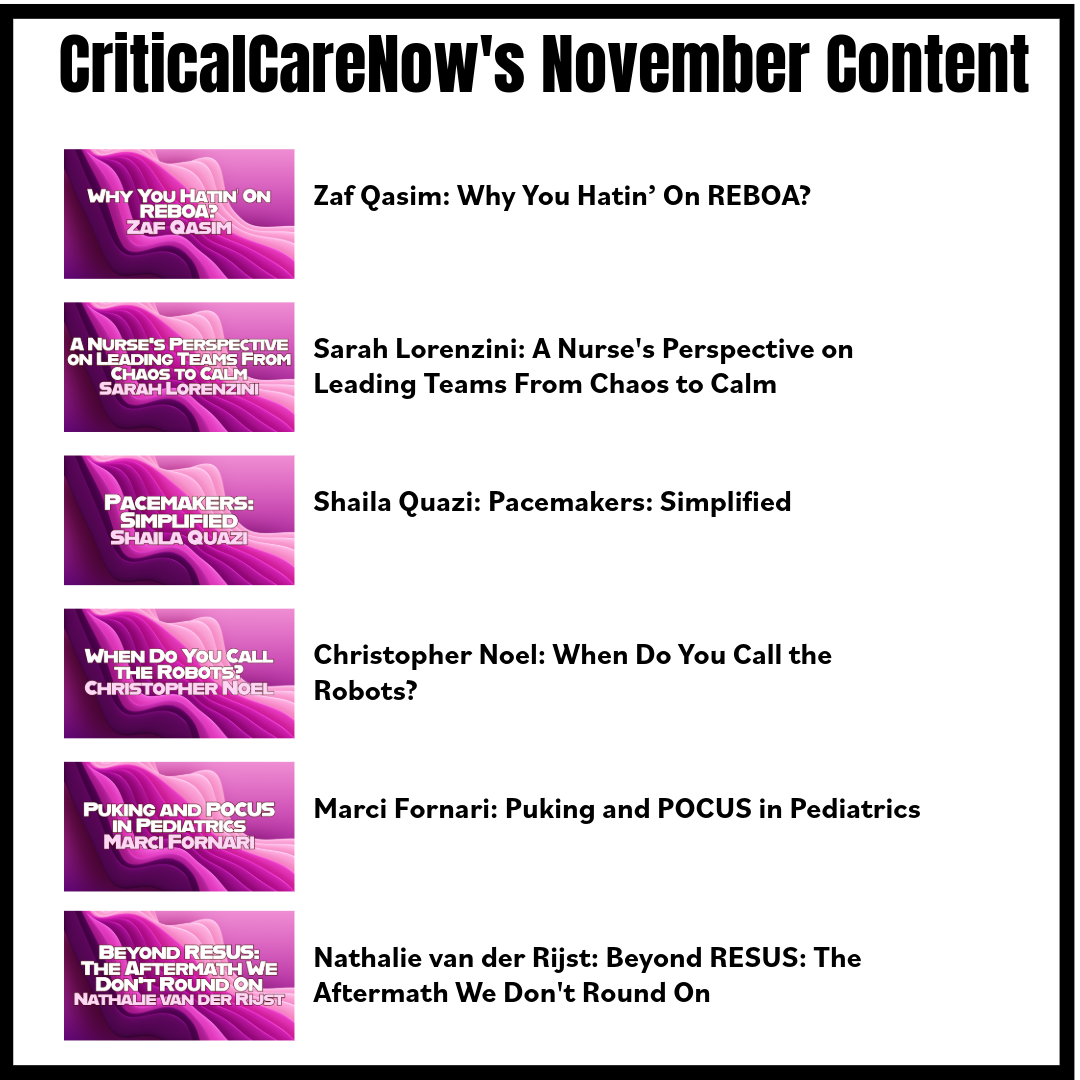
If you're a ResusNation paid Member (RN Video Pass or RN CME Pass), you're in for some great content this month. We have SIX videos hand-picked by our staff that are high-yield and our most highly watched. We're featuring:
- Qasim on "Why You Hatin' on REBOA"
- Lorenzini on "A Nurse's Perspective on Leading Teams From Chaos to Calm"
- Quazi on "Pacemakers: Simplified"
- Noel on "When Do You Call the Robots?"
- Fornari on "Puking & POCUS in Pediatrics"
- van der Rijst on "Beyond RESUS: The Aftermatch We Don't Round On"
Each month we bring you fresh new content from the best of the best in resuscitation. If you're a ResusNation paid Member, go watch these videos NOW!
Already a member? Click HERE to login.
Not a member? Click HERE to start a FREE trial.


Responses